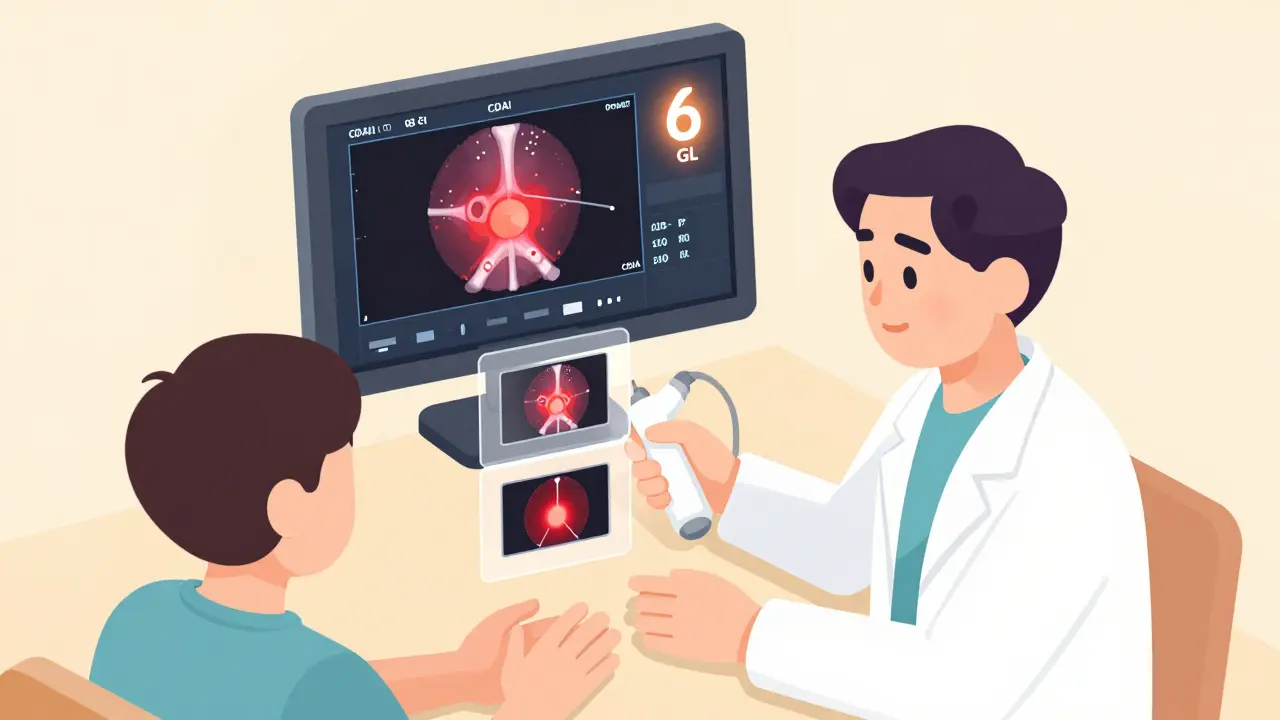
When you live with rheumatoid arthritis (RA), every visit to the rheumatologist isn’t just about how you’re feeling-it’s about measuring what’s happening inside your joints. Two simple numbers, a blood test, and an image can tell a story that no symptom checklist can. These tools-CDAI, DAS28, and imaging-are the backbone of modern RA care. They don’t just track pain; they predict damage, guide treatment, and help you avoid long-term disability. But which one matters most? And when do you need an MRI versus a quick ultrasound? Let’s cut through the noise.
What CDAI Really Tells You
The Clinical Disease Activity Index, or CDAI, is the quiet workhorse of RA monitoring. Developed in 2005 and now used in 78% of U.S. rheumatology practices, it’s built on four things you can measure right in the exam room: tender joints, swollen joints, how bad you feel, and how bad your doctor thinks you feel. No blood draw. No fancy machine. Just a count and a scale.
Here’s how it works: your doctor checks 28 specific joints-fingers, wrists, elbows, shoulders, knees, ankles-for swelling and tenderness. Each joint gets a score of 0 (no issue) or 1 (swollen or tender). Then you rate your own pain and fatigue on a scale from 0 to 10. Your doctor does the same. Add them all up. The total? That’s your CDAI score.
That number tells you everything:
- Under 2.8 = remission
- 2.8 to 10 = low disease activity
- 10 to 22 = moderate
- Above 22 = high
Why does this matter? Because if your score stays above 10 for months, your joints are still under attack-even if you don’t feel terrible. Studies show patients with persistent high CDAI scores are 4.2 times more likely to develop joint damage within a year. That’s why your doctor won’t just say, “You’re doing better.” They’ll say, “Your CDAI dropped from 18 to 6. That’s a win.”
And here’s the kicker: CDAI matches what doctors see better than any other score. In a 2023 study of nearly 4,000 patients, CDAI had a 0.84 correlation with clinical judgment. That’s higher than DAS28. Higher than patient-reported apps. It’s simple, fast, and accurate. Most clinics now have it built into their electronic records. It takes less than two minutes.
DAS28: The Blood Test Advantage
If CDAI is the street-level view, DAS28 is the satellite image. It includes everything CDAI does-but adds two more pieces: your ESR (erythrocyte sedimentation rate) or CRP (C-reactive protein). These are blood markers of inflammation. They don’t lie. If your joints feel okay but your CRP is sky-high, something’s still burning inside.
There are two versions: DAS28-ESR and DAS28-CRP. The formula looks complicated, but you don’t need to calculate it. Your doctor’s software does it. The score ranges the same way:
- Under 2.6 = remission
- 2.6 to 3.2 = low
- 3.2 to 5.1 = moderate
- Above 5.1 = high
Here’s where DAS28 shines: it catches hidden inflammation. In one study, 17% of patients with low CDAI scores had high CRP levels-meaning their disease was still active, even if joints looked quiet. That’s why DAS28-CRP is the go-to in Europe, where 68% of clinics use it. But there’s a catch: you need lab results. And labs don’t always deliver on time.
Doctors in the RISE registry report that 57% of the time, they have to make treatment decisions before CRP results come back. That’s stressful. You leave the office thinking, “Did I get the right dose?” Then, a week later, the lab report says your inflammation spiked. Now you’re back for a change. It’s inefficient. That’s why many U.S. clinics prefer CDAI-it’s immediate. DAS28 gives you more data, but it’s slower.
Imaging: Seeing What Your Eyes Can’t
Here’s the truth: you can’t feel joint damage until it’s already there. That’s where imaging steps in. Three tools dominate: X-rays, ultrasound, and MRI. Each has a role.
Conventional X-rays have been the gold standard since the 1940s. They show bone erosion and narrowing of joint space. But they’re latecomers. It takes 6 to 12 months of active inflammation before X-rays show damage. By then, the damage is done. Still, they’re cheap, widely available, and perfect for tracking long-term changes. The Sharp/van der Heijde score measures up to 448 points of damage across your hands and wrists. A rise of 5 points in a year means progression.
Ultrasound is the game-changer. It shows swelling in the synovium-the lining of the joint-before it turns into bone damage. Power Doppler ultrasound even shows blood flow in inflamed tissue. That’s critical. Inflamed tissue has more blood. More blood = more damage coming.
Studies show ultrasound detects synovitis 85% of the time, compared to just 65% with physical exam alone. In one trial, ultrasound changed treatment plans in 22% of cases where doctors thought the disease was under control. And it’s fast. A hand ultrasound takes 10 minutes. Costs around $150. You can see the swelling on the screen in real time. Patients often say, “I finally see why you’re changing my meds.”
MRI is the most sensitive. It catches bone edema-swelling in the bone itself-up to a year before X-rays show erosion. One study found MRI predicted future joint damage with 89% accuracy. But here’s the problem: it costs $1,200. It’s not always covered. And it’s not practical for every visit. Most clinics use MRI only when things don’t add up-like when your CDAI is low but you’re still in pain, or when X-rays show damage but your blood tests are normal.
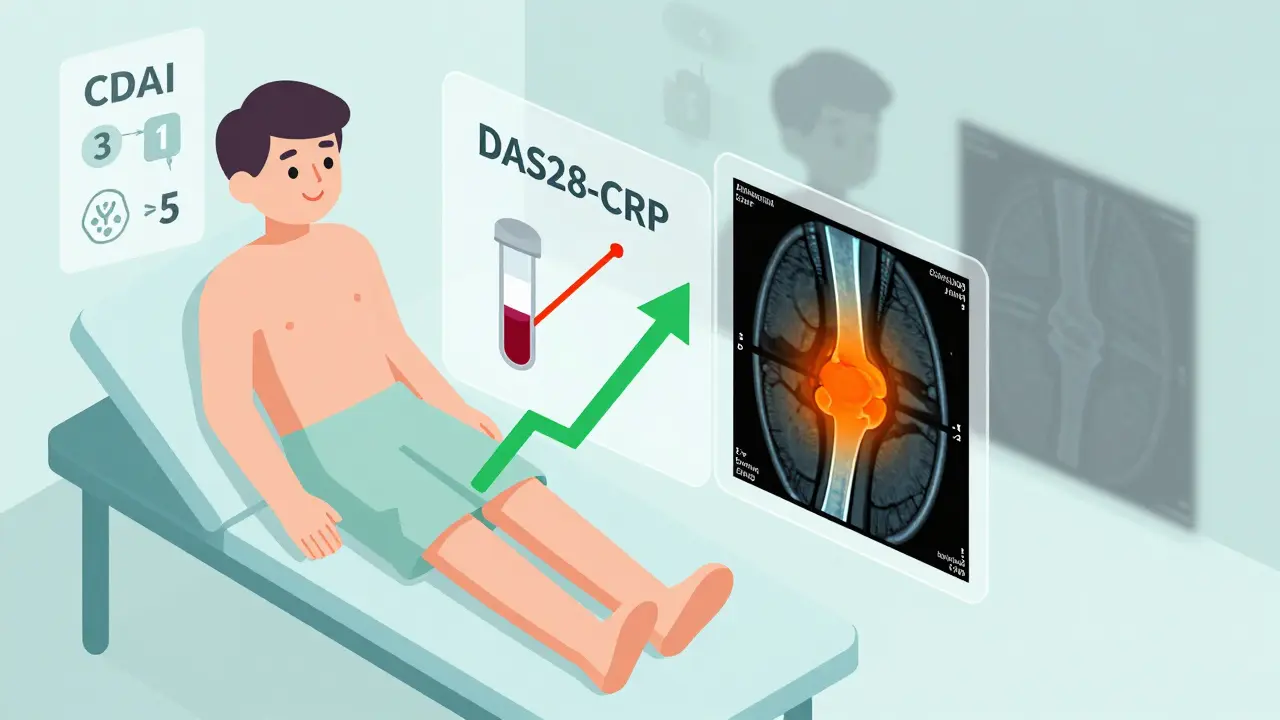
Which Tool Should You Trust?
There’s no single answer. But there’s a smart approach.
Start with CDAI. It’s fast, reliable, and built into your clinic’s workflow. If your score is above 10, you need to act. If it’s below 2.8, you’re in remission. That’s your baseline.
Add DAS28-CRP if your symptoms don’t match your score. If you’re still tired, stiff, and achy but your CDAI says “low,” ask for a CRP test. That hidden inflammation could be why you’re not improving.
Use ultrasound when there’s uncertainty. If your doctor isn’t sure whether your swollen knuckles are just fluid or active synovitis, a quick scan clears it up. It’s not about fear-it’s about precision. And if you’re on a new drug and your doctor wants to know if it’s working, ultrasound can show improvement in weeks, not months.
Save MRI for the big questions. If you have persistent pain despite low scores, or if you’ve had damage before, an MRI might be worth it. But don’t assume you need one every year. Most patients never need one.
What Patients Say
Patients aren’t just passive data points. They’re part of the system. In a 2023 survey of 2,841 RA patients, 68% liked using apps to report symptoms before their visit. But 42% said it made them anxious. “I worry if I say I’m in pain, they’ll change my meds,” one patient wrote.
Another big concern? Imaging pressure. 52% of respondents felt pushed into MRIs they didn’t need. That’s not your fault. It’s a system issue. Some doctors over-rely on imaging because they’re unsure of clinical scores. Others use it to reassure themselves.
On the flip side, 38% loved ultrasound. “Seeing the swelling on the screen made me feel heard,” said a woman from Chicago. “I didn’t think my pain was ‘real’ until I saw it.”
There’s also a gap between patient and doctor perception. In Brazil’s REAL study, 33% of patients rated their pain higher than their doctor did. That’s not disagreement-it’s a signal. It means the patient’s experience isn’t fully captured by joint counts. Fatigue, brain fog, and stiffness aren’t in CDAI. That’s a blind spot.
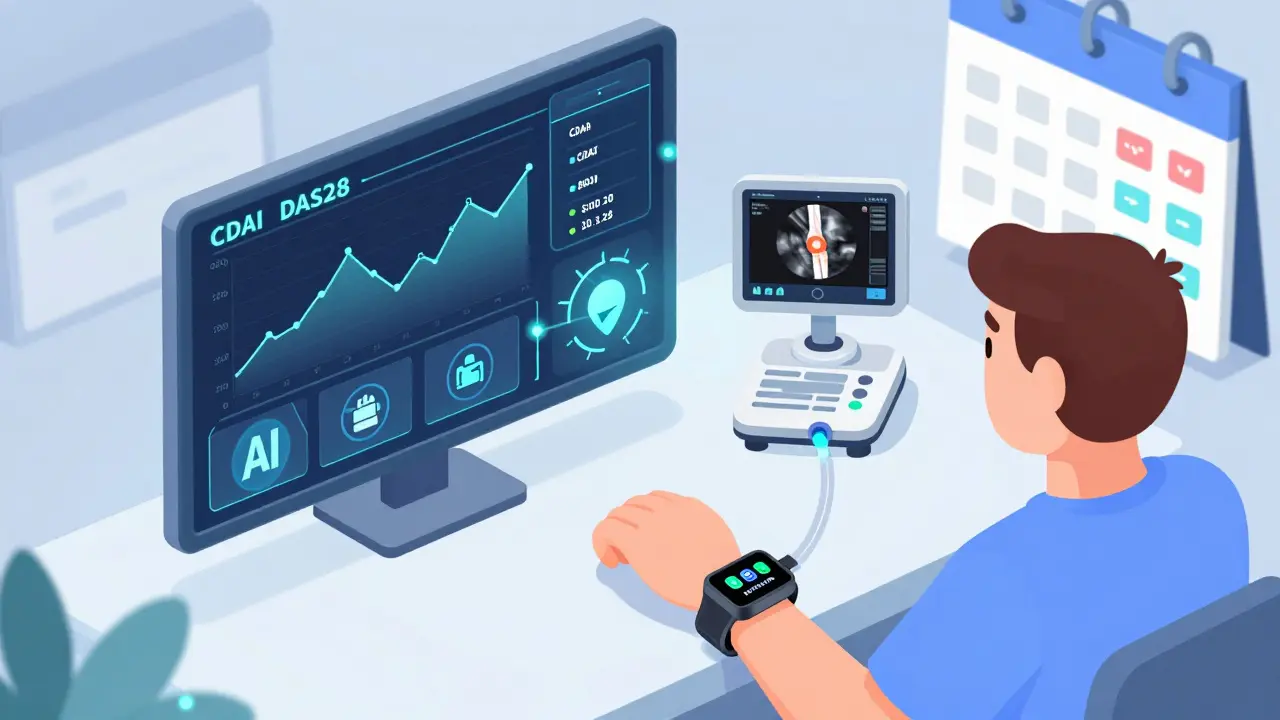
The Future: Smarter, Not Just More Tests
The next five years will change how RA is monitored. AI is already helping. Software like Quantitative Ultrasound Synovitis Assessment (QUASAR) can analyze ultrasound images automatically, matching expert readings 88% of the time. That means faster, cheaper scans.
Electronic health records are getting smarter too. The ACR’s new “RA Monitor” tool automatically flags patients with CDAI scores over 10 and suggests an ultrasound referral. No more forgetting.
And then there’s wearable tech. The NIH-funded RACoon trial is testing a system that combines CDAI, ultrasound, and a wristband that tracks movement, sleep, and activity. Imagine: your phone alerts your doctor if your hand movement drops for three days. That’s early warning.
By 2027, half of all RA monitoring could come from remote data-not clinic visits. But the core won’t change. You still need to know: Is your disease active? Is it causing damage? Are you getting better? CDAI, DAS28, and imaging won’t disappear. They’ll just get smarter.
What You Can Do Today
- Ask for your CDAI score after every visit. Don’t settle for “you’re doing fine.”
- If you’re still in pain despite a low score, ask about CRP or ultrasound.
- Track your own symptoms. Use an app or journal. Your input matters.
- Don’t fear imaging-but don’t assume you need it every time. Ask why it’s being ordered.
- Know your numbers. Remission isn’t just “no pain.” It’s CDAI under 2.8.
RA isn’t just about joints. It’s about keeping your life. And that starts with knowing exactly what’s happening inside you-not just how you feel.
What is the difference between CDAI and DAS28?
CDAI uses only clinical measures: tender joints, swollen joints, patient and doctor assessments. DAS28 adds blood tests-either ESR or CRP-to measure inflammation. CDAI is faster and doesn’t require labs. DAS28 is more sensitive to hidden inflammation but depends on lab results, which can delay treatment decisions.
Is MRI always necessary for RA monitoring?
No. MRI is the most sensitive tool for detecting early joint damage, but it’s expensive and not needed for everyone. It’s typically used when clinical scores don’t match symptoms, or if there’s concern about rapid progression. Most patients rely on CDAI, DAS28, and ultrasound instead.
Why does my doctor use ultrasound instead of X-rays?
Ultrasound detects inflammation in the joint lining (synovitis) and blood flow (power Doppler) long before X-rays show bone damage. X-rays only show damage after 6-12 months of active disease. Ultrasound gives real-time feedback and can change treatment decisions sooner.
Can I monitor RA at home without seeing a doctor?
You can track symptoms with apps or journals, but you can’t replace clinical tools. CDAI requires a trained professional to count joints. DAS28 needs lab tests. Imaging requires specialists. Home tracking helps your doctor, but it doesn’t replace them.
What if my CDAI score is low but I still feel awful?
That’s a red flag. CDAI doesn’t measure fatigue, brain fog, or systemic inflammation. Ask for a CRP or ESR test. You might also benefit from an ultrasound to check for hidden joint inflammation. Your symptoms matter-even if the numbers look good.


