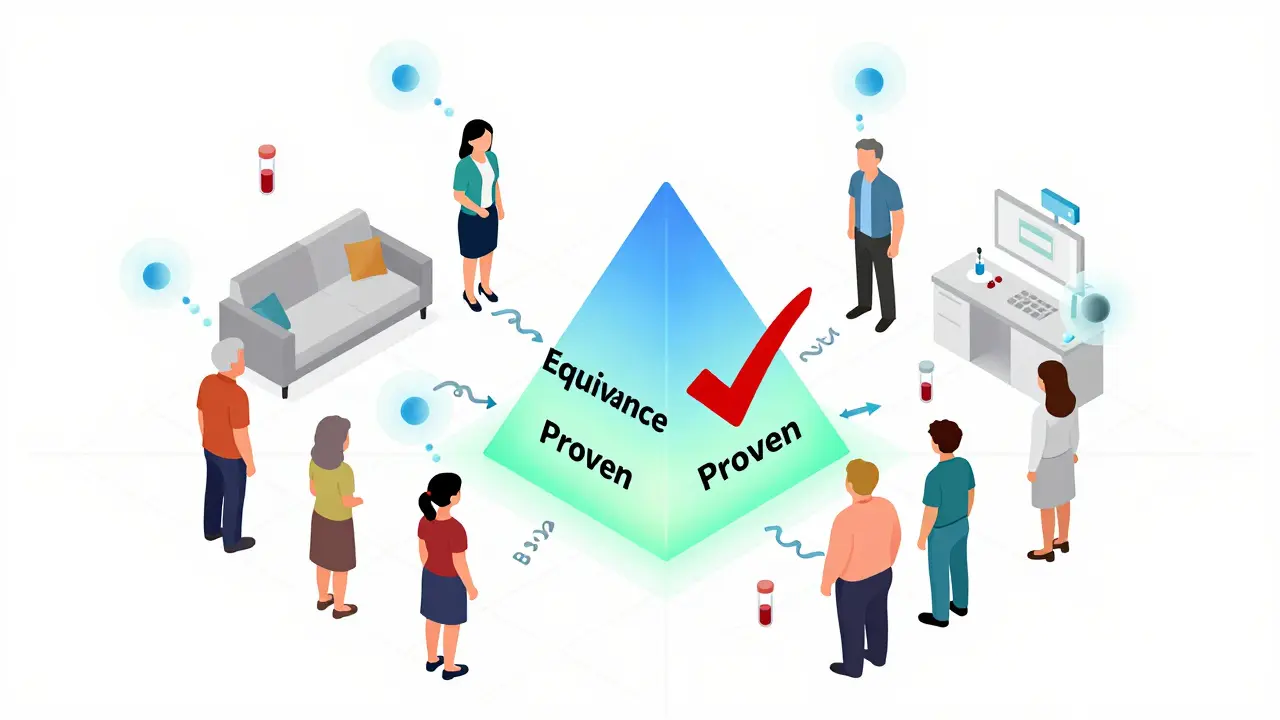
When two drugs are supposed to do the same thing, how do you prove they work the same way in real people-not just in healthy volunteers? Traditional bioequivalence studies used to rely on tightly controlled trials with 24 to 48 healthy adults, taking blood every 15 to 30 minutes for days. But that doesn’t reflect how most patients actually take medicine. Enter population pharmacokinetics-a smarter, more realistic way to show that one drug is just as safe and effective as another, even across diverse groups like the elderly, children, or people with kidney disease.
Why traditional bioequivalence falls short
For decades, regulators accepted bioequivalence based on two numbers: AUC (how much drug the body absorbs over time) and Cmax (how high the peak concentration goes). If the 90% confidence interval for both fell between 80% and 125% of the reference drug, the two were considered equivalent. Simple. Clean. But it had a big flaw: it only told you about the average person. What about someone who weighs 45 kg? Or someone with 30% kidney function? Or a 78-year-old on five other medications? Those people were left out. And that’s dangerous when you’re dealing with drugs that have a narrow therapeutic window-like warfarin, digoxin, or certain epilepsy meds. A tiny difference in exposure could mean a seizure, a bleed, or even death.What population pharmacokinetics actually does
Population pharmacokinetics (PopPK) flips the script. Instead of forcing everyone into the same sampling schedule, it uses whatever data you already have-spotty, irregular, real-world data. A patient gets their drug, a nurse draws one or two blood samples during a routine visit, and that’s it. No overnight hospital stays. No extra needles just for a trial. PopPK takes all these scattered data points from dozens, sometimes hundreds, of real patients and builds a statistical model that shows how drug levels change across the whole population. It doesn’t just give you an average. It shows you why levels vary. Does weight matter? Age? Liver function? Are certain drugs making others less effective? The model finds those patterns. And then it answers the real question: Are the differences between Drug A and Drug B big enough to matter? If the variability in exposure between the two drugs stays within a safe range across all subgroups, you’ve proven equivalence-not just statistically, but clinically.How it works: models, not magic
At its core, PopPK uses nonlinear mixed-effects modeling. Think of it like stacking two layers of math. The first layer looks at each individual’s drug levels over time. The second layer looks at how those individual patterns fit into the bigger picture of the whole group. It’s not guessing. It’s learning from the data. The model calculates two key numbers: between-subject variability (BSV) and residual unexplained variability (RUV). BSV tells you how much drug exposure naturally differs from person to person-because of genetics, body size, organ function. RUV is the noise-the random stuff you can’t explain, like when someone forgot to take their pill or had a late meal. For most drugs, BSV ranges from 10% to 60%. If the difference in BSV between two formulations is less than 15%, regulators consider it acceptable. That’s the threshold. The FDA’s 2022 guidance made this official: if your PopPK model shows consistent exposure across key subgroups, you might not need to run a full bioequivalence trial at all. That’s huge. It cuts costs, speeds up access, and avoids exposing vulnerable people to unnecessary testing.
Tools of the trade
You can’t do PopPK with Excel. You need specialized software. NONMEM has been the industry standard since 1980 and is still used in 85% of FDA submissions. Monolix and Phoenix NLME are also common. These tools handle the heavy math: fitting models, testing covariates, validating results. But the software is only part of the battle. The real challenge is knowing what to put in, what to leave out, and how to prove your model isn’t just fitting noise. A good PopPK model avoids overfitting-adding too many variables just because you can. It doesn’t assume everything matters. It lets the data speak. That’s why collaboration matters: pharmacokineticists, clinicians, and statisticians need to work together from day one. If you don’t plan for PopPK during Phase 1 trials, you’ll end up with messy, unusable data. And regulators will ask for more studies-delaying approval.Where PopPK shines: real-world cases
PopPK isn’t theoretical. It’s being used now. In 2021, Pfizer used PopPK to show that a new generic version of a critical anticoagulant was equivalent in patients with moderate kidney impairment. Traditional studies would have required dosing people with failing kidneys-risky and ethically questionable. PopPK used data from routine clinical monitoring. Same outcome. Fewer risks. Merck did something similar with a cancer drug. Instead of running separate trials for elderly patients, children, and those with liver disease, they used one PopPK model built from data across all groups. The result? They cut three clinical trials down to one. Saved millions. Got the drug to patients faster. Even biosimilars-complex biologic drugs that are nearly identical to brand-name products-rely on PopPK. Traditional methods don’t work well for large molecules. Their behavior in the body is too messy. PopPK lets regulators compare exposure patterns across hundreds of patients, not just averages. That’s why 92% of the top 25 pharmaceutical companies now have dedicated pharmacometrics teams. It’s not optional anymore.
Where it struggles
PopPK isn’t perfect. It’s not a magic bullet. If a drug has wildly unpredictable absorption-like some extended-release formulations-PopPK might not catch small but meaningful differences. In those cases, replicate crossover studies (where the same person takes both drugs multiple times) still give you more precise data on within-subject variability. Another problem? Validation. There’s no universal standard for how to prove a PopPK model is reliable. Some companies use bootstrapping. Others use visual predictive checks. Regulators in Europe sometimes demand more proof than the FDA. A 2023 survey found 65% of pharmacometricians say model validation is their biggest headache. And without consistent rules, the same model might get approved in the U.S. but rejected in Japan. Then there’s data quality. If the blood samples were taken at random times, or if the lab results are inconsistent, the model will be garbage. Garbage in, garbage out. That’s why early planning matters. You can’t retrofit PopPK into a trial designed for something else.The future: machine learning and global alignment
The next leap is coming from machine learning. A January 2025 study in Nature showed AI models could spot hidden patterns in PopPK data that traditional methods missed-like how a combination of low albumin and high creatinine affects drug clearance in a way no single covariate could explain. That’s powerful. It means we’ll soon be able to predict individual responses with more accuracy, not just population averages. Regulators are catching up. The FDA’s 2022 guidance was a turning point. The EMA and Japan’s PMDA have followed suit. Now, groups like the IQ Consortium are working on standardizing validation methods by late 2025. That’s the next big step: making PopPK as reliable and predictable as a blood test.What this means for patients
Behind all the models and software, there’s one simple truth: PopPK helps get the right dose to the right person, faster. It means generics for elderly patients with multiple conditions aren’t delayed because regulators can’t test them safely. It means kids with epilepsy get effective meds without needing invasive blood draws. It means life-saving drugs reach people who need them-not just the ones who fit the textbook profile. PopPK doesn’t replace traditional bioequivalence. It complements it. But for complex drugs, rare populations, and real-world use, it’s becoming the gold standard. The data is there. The science is solid. The regulators are on board. The only thing left is for more companies to start using it-not as a backup plan, but as the first plan.Is population pharmacokinetics the same as traditional bioequivalence?
No. Traditional bioequivalence compares average drug exposure in healthy volunteers using tightly controlled, intensive sampling. PopPK uses sparse, real-world data from diverse patient groups to model how drug levels vary across the entire population. It doesn’t just check if two drugs are similar on average-it checks if they’re similar for everyone, including those with kidney disease, obesity, or age-related changes.
Can PopPK replace clinical trials entirely?
In some cases, yes. The FDA’s 2022 guidance explicitly states that adequate PopPK data can eliminate the need for additional postmarketing studies. For example, if a generic drug shows equivalent exposure across subgroups like elderly patients or those with liver impairment using real-world data, regulators may waive the requirement for a separate clinical trial. But PopPK can’t replace trials for entirely new drugs-it’s used to prove equivalence between similar products.
Why is NONMEM still the most used software for PopPK?
NONMEM has been the industry standard since the 1980s because it’s robust, well-documented, and accepted by global regulators. While newer tools like Monolix and Phoenix NLME offer user-friendly interfaces, NONMEM remains dominant in regulatory submissions-used in 85% of FDA PopPK analyses. Its long history means regulators trust its outputs, and its flexibility allows complex models to be built for challenging scenarios like multi-compartment pharmacokinetics or nonlinear clearance.
How many patients do you need for a reliable PopPK study?
The FDA recommends at least 40 participants, but the real number depends on the drug and the variability you’re trying to measure. For drugs with low variability and strong covariate effects (like weight or age), 30-50 patients may be enough. For drugs with high variability or weak covariates, you might need 100 or more. The key isn’t just quantity-it’s data quality. A few well-placed blood samples from 60 patients are better than 100 poorly timed samples.
Why is PopPK especially important for biosimilars?
Biosimilars are large, complex molecules that behave differently in the body than small-molecule drugs. Traditional bioequivalence methods-like measuring AUC and Cmax-are often too crude to capture their subtle differences. PopPK allows regulators to compare entire concentration-time profiles across hundreds of patients, accounting for factors like immune response, protein binding, and organ clearance. This makes it the most reliable way to prove that a biosimilar delivers the same therapeutic effect as the original biologic.
What’s the biggest mistake companies make when using PopPK?
The biggest mistake is waiting until late-stage development to think about PopPK. If your clinical trial wasn’t designed with sparse sampling in mind, you’ll end up with unusable data. The best approach is to integrate PopPK planning into Phase 1 trials-decide early which covariates matter (age, weight, kidney function), design sampling schedules around them, and collect consistent lab data. Skipping this step leads to delays, extra studies, and rejected submissions.


