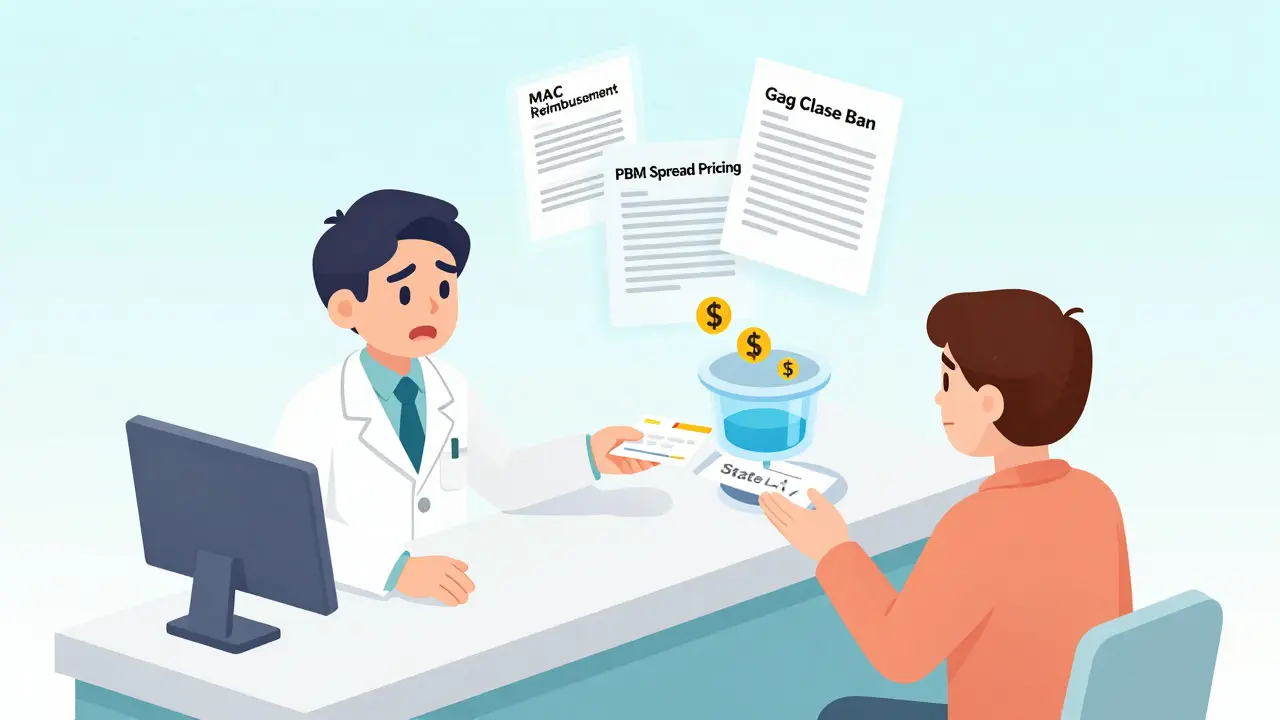
When you pick up a prescription for a generic drug, you might assume the price is straightforward. But behind that $4.50 copay or $12 out-of-pocket cost is a web of federal and state laws, complex reimbursement models, and financial incentives that dictate exactly how much pharmacies get paid-and whether they can even afford to fill the prescription. These aren’t just backroom deals; they’re legal frameworks that directly impact your access to affordable medication. And if you’re on Medicare, Medicaid, or even private insurance, the system shaping your drug costs is more broken than most people realize.
How Generic Drugs Got Their Reimbursement Rules
The modern system for paying pharmacies for generic drugs didn’t emerge by accident. It was built in 1984 with the Hatch-Waxman Act, which created a fast-track approval path for generics while protecting brand-name drug patents. The goal? Lower drug prices by encouraging competition. And it worked-today, generics make up 90% of all prescriptions filled in the U.S. But only 23% of total drug spending. That gap is the entire reason this system exists: to save money. But how that savings gets distributed isn’t fair, transparent, or consistent.
Reimbursement isn’t one single payment method. It’s a patchwork. The two main models are Average Wholesale Price (AWP) minus a percentage and Maximum Allowable Cost (MAC). AWP was originally meant to reflect what wholesalers charge pharmacies, but it became inflated over time. Many insurers now avoid it for generics. MAC is the real player today. Under MAC, pharmacies are paid based on the lowest price they can realistically buy the drug for. If a generic costs $1.20 per pill to acquire, that’s what the pharmacy gets-no more. If the brand-name version costs $15, and you accidentally get that instead? The pharmacy eats the $13.80 difference. No one else pays it. That’s not just risky-it’s financially dangerous for small pharmacies.
Medicare Part D and the Hidden Costs of Formularies
Medicare Part D covers over 50 million people. Its formulary rules are strict: only FDA-approved drugs used for medically accepted reasons get covered. But approval doesn’t mean access. Each Part D plan decides which generics go on which tier. Tier 1? Usually preferred generics with the lowest copay. Tier 3? Non-preferred drugs-sometimes brand-name, sometimes generic-that cost more. And 28% of Part D plans required prior authorization for at least one generic drug in 2022. That means your pharmacist has to call your doctor, wait for approval, and sometimes you’re stuck without your meds for days.
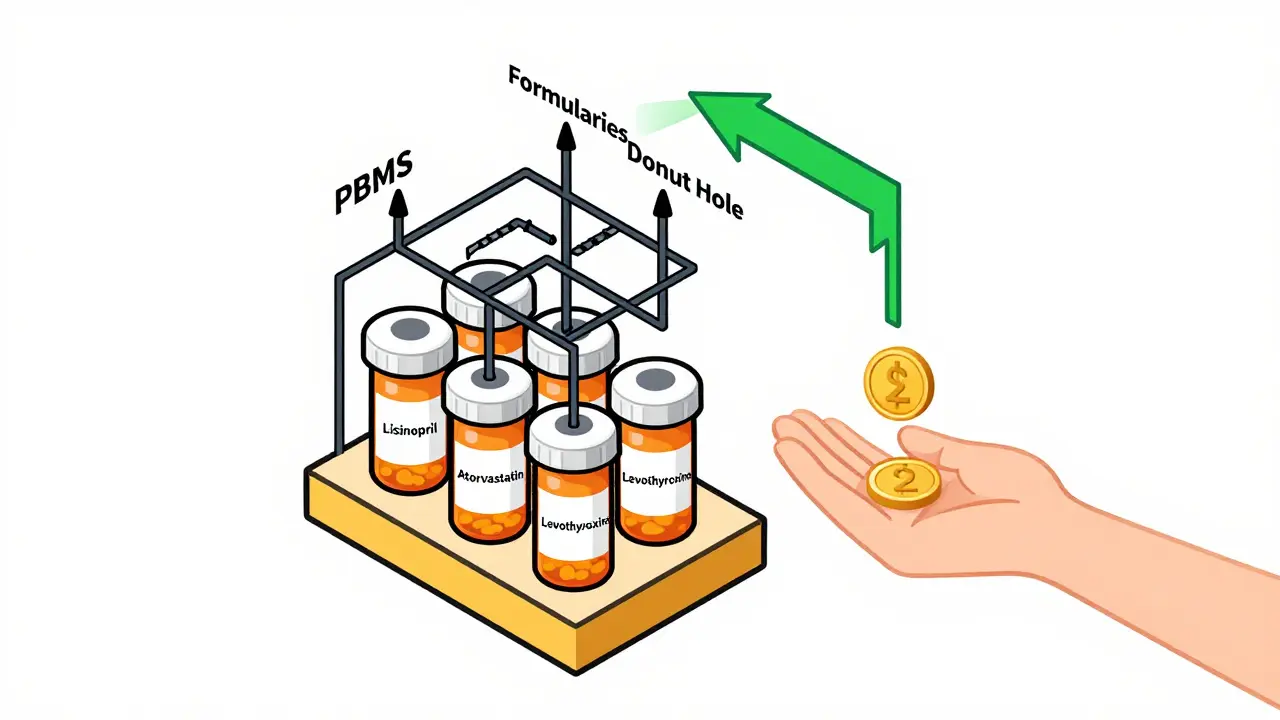
Then there’s the donut hole-the coverage gap where you pay full price after hitting your initial coverage limit. Even though the Inflation Reduction Act capped out-of-pocket costs at $2,000 starting in 2025, the path there is messy. Some plans still charge high deductibles. Others push you toward more expensive brand-name drugs because their formulary doesn’t include the generic you need. And if you’re on Extra Help, you pay $4.50 for generics. But if you’re not? Your cost depends entirely on which plan you picked-and how aggressively it negotiates with PBMs.
Pharmacy Benefit Managers: The Middlemen Nobody Talks About
Three companies-CVS Caremark, Express Scripts, and OptumRX-control over 80% of all prescription claims in the U.S. They’re called Pharmacy Benefit Managers (PBMs). You’ve never heard their names, but they’re the ones deciding how much pharmacies get paid and how much you pay at the counter.
They make money in three ways: rebates from drugmakers, spread pricing, and steering you to their own pharmacies. Spread pricing is the most controversial. Here’s how it works: your insurer agrees to pay $15 for a generic drug. The PBM tells the pharmacy it will be paid $12. The PBM pockets the $3 difference. That’s called the spread. And until 2018, many PBMs had gag clauses that legally prevented pharmacists from telling you: "You could pay $8 cash for this same drug without using your insurance." That’s not a mistake. It was policy. And it affected 1 in 5 prescriptions, according to consumer advocates.
Independent pharmacies are especially hurt. In 2018, the average margin on generic drugs was 3.2%. By 2023, it dropped to 1.4%. That’s barely enough to cover rent, staff, and utilities. Some pharmacies are forced to fill prescriptions at a loss just to stay in network. And if they refuse? They’re kicked out. No more patients. No more revenue.
State Laws and the Battle Over Reimbursement
While federal laws set the stage, states are fighting back. As of 2023, 44 states passed laws to regulate how PBMs reimburse pharmacies for generics. These laws require transparency. They ban gag clauses. Some even set minimum reimbursement rates-meaning PBMs can’t pay less than what pharmacies actually pay for the drug.
Medicaid programs use Preferred Drug Lists (PDLs) to steer prescribers toward cheaper generics. Each state has a Pharmacy and Therapeutics committee that reviews drugs annually. If a generic is on the preferred list, you pay less. If it’s not? You might pay double-or get denied coverage unless your doctor jumps through hoops.
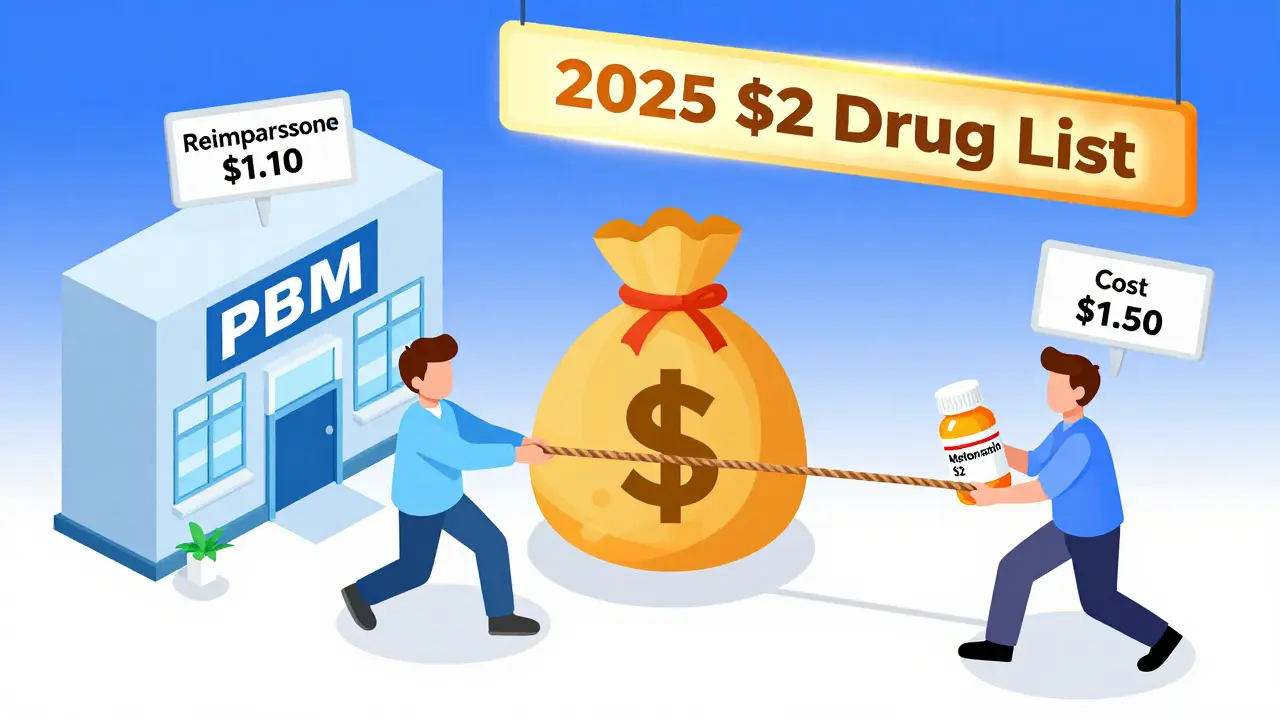
But here’s the catch: PBMs often ignore these state laws. They operate across state lines, and many contracts don’t honor local regulations. So a pharmacy in Ohio might be legally required to be paid $1.50 for a generic, but if their PBM contract says $1.10, they’re stuck. That’s why state laws alone aren’t enough. You need federal oversight.
The $2 Drug List Model: A New Hope?
In 2025, the Centers for Medicare & Medicaid Services (CMS) is testing a new model called the Medicare $2 Drug List. It’s simple: pick about 100 to 150 low-cost, high-use generic drugs-and cap the patient copay at $2. No deductible. No tiering. Just $2. This isn’t just about affordability. It’s about adherence. When people can’t afford their meds, they skip doses. When they skip doses, they end up in the hospital. That costs more.
These drugs are chosen based on three criteria: clinical importance (do doctors use it widely?), frequency of use (how many Medicare patients take it?), and cost (is it already cheap?). Think metformin, lisinopril, atorvastatin. Drugs that are essential, widely used, and already priced low. The model is voluntary for Part D plans. But if it works, it could become standard.
Big retailers like Walmart and Kroger already offer $4 generics. This just brings that model into Medicare. And if it reduces out-of-pocket costs and increases adherence? It could save billions.
What’s Really Holding Back Generic Access?
It’s not just about price. It’s about control. Brand-name manufacturers release "authorized generics"-identical drugs sold under the brand name-to block cheaper competitors. That’s legal. And it works. It delays market entry, keeps prices high, and reduces competition. The FDA’s GDUFA program tried to fix this by lowering fees for small generic manufacturers. But the big players still dominate.
Then there’s "pay-for-delay" deals. A brand-name company pays the first generic maker to delay launching its version. These settlements are still happening. The FTC is cracking down, but they’re hard to prove. And without competition, prices don’t fall.
And let’s not forget the administrative burden. Pharmacists spend hours on prior authorizations, formulary checks, and reimbursement disputes. Doctors spend nearly 13 hours a week on prior auths alone. That’s time taken from patient care. And it’s all because the system is fragmented, opaque, and outdated.
What You Can Do
You don’t have to accept this. If you’re on Medicare, ask your pharmacist: "Is this generic on the preferred list?" If not, ask if there’s a cheaper alternative. Use GoodRx or SingleCare to compare cash prices. Sometimes paying cash is cheaper than using insurance. Ask if your pharmacy offers a discount program. And if you’re paying more than $2 for a common generic like metformin or levothyroxine, it’s worth questioning why.
Advocacy matters. Support state laws that require PBM transparency. Push for federal action to ban spread pricing. Demand that your Part D plan include the most cost-effective generics. You’re not just a patient-you’re a consumer with power. And when enough people ask, the system changes.
Why do pharmacies sometimes lose money on generic drugs?
Pharmacies lose money on generics when the reimbursement rate from their PBM or insurer is lower than what they paid to buy the drug. This often happens under MAC pricing, where the pharmacy is paid a fixed amount based on an estimated cost, not the actual purchase price. If the market price of the drug drops suddenly, the pharmacy still gets paid the old MAC rate, but may have paid more for inventory. Independent pharmacies are especially vulnerable because they lack the volume to negotiate better prices.
Can I ask my pharmacist if a generic drug is cheaper without insurance?
Yes. Since 2018, federal law banned "gag clauses" that prevented pharmacists from telling patients about lower cash prices. You have the right to ask: "Is this cheaper if I pay cash?" Many pharmacies now offer discount programs or use services like GoodRx, which can save you 30-80% off the insurance price. Always check-it’s your right.
Why do some generic drugs cost more than others even if they’re the same medicine?
Different manufacturers make the same generic drug, and their prices vary. Insurance plans choose which version to cover based on which manufacturer offers the best rebate to the PBM-not necessarily which one is cheapest. So even if two generics are identical, your plan might cover one and not the other. That’s why your copay can jump from $4 to $20 for the same drug, depending on which brand your pharmacy stocks.
What’s the difference between MAC and AWP reimbursement?
AWP (Average Wholesale Price) is a list price set by manufacturers that often has little to do with actual market cost. Reimbursement based on AWP subtracts a percentage (like 15%) to estimate what the pharmacy paid. MAC (Maximum Allowable Cost) sets a cap based on the actual price pharmacies pay for the generic drug. MAC is more accurate and widely used today because it prevents overpayment and encourages generic substitution. AWP is outdated and rarely used for generics anymore.
How does the Medicare $2 Drug List Model work?
The Medicare $2 Drug List Model selects about 100-150 low-cost, high-use generic drugs that are clinically important and widely prescribed to Medicare beneficiaries. Participating Part D plans agree to charge no more than $2 in copay for these drugs, regardless of the plan’s usual structure. The goal is to improve adherence by removing financial barriers. Drugs are chosen based on clinical guidelines, frequency of use, and cost. This model is voluntary for 2025 but could become standard if successful.
If you’re paying more than $5 for a common generic like metformin or simvastatin, you’re likely being overcharged by the system-not the pharmacy. The real issue isn’t drug cost. It’s who controls the money-and whether the law protects you or just the middlemen.


