Every year, hundreds of thousands of patients in U.S. hospitals suffer harm from medication errors that never should have happened. These aren’t rare mistakes-they’re systemic failures that happen because of gaps in process, training, or technology. The good news? We know exactly what works to stop them. Medication safety isn’t about hoping staff pay attention. It’s about building systems so strong that even when people slip up, the system catches it before harm occurs.
Why Medication Errors Still Happen
It’s easy to blame nurses or pharmacists for giving the wrong dose. But the real problem isn’t people-it’s the system. In 1999, the Institute of Medicine revealed that between 44,000 and 98,000 people die each year in U.S. hospitals from preventable errors. Medication errors alone account for about 7,000 of those deaths. That’s more than traffic accidents or breast cancer.
Studies show that on average, each hospitalized patient experiences at least one medication error per day. Many are caught before they cause harm. But thousands aren’t. A 2019 AHRQ study found hospitals with full medication safety systems saw 55% fewer serious errors. That’s not luck. That’s design.
The biggest risks come from high-alert medications-drugs where a mistake can kill. Think insulin, opioids, anticoagulants, and chemotherapy agents like methotrexate. One wrong dose of methotrexate, given daily instead of weekly, can cause bone marrow failure and death. And it’s happened. More than once.
The ISMP Targeted Best Practices: What Actually Works
The Institute for Safe Medication Practices (ISMP) released its Targeted Medication Safety Best Practices for Hospitals in 2020-2021. These aren’t suggestions. They’re proven, non-negotiable rules based on real error reports from thousands of incidents. There are 19 of them. Here are three that save lives daily:
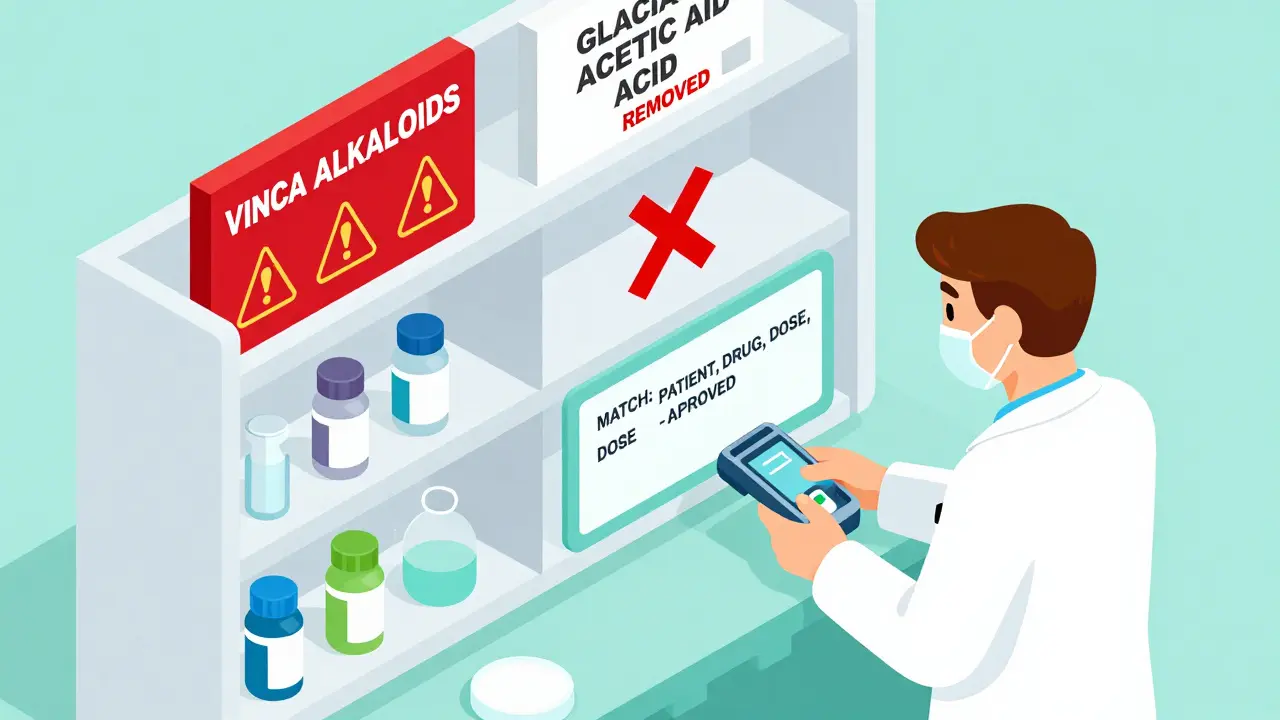
- Preventing intrathecal administration of vinca alkaloids: These chemo drugs are meant to go into veins, not the spinal fluid. One accidental spinal injection can paralyze or kill. ISMP requires these drugs to be stored separately, labeled with bright red warnings, and never kept near spinal medications.
- Eliminating glacial acetic acid from hospital areas: This chemical looks like water. It’s used in labs. But if someone mistakes it for saline and injects it? Tissue death. ISMP requires it to be removed entirely from patient care areas.
- Weekly methotrexate dosing with hard stops: Electronic systems now default to weekly dosing. If a doctor tries to order it daily, the system blocks it-unless they override it with a second confirmation that the patient has cancer. This single change has prevented an estimated 1,200 serious errors each year.
These aren’t theoretical. A pharmacy director in a Midwest hospital reported that after implementing the methotrexate hard stop, they stopped three near-misses in the first month. That’s three patients who didn’t end up in the ICU because a computer said no.
Technology That Makes a Difference
Barcode medication administration (BCMA) is one of the most effective tools hospitals have. Nurses scan the patient’s wristband, the medication, and their own badge before giving any drug. If anything doesn’t match, the system alerts them. Hospitals with full BCMA use report 40% fewer medication errors.
But not every hospital has it. AHRQ data shows 89% of hospitals with 300+ beds use BCMA. Only 54% of small hospitals do. Why? Cost. Training. Outdated systems. Many small clinics still rely on paper charts and handwritten orders-exactly where errors thrive.
Electronic health records (EHRs) with clinical decision support help too. They flag drug interactions, kidney function issues, duplicate orders, and allergies in real time. But if the system doesn’t have the right alerts turned on, it’s useless. A 2021 ASHP survey found 63% of hospitals struggled to build hard stops in their EHRs because vendors wouldn’t customize them.

High-Alert Medications: More Than Just a List
ASHP and ISMP agree: high-alert meds need more than just a label. They need layers of protection:
- Independent double-checks: Two licensed staff members verify high-risk drugs before administration.
- Standardized concentrations: IV bags of insulin or heparin must use the same strength across the hospital. No more 10 units/mL vs. 100 units/mL confusion.
- Automated dose range checking: If a doctor orders 500 mg of morphine for a 120-pound woman, the system screams.
Obstetrics has its own risks. Intravenous oxytocin, used to start labor, has caused deadly hemorrhages when given too fast. ISMP lists it as high-alert in maternity units. But many general hospital protocols don’t cover this. That’s why ACOG created separate guidelines for OB units.
Where Systems Fall Short
Even the best plans fail without consistent implementation. A 2022 ECRI Institute study found only 42% of community hospitals fully adopted all ISMP best practices. Academic centers? 78%. The gap? Resources. Training. Leadership commitment.
One nurse manager from a rural hospital told the American Nurses Association: “The requirement for both written and verbal methotrexate discharge instructions created workflow bottlenecks during staffing shortages.” She wasn’t complaining about safety-she was pointing out a flaw in how it was rolled out. Adding one more step without removing another creates burnout. And burnout leads to shortcuts.
Another issue: documentation. ISMP’s guidelines are detailed but complex. The Joint Commission’s standards are simpler-but vague. A hospital might meet the letter of the law but miss the spirit. One hospital followed every Joint Commission rule but still had a fatal insulin error because they didn’t standardize concentrations.
What’s Changing in 2025
Medication safety isn’t standing still. In 2023, ISMP added new rules for compounded sterile preparations after a fungal meningitis outbreak killed 76 people. The FDA now requires clearer labeling on high-concentration electrolytes like potassium chloride. By December 2024, all hospitals must comply.
The AHRQ’s 2023 National Action Plan aims to cut opioid-related harm by 50% by 2027. That means better pain management protocols, naloxone availability, and real-time monitoring.
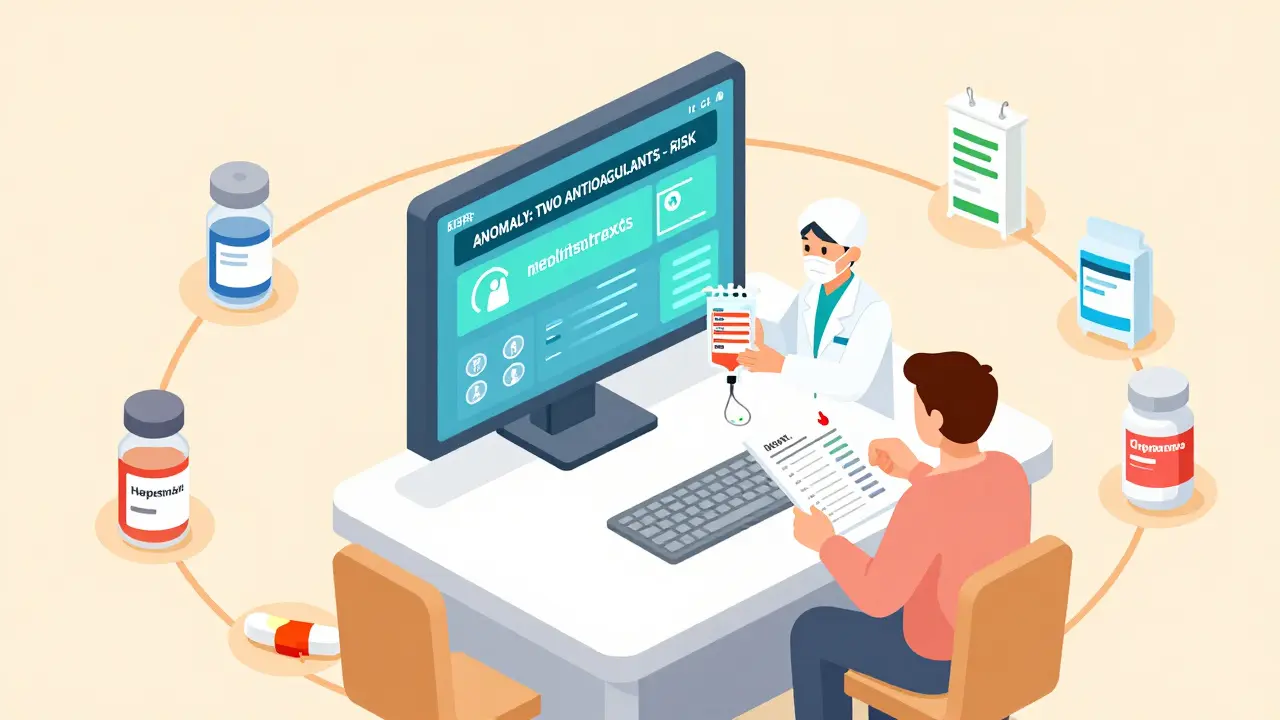
Most exciting? AI. Gartner predicts 75% of U.S. hospitals will use artificial intelligence to detect medication errors in real time by 2025. Right now, only 22% do. These systems can spot patterns humans miss-like a patient getting two different anticoagulants on the same day, or a dose that’s 300% too high based on weight.
Patient feedback is also becoming part of the system. Pilot programs at Mayo Clinic and Johns Hopkins showed a 32% improvement in error detection when patients were asked to review their own medication lists before discharge. That’s not just good practice-it’s a safety net.
What You Can Do
If you’re a patient: Always ask, “Is this the right drug for me?” Check your wristband. Ask the nurse to scan it. Read your discharge instructions. If something looks off-like a daily methotrexate pill when you thought it was weekly-speak up.
If you’re a provider: Push for barcode scanning. Demand standardized concentrations. Insist on hard stops for high-risk meds. Don’t accept “We’ve always done it this way.” That phrase kills.
If you’re a leader: Fund the systems. Train staff. Measure outcomes. Don’t just check a box. If you’re not reducing errors, you’re not doing your job.
Medication safety isn’t about perfection. It’s about layers. One layer fails? The next catches it. And if every layer fails? That’s not an accident. That’s negligence.
What is the most common cause of medication errors in hospitals?
The most common cause isn’t human error-it’s system design. Poor labeling, lack of barcode scanning, inconsistent dosing standards, and incomplete electronic alerts create opportunities for mistakes. For example, storing similar-looking drugs next to each other or allowing daily dosing of weekly methotrexate without a hard stop. Systems that rely on memory or vigilance fail. Systems that build in automatic checks succeed.
How do barcode medication administration systems reduce errors?
Barcode medication administration (BCMA) requires nurses to scan three things before giving a drug: the patient’s wristband, the medication’s barcode, and their own ID. If any item doesn’t match-wrong patient, wrong drug, wrong dose-the system blocks administration and alerts staff. This simple check prevents 40% of dosing errors. It’s not foolproof, but it stops the most common mistakes: wrong patient, wrong drug, and wrong time.
Why is methotrexate dosing such a big safety issue?
Methotrexate is used weekly for autoimmune diseases like rheumatoid arthritis, but daily for cancer. Giving it daily by accident causes severe bone marrow suppression, leading to infection, bleeding, and death. Before ISMP’s hard stop rule, this mistake happened dozens of times a year. Now, the EHR defaults to weekly dosing. If a doctor tries to order it daily, the system requires a second confirmation and documentation proving the patient has cancer. Since 2017, this change has prevented over 1,200 serious errors annually.
What’s the difference between ISMP best practices and Joint Commission standards?
ISMP’s Targeted Best Practices are specific, actionable rules based on real error reports-like requiring red labels for vinca alkaloids or removing glacial acetic acid from patient areas. They’re designed to stop known, deadly mistakes. The Joint Commission’s National Patient Safety Goals are broader: “Identify high-alert medications” or “Improve medication reconciliation.” They set the floor, not the ceiling. Hospitals following only Joint Commission standards see 37% more preventable harm than those fully implementing ISMP practices.
Are small hospitals at higher risk for medication errors?
Yes. Small hospitals (under 100 beds) are far less likely to have barcode scanning, automated dose checking, or dedicated pharmacists on staff. Only 54% of small hospitals use barcode systems, compared to 89% of large ones. They also struggle with EHR customization and funding staff training. This gap in technology and staffing makes them 2.3 times more likely to experience serious medication errors, according to AHRQ data. The solution isn’t just money-it’s prioritizing safety over cost savings.
Final Thought
Medication safety isn’t a project. It’s a culture. It’s not about blaming someone for a mistake. It’s about asking: Why did the system let that mistake happen? And how do we fix it so it never happens again?
The tools exist. The data proves they work. The question isn’t whether we can do better. It’s whether we’re willing to.


