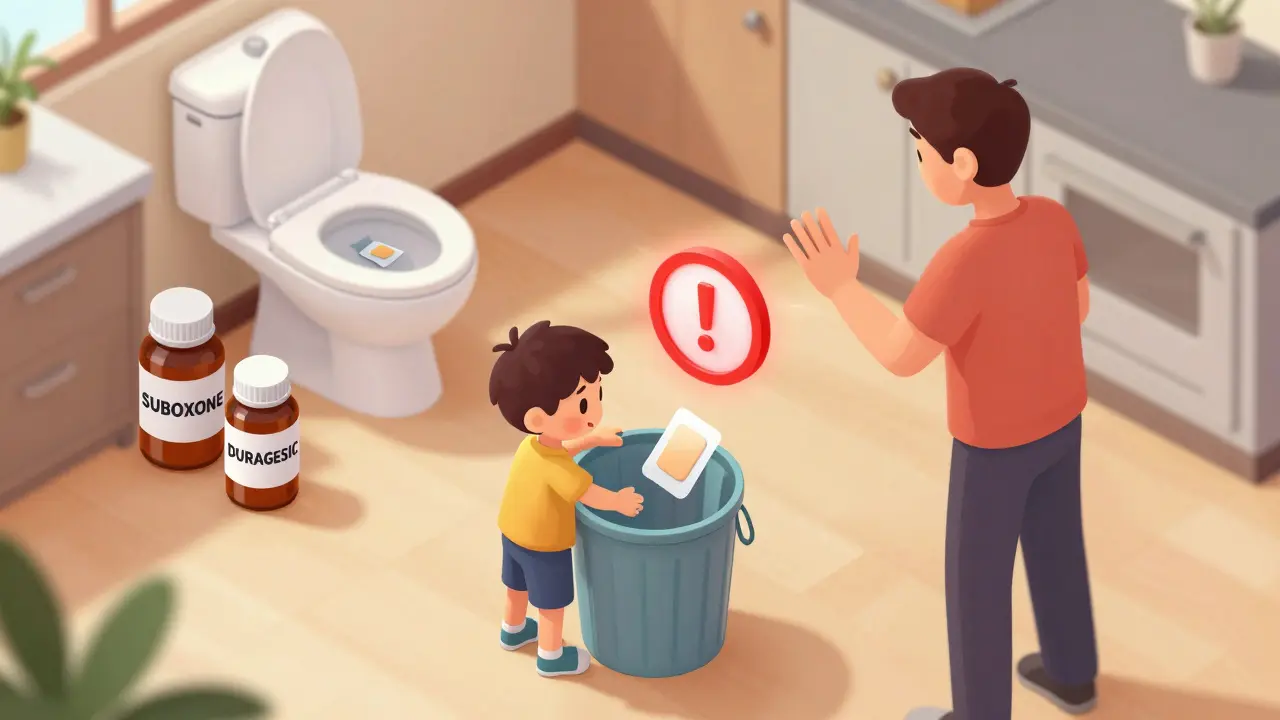
Putting old pills in the trash might seem harmless-until it isn’t. Every year, children, teens, and even adults end up in emergency rooms because they found unused medications in household trash. The medication disposal rules aren’t just suggestions. Some drugs are so dangerous that if they’re not flushed right away, they can kill someone in minutes. This isn’t fearmongering. It’s science. And it’s backed by the U.S. Food and Drug Administration (FDA), which maintains a strict list of medications that must never go in the trash.
Why Some Medications Can’t Go in the Trash
Most expired or unwanted medicines can be safely thrown away after mixing them with coffee grounds or cat litter. But not all. The FDA’s Flush List includes drugs that are highly addictive, deadly in single doses, and frequently stolen from home medicine cabinets. Think about it: if a child finds a fentanyl patch in the trash, that one patch can be enough to stop their breathing. Fentanyl is 50 to 100 times stronger than morphine. A single patch, left in a pile of old cereal boxes or under a stack of newspapers, could be fatal.
The CDC reported over 107,000 drug overdose deaths in 2021. Of those, opioids were involved in about 70%. Many of those overdoses started with a pill or patch someone found in a neighbor’s trash or a relative’s cabinet. The Substance Abuse and Mental Health Services Administration (SAMHSA) found that over half of people who misused prescription painkillers got them from friends or family-often without permission. That’s why the FDA says: if it’s on the flush list, flush it immediately. No waiting. No storing. No hoping.
The FDA Flush List: What You Can’t Throw Away
The FDA’s list isn’t long, but it’s deadly serious. These are the exact medications you must flush down the toilet if you no longer need them:
- Any drug containing buprenorphine (brands: SUBOXONE, SUBUTEX, BELBUCA, BUTRANS)
- Any drug containing fentanyl (brands: DURAGESIC, ACTIQ, ABSTRAL, FENTORA)
- Hydromorphone (EXALGO)
- Meperidine (DEMEROL)
- Methadone (DOLOPHINE, METHADOSE)
- Morphine (MS CONTIN, ARYMO ER, EMBEDA, KADIAN)
- Oxymorphone (OPANA, OPANA ER)
- Tapentadol (NUCYNTA, NUCYNTA ER)
- Sodium oxybate (XYREM, XYWAV)
- Diazepam rectal gel (DIASTAT, DIASTAT ACUDIAL)
- Methylphenidate transdermal system (DAYTRANA)
These aren’t random drugs. They’re all powerful, fast-acting, and frequently abused. A single dose of fentanyl or methadone can be lethal-even for someone with no tolerance. And unlike antibiotics or blood pressure pills, these aren’t just dangerous if misused. They’re dangerous if they’re simply accessible.
What Happens If You Don’t Flush Them?
There are real stories behind these rules. In 2023, a 3-year-old in Ohio was rushed to the hospital after finding a discarded fentanyl patch in the trash. He survived, but barely. The American Association of Poison Control Centers logged over 8,900 single-exposure cases involving fentanyl that year-42% of them in children under five. These aren’t rare accidents. They’re predictable.
And it’s not just kids. Teens often search through trash for pills. A teenager in Montgomery County, Ohio, died in 2021 after finding OPANA ER (oxymorphone) in a neighbor’s bin. That death led to a local law requiring special disposal for Schedule II medications. In Bristol, where I live, pharmacies report that nearly one in three patients don’t know which meds to flush and which to mix with dirt. That confusion kills.

Environmental Concerns? Yes. But Not Here.
You’ve probably heard that flushing medicine pollutes water. That’s true-pharmaceuticals do show up in rivers and lakes. Studies from the University of Nebraska show wastewater plants remove only 30% to 90% of drugs. Some, like carbamazepine, barely get filtered out at all.
But here’s the catch: the FDA doesn’t ignore the environment. They’ve weighed the risks. The EPA says that while pharmaceuticals in water are a concern, the risk of death from a single fentanyl patch or methadone tablet is far greater. Dr. John Scott from the EPA’s National Homeland Security Research Center put it plainly: “The environmental impact of flushing one fentanyl patch is negligible compared to the risk of multiple deaths if it ends up in the trash.”
The EPA and FDA jointly updated their guidelines in September 2022. They made it clear: for these 11 medications, the toilet is the safest place. For everything else? Use the trash-with care.
How to Dispose of Medications That Aren’t on the List
For drugs not on the flush list, the FDA gives clear steps:
- Take pills out of their original bottles.
- Don’t crush tablets or capsules. Just leave them as they are.
- Mix them with something unappealing-used coffee grounds, kitty litter, or dirt.
- Put the mixture in a sealed plastic bag.
- Throw the bag in your household trash.
This makes the pills harder to find, taste awful, and prevents them from being easily recovered. Don’t flush these. Don’t pour them down the sink. Just mix, seal, and toss.
Some people think crushing pills helps. It doesn’t. Crushing can release dangerous doses all at once. And it’s unnecessary. The FDA says: leave them whole.

What About Take-Back Programs?
Yes, they exist. Walgreens has over 2,000 medication disposal kiosks across the U.S. CVS has nearly 1,800. Many pharmacies, police stations, and hospitals offer drop-off bins. These are great for non-controlled drugs-antibiotics, antidepressants, blood pressure meds, etc.
But here’s the problem: take-back programs aren’t always available. In rural areas, they’re rare. Even in cities, people forget. And if you have a drug on the flush list, you shouldn’t wait. You shouldn’t store it for a drop-off day. You should flush it the moment you no longer need it.
Some states have better systems. Minnesota has over 300 collection sites. California and Oregon offer mail-back envelopes. But until every home has a drop-off bin right outside the door, flushing remains the only reliable safety net for the most dangerous drugs.
What to Do Right Now
Check your medicine cabinet today. Look for any of the drugs on the flush list. If you find them:
- Flush them immediately-no delay.
- Don’t wait for a collection day.
- Don’t store them “just in case.”
- Don’t give them to a friend.
For everything else, mix with coffee grounds or dirt, seal in a bag, and toss. Keep the original bottles? No. Remove labels if you can. But even without labels, mixing with unappealing stuff is enough.
And if you’re unsure? Call your pharmacist. They’ll tell you. Most have printed lists. Some even put stickers on the bottle.
What’s Changing?
New packaging is starting to appear. A 2023 pilot at the University of Florida tested envelopes with activated charcoal that neutralize drugs when wet. Early results showed a 63% drop in improper disposal. Companies like DisposeRx sell single-use powder packets for $1.50 that turn pills into sludge. Over 1,200 pharmacies now use them.
The FDA updated the flush list in January 2023 to include newer versions of old drugs. Congress is also considering the SNIPED Act, which would require doctors to give disposal instructions with every prescription for strong painkillers.
But for now, the rules are simple: if it’s on the list, flush it. If it’s not, mix and trash. There’s no gray area.
What happens if I accidentally flush a medicine not on the list?
Flushing a single non-flush-list medication once won’t cause major harm, but it’s not recommended. The goal is to minimize pharmaceuticals in water. If you’ve done it, don’t panic. Just follow the correct method going forward: mix with coffee grounds or cat litter, seal in a bag, and throw it in the trash. Consistency matters more than one mistake.
Can I flush pills if I don’t have a toilet?
If you live in a home without a toilet-like a mobile home or RV-contact your local pharmacy or public health department. Many offer free disposal kits or mail-back envelopes. In the UK, you can return unused meds to any pharmacy for safe disposal. Don’t pour them down the sink or throw them in the trash. There’s always a safe option.
Is it safe to flush old patches like fentanyl or methadone?
Yes. The FDA specifically says to flush patches immediately. Don’t remove the adhesive backing or cut them. Just flush the whole patch. Water will break it down. The risk of someone finding it in the trash far outweighs any environmental impact. This is the one time flushing is the safest choice.
Why can’t I just throw away my old painkillers if I live alone?
Because you never know who might go through your trash. A neighbor’s child. A friend. A visitor. Even if you’re careful, accidents happen. The FDA’s guidelines exist because of real deaths-not hypothetical risks. Your responsibility isn’t just to yourself. It’s to everyone around you.
Do pharmacies really take back all types of medication?
Most pharmacies take back non-controlled medications like antibiotics, statins, and antidepressants. But they can’t take back controlled substances like opioids or stimulants. Those must be handled by law enforcement or special collection sites. That’s why the flush list exists-for the drugs that pharmacies can’t safely accept, but that are too dangerous to leave in the trash.


