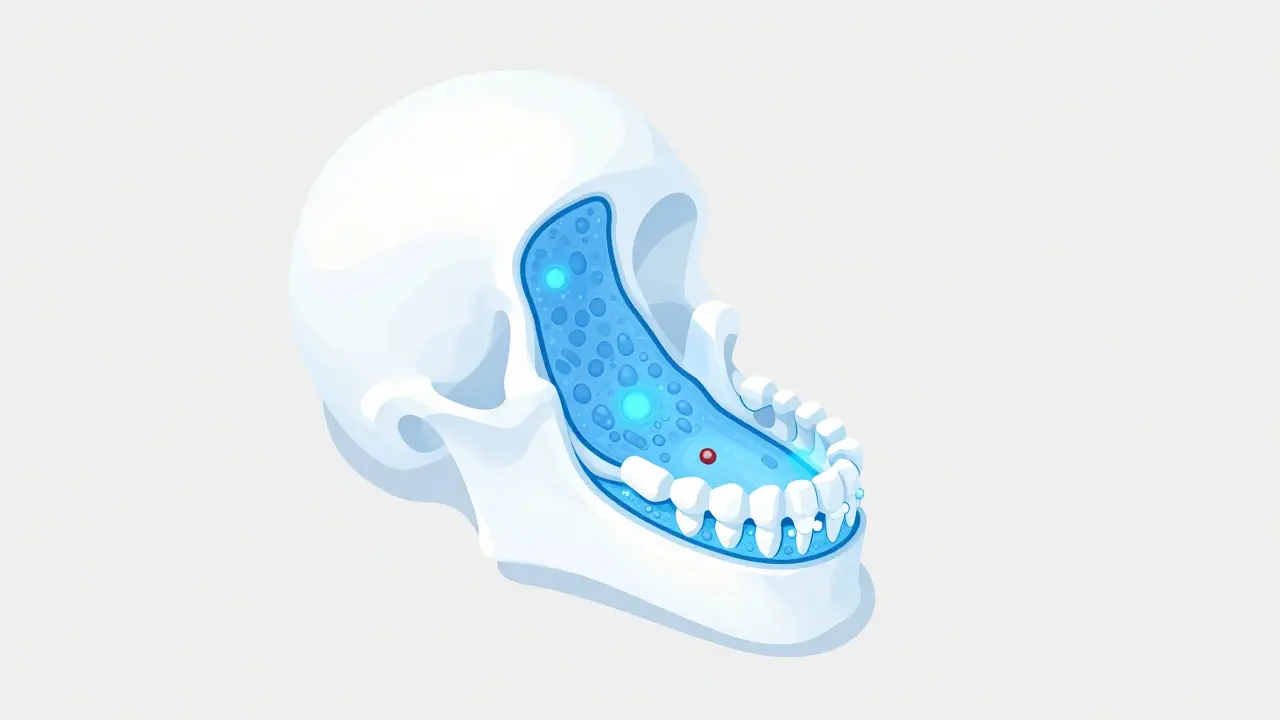
MRONJ Risk Assessment Tool
Select Your Profile Factors
Check all boxes that apply to your current situation.
Your Estimated Risk Level
Recommended Action:
Please select your medication type to see personalized advice.
You take your medication to strengthen your bones or treat cancer, trusting it will protect you. But what if that same medicine silently weakens the very structure of your jaw? This is the reality for a small but vulnerable group of patients facing medication-related osteonecrosis of the jaw, often abbreviated as MRONJ. It is a condition where the jawbone dies because it cannot heal itself, leaving bone exposed in the mouth for more than eight weeks. While rare, the consequences are severe, painful, and difficult to treat.
The good news? You don’t have to accept this risk blindly. Understanding the warning signs, knowing which medications carry the highest danger, and coordinating care between your doctor and dentist can prevent this condition entirely. Let’s break down exactly what happens, who is at risk, and how you can stay safe.
What Is Medication-Related Osteonecrosis of the Jaw?
To understand MRONJ, you first need to understand how bone works. Your bones are not static; they are living tissue that constantly breaks down old cells and builds new ones. This process is called bone turnover. When you suffer microfractures from daily chewing or minor trauma, your body repairs them seamlessly.
Certain powerful medications stop this natural repair cycle. They do this to prevent bone loss in conditions like osteoporosis or to stop cancer from spreading to the bones. However, when the turnover stops completely, the jawbone becomes brittle and unable to heal. If the gum tissue over the bone gets damaged-whether by a tooth extraction, a loose denture, or even spontaneous breakdown-the bone underneath loses its blood supply. Without blood, the bone tissue dies (necrosis) and exposes itself through the gum.
The National Institute of Dental and Craniofacial Research defines MRONJ specifically by this persistent exposure. If the bone stays uncovered for more than eight weeks without an obvious cause like radiation therapy or direct trauma, it meets the diagnostic criteria for this condition.
Which Medications Cause MRONJ?
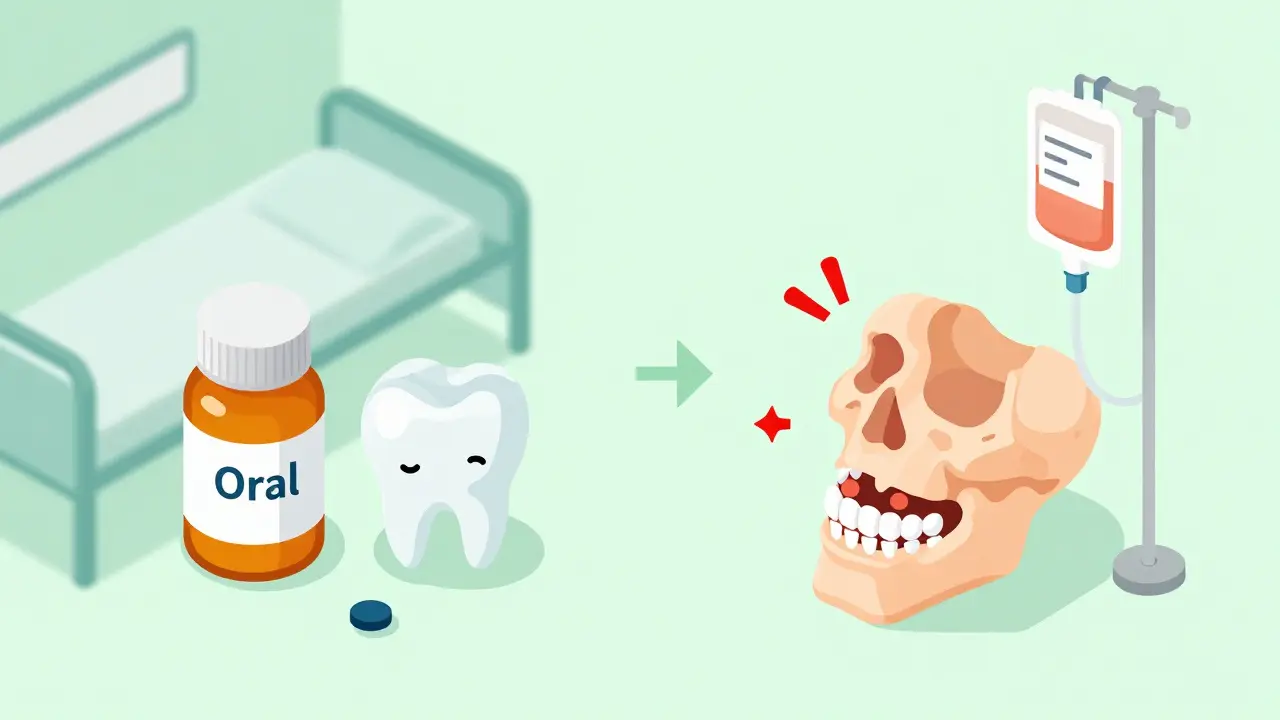
Not all drugs carry the same weight of risk. The primary culprits are antiresorptive agents, which suppress bone breakdown. Here is a breakdown of the specific medications linked to MRONJ:
- Bisphosphonates: These are the most common cause. They come in two forms:
- Oral Bisphosphonates: Taken as pills for osteoporosis. Examples include alendronate (Fosamax), risedronate (Actonel), and ibandronate (Boniva). The risk here is extremely low.
- Intravenous Bisphosphonates: Injected directly into the vein, usually for cancer patients with bone metastases. Zoledronic acid (Zometa) and zoledronate (Reclast) fall into this category. The risk is significantly higher here.
- RANK Ligand Inhibitors: Denosumab (Prolia for osteoporosis, Xgeva for cancer) works differently than bisphosphonates but carries a similar, albeit slightly lower, risk profile.
- Anabolic Agents: Romosozumab (Evenity) has also been associated with cases, though less frequently.
| Medication Type | Common Use | Incidence Rate | Risk Level |
|---|---|---|---|
| Oral Bisphosphonates | Osteoporosis | 0.001% - 0.01% | Very Low |
| Intravenous Bisphosphonates | Bone Metastasis/Cancer | 1% - 10% | High |
| Denosumab (Prolia) | Osteoporosis | < 0.1% | Low |
| Denosumab (Xgeva) | Cancer/Bone Mets | Higher than Prolia | Moderate-High |
Note the massive gap in incidence rates. According to data from the American Dental Association, cancer patients receiving IV treatments face a risk up to 1,000 times higher than those taking oral pills for osteoporosis. Duration matters too. Studies show that risk climbs sharply after three to four years of continuous therapy.
Dental Warning Signs: What to Look For
Early detection is your best defense. MRONJ does not always start with visible bone. Often, it begins subtly. If you are on any of the medications listed above, watch for these specific symptoms:
- Persistent Pain or Swelling: An ache in the jaw that doesn’t go away, or swelling in the gums that feels unusual. About 87% of diagnosed patients report pain or swelling as an early sign.
- Poor Healing After Extraction: If you had a tooth pulled and the socket hasn’t closed or still hurts after two weeks, call your dentist immediately. Normal healing should be well underway by then.
- Loose Teeth: Teeth becoming mobile without obvious gum disease or trauma can indicate underlying bone issues.
- Exposed Bone: This is the definitive sign. You might see white or yellowish hard tissue poking through the gum line. By definition, if this lasts more than eight weeks, it is MRONJ.
- Numbness or Heaviness: A feeling of pressure in the jaw or numbness in the lip/chin area suggests nerve involvement due to bone changes.
- Infection Discharge: Pus or foul-tasting drainage from the gums indicates an infection complicating the necrotic bone.
Don’t ignore "just a sore gum." In high-risk patients, minor trauma can trigger the cascade. As Dr. Mark A. Reynolds from UNC Adams School of Dentistry notes, ONJ can develop even after seemingly insignificant irritation.
Who Is Most at Risk?
While the medication is the primary driver, other factors stack the odds against you. You are at higher risk if:
- You undergo invasive dental procedures: Tooth extraction is the biggest trigger. Data shows a 3.2% development rate of ONJ in bisphosphonate users after extractions, compared to near-zero for routine cleanings.
- You wear ill-fitting dentures: Chronic friction from poorly fitting appliances can damage the gum lining over time.
- You have comorbidities: Diabetes, poor oral hygiene, smoking, and use of corticosteroids significantly impair healing and increase susceptibility.
- You have been on therapy for years: The longer you suppress bone turnover, the less resilient your jaw becomes.
Prevention Strategies: Protecting Your Jaw
You cannot change your medical diagnosis, but you can control your dental preparation. The goal is to eliminate potential problems before starting high-risk medication.
Step 1: The Pre-Treatment Dental Clearance Before starting intravenous bisphosphonates or denosumab, get a comprehensive dental exam. The American College of Rheumatology recommends this 4-6 weeks prior to initiation. For oral osteoporosis meds, 2-4 weeks is sufficient. Address any infections, remove hopeless teeth, and ensure your dentures fit perfectly. Do not skip this step.
Step 2: Maintain Rigorous Oral Hygiene Brush twice daily and floss. Consider using a chlorhexidine mouth rinse (0.12%) twice daily if your dentist recommends it. A 2021 trial showed this simple addition reduced ONJ risk by 37% in high-risk patients.
Step 3: Coordinate Care Between Providers Your oncologist and your dentist need to talk. Ensure your dentist knows exactly what medications you are taking and for how long. Conversely, your doctor should know if you require urgent dental surgery. Sometimes, a "drug holiday"-pausing the medication for 2-3 months under strict medical supervision-may be advised before major oral surgery, particularly for IV bisphosphonate users.
Treatment Options if MRONJ Develops
If prevention fails, treatment focuses on pain management and removing dead bone. There is no single cure, but approaches vary by stage:
- Conservative Care: For early stages, antibiotics, antifungal rinses, and debridement (cleaning out loose debris) may suffice.
- Surgical Intervention: In advanced cases, surgeons may need to resect (cut away) the necrotic bone segments to allow healthy tissue to heal.
- Emerging Therapies: Research is promising. Teriparatide (Forteo), an anabolic agent that stimulates bone growth, has shown a 78% resolution rate in Stage 1 cases in recent trials, compared to just 32% with standard care. This highlights the shift toward personalized, biologically targeted treatments.
Frequently Asked Questions
Can I stop my osteoporosis medication to avoid MRONJ?
No, you should never stop prescribed medication without consulting your doctor. The risk of hip or spine fractures from untreated osteoporosis far outweighs the minimal risk of MRONJ for most patients on oral bisphosphonates. The benefit of preventing debilitating fractures is critical. Instead, focus on preventive dental care.
Is MRONJ reversible?
Dead bone cannot regenerate on its own. Treatment aims to remove the necrotic tissue and manage infection so that surrounding healthy bone can stabilize. Early intervention leads to better outcomes, potentially avoiding extensive surgery. Newer therapies like teriparatide show promise in accelerating healing in early stages.
Do routine dental cleanings pose a risk?
No. Routine prophylaxis (cleanings) and fillings do not significantly increase the risk of MRONJ. The risk is primarily associated with invasive procedures that expose bone, such as extractions, implants, or deep periodontal surgeries. Continue regular dental visits to maintain oral health.
How long does the risk last after stopping medication?
Bisphosphonates bind tightly to bone and can remain active for years. The risk decreases over time but does not disappear immediately. For oral bisphosphonates, risk declines significantly after discontinuation but may persist for several years. Intravenous agents also have long half-lives in bone tissue. Always inform your dentist of past medication history.
What should I tell my dentist if I am on these drugs?
Be explicit. State the name of the drug, the dosage, how you take it (pill vs. injection), and how long you have been taking it. Ask them to document this in your chart. This ensures they adjust their treatment plan, perhaps opting for less invasive options or prescribing preventive antibiotics/rinses.
Are there genetic tests to predict MRONJ risk?
Currently, there are no widely available clinical genetic tests for MRONJ prediction. However, research is ongoing. The NIH-funded Osteonecrosis Prediction Algorithm (OPA) is in phase 3 trials, aiming to combine genetic markers, medication history, and dental status to provide individualized risk scores. Until then, clinical assessment remains the standard.
Next Steps for Patients
If you are newly prescribed one of these medications, schedule a dental appointment this week. Bring your prescription bottle. If you are already on therapy and haven’t seen a dentist in six months, make an appointment now. Tell them about your medication. If you notice any unexplained jaw pain or slow-healing sores, do not wait. Contact your dentist and physician immediately. Early action saves bone.