Patents don’t run forever-but market exclusivity often does
When a new drug hits the market, people assume the clock starts ticking on its monopoly the moment the patent is granted. That’s not true. The real clock starts when the FDA approves it. And even then, the clock doesn’t stop at 20 years. Many drugs keep their monopoly for over a decade longer-not because of stronger patents, but because of a set of hidden rules called market exclusivity extensions.
These aren’t patents. They’re regulatory tools. Created by Congress in 1984 through the Hatch-Waxman Act, they were meant to balance innovation with access. But today, they’ve become the primary way drugmakers delay generic competition. In fact, 91% of drugs that get patent extensions still enjoy monopoly pricing years after those extensions expire, thanks to layer upon layer of other protections.
What exactly counts as a market exclusivity extension?
There are five main types in the U.S., each with its own rules and rewards. They don’t require a patent. You don’t even need one to qualify.
- New Chemical Entity (NCE) exclusivity: Five years of protection for a drug with an active ingredient never approved before. No generics can even file an application during this time.
- Orphan Drug exclusivity: Seven years for drugs treating diseases affecting fewer than 200,000 Americans. This one’s been wildly popular-over 1,000 orphan drug designations were approved in 2022, up from just 201 in 2010.
- New Clinical Investigation exclusivity: Three years for a new use, new dosage, or new formulation of an existing drug. But here’s the catch: the FDA now demands real clinical proof, not just a tweak. You can’t just repack the same pill and call it new.
- Pediatric exclusivity: Six months added to any existing exclusivity period if the company completes FDA-requested pediatric studies. This one’s a game-changer. Add it to a five-year NCE exclusivity? You get 5.5 years. Stack it with orphan drug protection? That’s 7.5 years. It’s not a bonus-it’s a strategic lever.
- Patent Challenge exclusivity: 180 days of exclusive generic market access for the first company to successfully challenge a brand-name patent. This one’s meant to speed up generics, but it’s often used as a bargaining chip in settlements.
In the EU, it’s similar but structured differently. They use Supplemental Protection Certificates (SPCs) to extend patent life up to 15 years after approval. Orphan drugs get 10 years, extended to 12 if pediatric data is submitted. Pediatric-Use Marketing Authorization (PUMA) gives eight years plus two more if the drug is specifically designed for children. The EU doesn’t stack as freely as the U.S., but the total protection time can still stretch past 15 years.
How do companies stretch exclusivity beyond the rules?
It’s not just about applying for the right exclusivity. It’s about stacking them-and gaming the system.
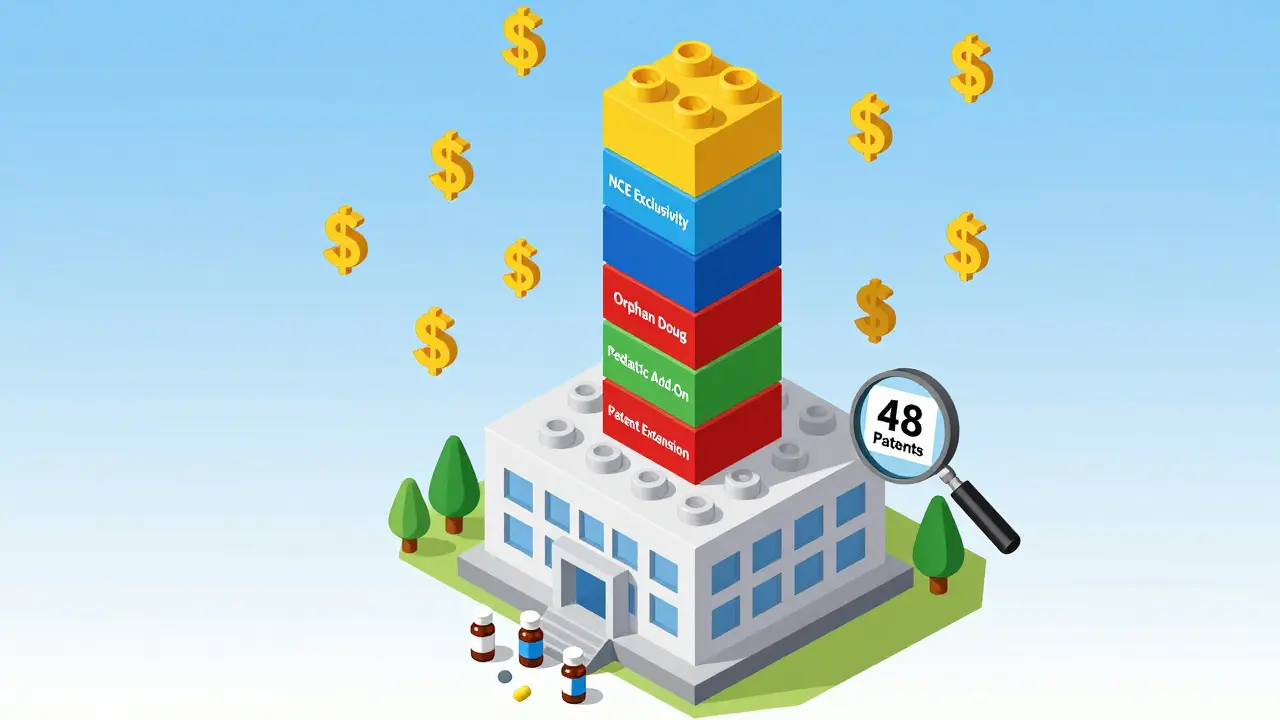
Take tazarotene, a skin treatment. The core patent expired years ago. But the company filed 48 additional patents covering things like packaging, dosing schedules, and even the color of the capsule. These aren’t new inventions-they’re tweaks. But under U.S. law, each one can delay a generic. This is called a “patent thicket.”
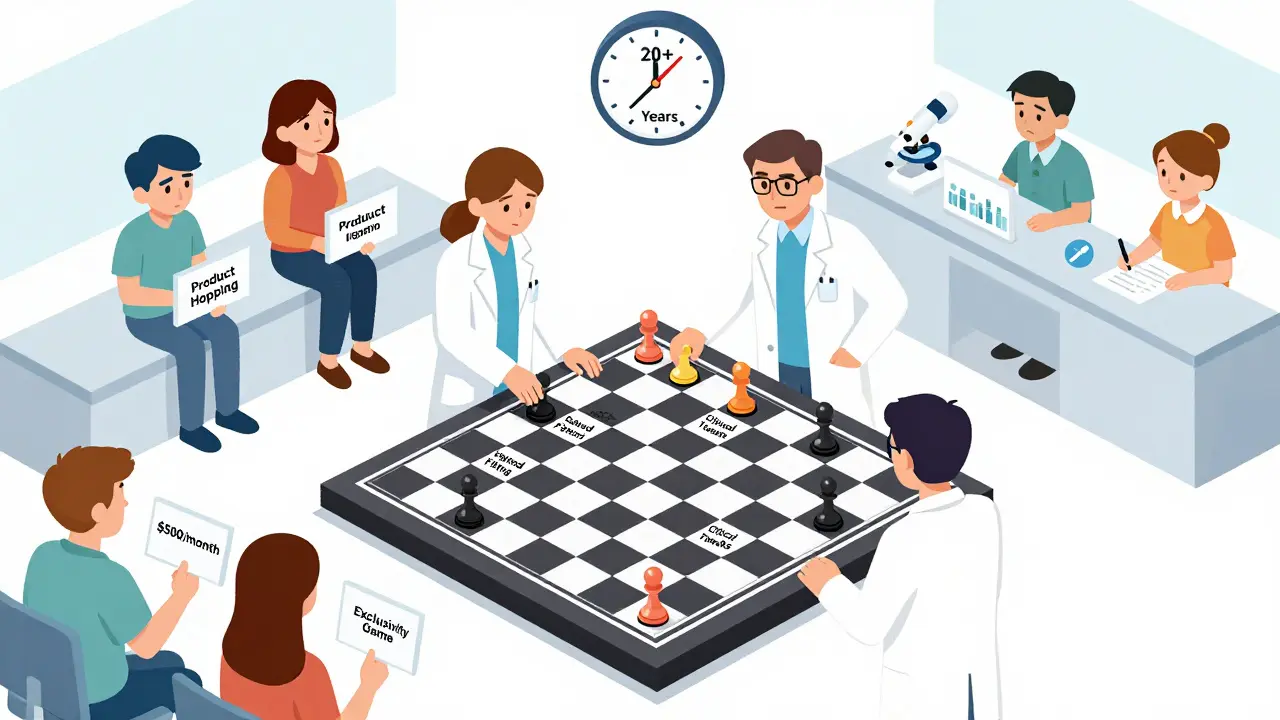
Another tactic: “product hopping.” Just before a patent expires, a company launches a slightly modified version-a pill that dissolves faster, a liquid instead of a tablet, a new dosage. Then they stop selling the original. Generic makers can’t copy the old version because it’s no longer on the market. The FDA says this is legal unless it’s clearly anti-competitive. The FTC disagrees. In 2023, they filed a legal brief arguing that product hopping violates antitrust laws.
Then there’s timing. Big pharma companies like Bristol Myers Squibb and Novartis now wait until after Phase II clinical trials to file patents. Why? Because the 20-year patent clock starts when the patent is granted, not when the drug is developed. Delaying the filing means the patent expires closer to market launch. That gives them more time to profit.
Why does this matter to patients and the system?
Because money flows uphill.
In 2022, the U.S. pharmaceutical market made $621 billion. Branded drugs-just 10% of prescriptions-accounted for 78% of that revenue. Why? Because they’re the only ones allowed to sell. Generic drugs cost 80-90% less. But if exclusivity keeps them off the market, prices stay high.
A 2023 study in JAMA Health Forum looked at just four drugs: bimatoprost, celecoxib, glatiramer, and imatinib. After generics finally entered, the extra spending caused by delayed competition added up to $3.5 billion over two years. That’s not a rounding error. That’s enough to fund thousands of cancer screenings or insulin programs.
For rare diseases, orphan drug exclusivity is vital. Without it, no company would spend $2 billion developing a drug for 5,000 patients. Patient advocacy groups say these rules save lives. But critics point out that some companies use orphan status for drugs that could treat common conditions-like a diabetes drug reclassified as an “orphan” for a rare subtype. That’s not innovation. That’s loophole exploitation.
Who’s managing this complexity?
It’s not a one-person job. It takes teams.
Major pharmaceutical companies assign 15 to 25 specialists-patent lawyers, regulatory experts, clinical strategists-to manage exclusivity for their top-selling drugs. They start planning during Phase III trials. Should we pursue pediatric studies? Can we get a new indication? Should we delay the patent filing until after we see the final data?
It’s a high-stakes chess game. One mistake-filing the wrong paperwork, missing a deadline, failing to prove clinical superiority-and you lose years of monopoly. Get it right, and you extend your revenue stream by half a decade or more.
Biotech startups rely on this. A 2023 survey by the Biotechnology Innovation Organization found that 68% of early-stage companies say market exclusivity is critical to securing venture capital. Investors don’t bet on science alone. They bet on how long the cash flow will last.
The system is changing-slowly
Regulators are catching on.
In April 2023, the FDA tightened rules for three-year exclusivity. Now, you can’t just tweak a drug and call it new. You need real evidence that the change improves outcomes. In September 2023, the European Medicines Agency launched a pilot to speed up pediatric study reviews, hoping to encourage more legitimate pediatric research instead of just chasing the six-month bonus.
The European Commission is considering overhauling the SPC system to reward true innovation, not minor changes. In the U.S., the FTC is pushing back against product hopping. And in 2023, Yale Law and Policy Review found that the average drug now enjoys 9.2 years of extra monopoly after its core patent expires-up from just 3.1 years in 2000.
By 2028, Evaluate Pharma predicts the average drug will have 16.3 years of market exclusivity-nearly double what it was in 2018. That’s not innovation. That’s a system designed to protect profits, not patients.
What’s next?
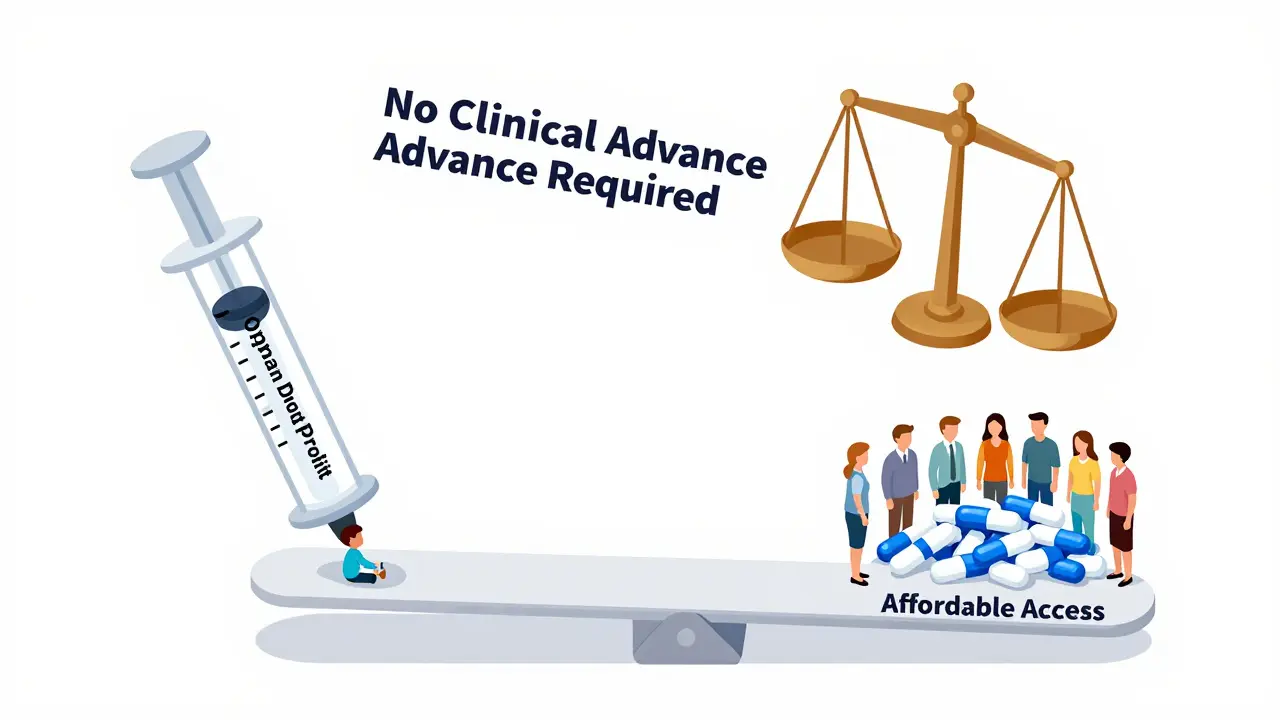
The tension isn’t going away. Drugmakers need returns to fund research. Patients need affordable access. The question is: where’s the line?
Right now, the system rewards complexity over clarity. It lets companies turn minor changes into multi-year monopolies. It lets them stack protections like Lego blocks. And it lets them delay generics long after the original science has passed its expiration date.
Some reform is coming. But until there’s a hard cap on total exclusivity time-or a rule that says you can’t extend protection unless the drug delivers a real clinical advance-this won’t change. The patents may expire. But the monopoly? That’s still running.
Can a drug have market exclusivity without a patent?
Yes. Market exclusivity is granted by regulatory agencies like the FDA, not by patent offices. A drug can have five years of New Chemical Entity exclusivity even if no patent exists. Orphan drug exclusivity and pediatric exclusivity also operate independently of patents. Many orphan drugs, especially biologics, have little or no patent protection but still enjoy seven to twelve years of market exclusivity.
How long can a drug’s market exclusivity last in the U.S.?
There’s no single cap, but in practice, it can reach 20+ years. The maximum patent term extension is 14 years after FDA approval. Add five years of NCE exclusivity, six months of pediatric exclusivity, and orphan drug protection (seven years), and you can stack these. If a drug gets orphan status, pediatric exclusivity, and a patent extension, it’s common to see 15-18 years of protection. Some drugs, like Vertex’s cystic fibrosis treatments, have pushed beyond 20 years through strategic patent filings and exclusivity stacking.
What’s the difference between patent term extension and regulatory exclusivity?
Patent term extension (PTE) is a legal adjustment to a patent’s expiration date, granted by the USPTO to make up for delays in FDA approval. It’s tied to a specific patent and capped at five years, with a total post-approval monopoly limit of 14 years. Regulatory exclusivity, on the other hand, is a separate FDA-granted period that blocks generics from even applying for approval. It doesn’t require a patent and can be applied to the same drug alongside a patent extension. They’re two different tools with different rules.
Why do generics take so long to enter the market after a patent expires?
Because the patent isn’t the only barrier. Even after a patent expires, regulatory exclusivities may still be active. For example, if a drug has five years of NCE exclusivity, generics can’t file for approval until year five-even if the patent expired at year three. Then there are secondary patents, legal challenges, and product hopping tactics that delay generic entry. In some cases, generics wait years after patent expiry just to get past the regulatory and legal hurdles.
Are market exclusivity extensions good or bad?
It depends. For rare diseases, orphan drug exclusivity has led to treatments that wouldn’t exist otherwise. Pediatric exclusivity has improved safety data for children. But for blockbuster drugs, these tools are often used to delay competition and maintain high prices. The problem isn’t the intent-it’s the abuse. When companies file 48 patents on minor changes or swap out old versions for new ones just to block generics, it’s no longer about innovation. It’s about profit. The system needs clearer limits to prevent exploitation.


