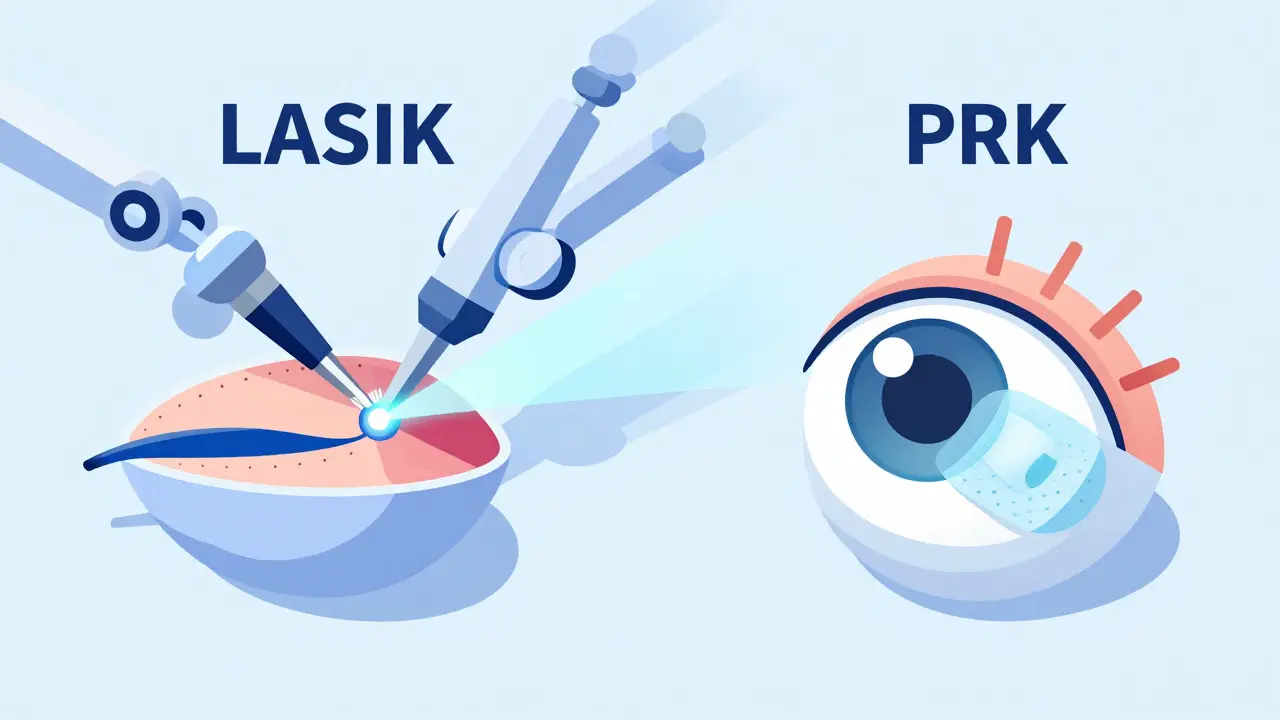
When you’re tired of glasses or contacts, laser eye surgery looks like a dream come true. But not all laser procedures are the same. Two of the most common options-LASIK and PRK-both correct nearsightedness, farsightedness, and astigmatism using the same laser technology. Yet their differences in how they work, how long recovery takes, and who they’re best for can make one a much better fit than the other. Choosing the wrong one doesn’t just mean longer healing-it could mean avoiding surgery altogether if your eyes aren’t a match.
How LASIK and PRK Work: The Core Difference
Both LASIK and PRK reshape the cornea-the clear front surface of your eye-to fix how light focuses on the retina. The laser used is identical in both: an excimer laser that removes microscopic amounts of tissue with pinpoint accuracy. The real difference lies in how the surgeon gets to that tissue.
LASIK creates a thin, hinged flap in the outer layer of the cornea. This flap is lifted, the laser reshapes the tissue underneath, and then the flap is gently laid back down. It sticks naturally, no stitches needed. The flap acts like a biological bandage, speeding up healing.
PRK skips the flap entirely. Instead, the thin outer skin of the cornea (the epithelium) is completely removed-either with a brush, alcohol solution, or the laser itself. The laser then reshapes the cornea directly. Afterward, a soft bandage contact lens is placed over the eye to protect it while new epithelial cells grow back over the next few days.
This small technical difference changes everything about recovery, risk, and who qualifies.
Recovery Time: Hours vs. Weeks
If you need to get back to work, driving, or your daily routine fast, LASIK wins by a landslide. Most people see well enough to drive the next day. By 48 hours, 90% of LASIK patients have 20/20 vision or better. There’s minimal discomfort-often just mild irritation for a day or two.
PRK is the opposite. The first 3 to 7 days are tough. Your vision will be blurry, your eyes sensitive to light, and you’ll likely feel a gritty, burning sensation. The bandage contact lens helps, but you can’t rush it. The epithelium needs time to regrow. Most people can’t return to work until day 5 or 6. It takes 1 to 4 weeks to get clear enough vision for daily tasks, and your eyes won’t fully stabilize until 3 to 6 months later.
One firefighter in his 30s wrote on Reddit after his PRK surgery: "Days 1-3 were the worst. I couldn’t even watch TV. But by week 4, my vision was 20/15. I’d do it again-no flap means no risk if I get hit in the eye on the job."
For someone who works a desk job and can take a long weekend off, LASIK’s speed is a huge advantage. For someone in physical jobs, sports, or the military, the longer healing of PRK is often worth it.
Who Is a Better Candidate for PRK?
Not everyone can get LASIK. About 15 to 20% of people seeking vision correction are turned down for LASIK because their corneas are too thin. The flap needs a minimum of 500 to 550 microns of corneal thickness to be safe. If your cornea is thinner than that, creating a flap could weaken the eye’s structure and lead to complications like corneal bulging (ectasia).
PRK doesn’t need a flap. That means it’s the only safe option for people with thin corneas, irregular corneal surfaces, or those who’ve had previous eye injuries. It’s also preferred for people with moderate to severe dry eye. LASIK can worsen dry eye because it cuts corneal nerves that help produce tears. PRK, while still causing temporary dryness, tends to have less long-term dry eye impact.
Active people-especially those in contact sports like boxing, martial arts, or rugby-often choose PRK. The flap in LASIK, while strong, can theoretically be dislodged by a direct blow to the eye. That’s why 63% of U.S. Marine Corps pilots opt for PRK, and the Department of Defense now fully covers PRK for all service members as of 2024.

Cost: What You Pay and What You Get
PRK typically costs $300 to $500 less per eye than LASIK. In 2023, average prices in the U.S. were around $2,200 per eye for PRK and $2,600 for LASIK. That difference comes from the extra equipment needed for flap creation-usually a femtosecond laser, which adds to the cost of the procedure.
But cost isn’t just about the upfront price. If you need to take more time off work with PRK, that lost income or paid leave adds up. If you’re a freelance worker or small business owner, those extra days off might make LASIK worth the extra $800 total.
Insurance rarely covers either procedure. Only about 12% of U.S. commercial plans offer any benefit, mostly for military personnel. Most people pay out of pocket. Some clinics offer financing plans, and you can use HSA or FSA funds to pay for both.
Long-Term Results: Are They the Same?
Here’s the good news: after the healing period, both procedures deliver nearly identical results. Studies tracking patients for 10 to 20 years show no meaningful difference in final visual acuity. More than 90% of patients in both groups achieve 20/20 vision or better.
PRK has a slight edge in long-term dry eye outcomes. A 2022 review by Dr. Robert Steinert, former chair of ophthalmology at the University of Washington, noted that PRK causes fewer chronic dry eye issues because it doesn’t sever as many corneal nerves.
LASIK carries a small but real risk of flap complications-about 0.8% of cases. These include epithelial ingrowth (cells growing under the flap), flap dislocation (rare after the first week), or wrinkles in the flap that can blur vision. PRK’s main risk is transient corneal haze during healing, which occurs in about 1.2% of cases and usually fades with time and steroid eye drops.
Both have complication rates below 2% when done by experienced surgeons. Neither procedure has been shown to cause blindness.

Pre-Op and Post-Op Requirements
Before either surgery, you’ll need a full eye exam. This includes corneal topography (a 3D map of your cornea), pachymetry (to measure thickness), and a dry eye test. You’ll also need to stop wearing contact lenses for a while-soft lenses for 1 to 2 weeks, rigid gas permeable lenses for 4 weeks. Contacts can temporarily change the shape of your cornea, and the laser needs the natural shape to work accurately.
After LASIK, you’ll use antibiotic and anti-inflammatory drops for about a week. Avoid rubbing your eyes, swimming, or using eye makeup for 10 to 14 days. Most people return to normal activities within a few days.
After PRK, you’ll need drops for 4 to 6 weeks, including steroids to prevent haze. You’ll wear the bandage contact lens for 3 to 5 days. You’ll need to avoid dusty environments, intense sunlight, and strenuous activity for at least a week. Your doctor will monitor your epithelial healing closely during the first week.
Why More People Choose LASIK (And Why That’s Not Always Right)
LASIK makes up about 78% of the global laser vision correction market. In the U.S., around 650,000 LASIK procedures are done each year, compared to just 100,000 PRK. Why? Because people want fast results. They don’t want to miss work. They don’t want to be blurry for weeks.
But popularity doesn’t mean it’s the best choice for everyone. If your cornea is too thin, LASIK is risky-even if you’re willing to pay more and wait less. If you play contact sports or serve in the military, PRK is the safer long-term bet. If you have dry eyes, PRK might give you better comfort years down the line.
The best decision isn’t based on what’s trending. It’s based on your eyes, your lifestyle, and your long-term goals.
What’s New in 2026?
Technology is improving both procedures. Trans-epithelial PRK, which uses the laser to remove the epithelium without touching the eye, has reduced healing time by about 25% compared to older PRK methods. It’s becoming more common in clinics with advanced lasers.
Meanwhile, LASIK is getting faster and more precise. Newer tracking systems can follow eye movements 1,000 times per second, making the laser even safer for people who move slightly during surgery.
But neither of these is replacing the other. Both LASIK and PRK remain the gold standard for low-to-moderate refractive errors. Emerging alternatives like ICLs (implantable collamer lenses) are better for people with very high prescriptions or thin corneas that still don’t qualify for PRK.
The bottom line? The best surgery is the one your eyes can safely handle-and your life can afford to recover from.
Is PRK safer than LASIK?
Both procedures are very safe when performed by experienced surgeons, with complication rates under 2%. PRK avoids flap-related risks like dislocation or ingrowth, making it safer for people in high-risk jobs or sports. LASIK has a slightly higher risk of dry eye long-term, but PRK has a small chance of temporary corneal haze during healing. Neither causes blindness. Safety depends more on your eye anatomy and surgeon skill than the procedure itself.
Can I get LASIK if I have thin corneas?
No, if your cornea is thinner than 500 microns, LASIK is not recommended. Creating a flap requires removing enough tissue to leave at least 250 to 300 microns of healthy corneal bed. If that’s not possible, the eye becomes vulnerable to bulging or distortion. PRK is the standard alternative for thin corneas because it doesn’t require a flap.
How long does the actual surgery take?
Each eye takes about 10 to 15 minutes total, with the laser itself applying for less than a minute per diopter of correction. Most of the time is spent preparing the eye and positioning you. You’ll be awake but numb from drops, and you won’t feel pain-just pressure. The whole process for both eyes usually finishes in under 30 minutes.
Will I still need reading glasses after surgery?
If you’re over 40, you’ll likely still need reading glasses for close work. LASIK and PRK correct distance vision, but they don’t fix presbyopia-the natural aging of the eye’s lens that makes focusing on near objects harder. Some people choose monovision (one eye corrected for distance, the other for near), but that’s a personal trade-off and not for everyone.
Can PRK be redone if my vision changes?
Yes, both PRK and LASIK can often be enhanced with a second procedure, called a retreatment or touch-up. This is more common with PRK because there’s no flap to worry about. But retreatments are only done if your prescription has stabilized (usually after 6 to 12 months) and your cornea still has enough thickness. Not everyone qualifies for a second surgery.


