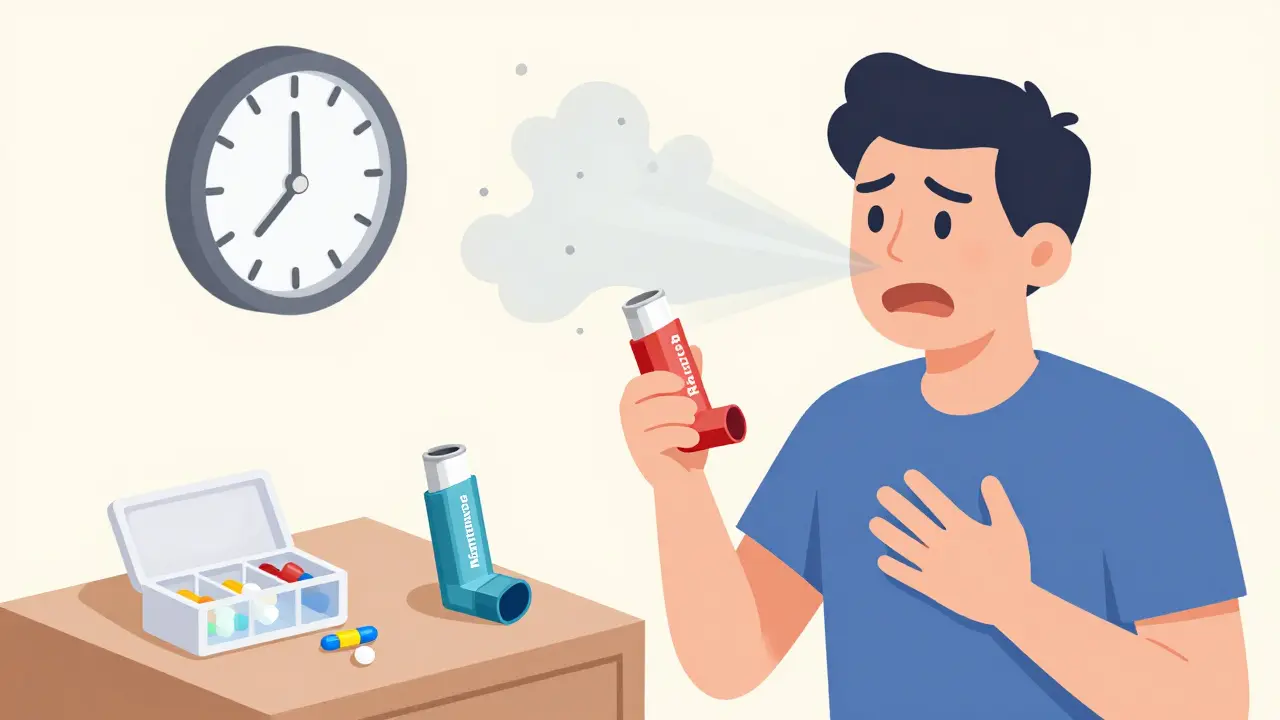
When you or someone you love struggles with asthma, the difference between a rescue inhaler and a maintenance inhaler isn’t just technical-it’s life or death. One gives you instant relief when you can’t breathe. The other keeps you from needing that relief in the first place. Yet, far too many people mix them up. In fact, rescue inhalers and maintenance inhalers aren’t interchangeable. They don’t work the same way. And using one when you should be using the other can turn a bad attack into a hospital trip.
What Rescue Inhalers Do-and What They Don’t
Rescue inhalers, also called quick-relief inhalers, are your emergency tool. They’re the first thing you grab when your chest tightens, your throat feels blocked, or you’re gasping for air. These devices contain short-acting beta agonists (SABAs), most commonly albuterol (sold as Ventolin, ProAir, or Proventil) or levalbuterol (Xopenex). They start working in as little as 1 to 5 minutes. Within 10 minutes, they can improve your peak airflow by up to 85%, according to data from the American Journal of Respiratory and Critical Care Medicine. That’s why they’re called rescue inhalers-they save you when you’re in trouble.But here’s the catch: rescue inhalers don’t fix the root problem. They don’t reduce inflammation. They don’t calm down the swelling in your airways. They simply relax the muscles around your breathing tubes so you can get air in. That’s why you can’t rely on them alone. If you’re using your rescue inhaler more than twice a week (not counting exercise), your asthma isn’t under control. That’s not normal. That’s a warning sign.
And if you’ve ever grabbed the wrong inhaler during an attack-like pulling out a Symbicort instead of a ProAir-you know how terrifying that delay feels. A case documented by Consumer Medsafety in 2023 involved a 9-year-old at summer camp who used his maintenance inhaler during an asthma attack. It took 12 minutes before he got real relief. That’s 12 minutes of worsening symptoms. That’s 12 minutes too long.
How Maintenance Inhalers Actually Work
Maintenance inhalers, also called controller inhalers, are the quiet heroes of asthma management. They don’t give you instant relief. In fact, you won’t feel any difference right away. But over time, they change the game. These inhalers contain inhaled corticosteroids (ICS) like fluticasone or budesonide, which fight inflammation deep in your lungs. Some also include long-acting beta agonists (LABAs) like formoterol or salmeterol, which keep airways open for 12 hours or more.Here’s the thing: it takes time. The anti-inflammatory effects of corticosteroids don’t kick in for 24 to 48 hours. It takes one to three weeks of daily use to reach full effectiveness. That’s why skipping doses is so dangerous. Missing just 20% of your scheduled doses-say, taking it 3 times a week instead of 5-cuts effectiveness by 45%, according to the UNC Adult Asthma Program. That’s like driving with the brakes half-on. You’re not going to crash today, but you’re not safe either.
Studies show that consistent use of maintenance inhalers reduces asthma exacerbations by 40% to 60% compared to placebo. That’s not a small win. That’s the difference between staying out of the ER and ending up there every few months. A 2022 Cochrane Review of over 15,000 people confirmed this. The more regularly you use your maintenance inhaler, the less you need your rescue inhaler.
The Dangerous Confusion Between the Two
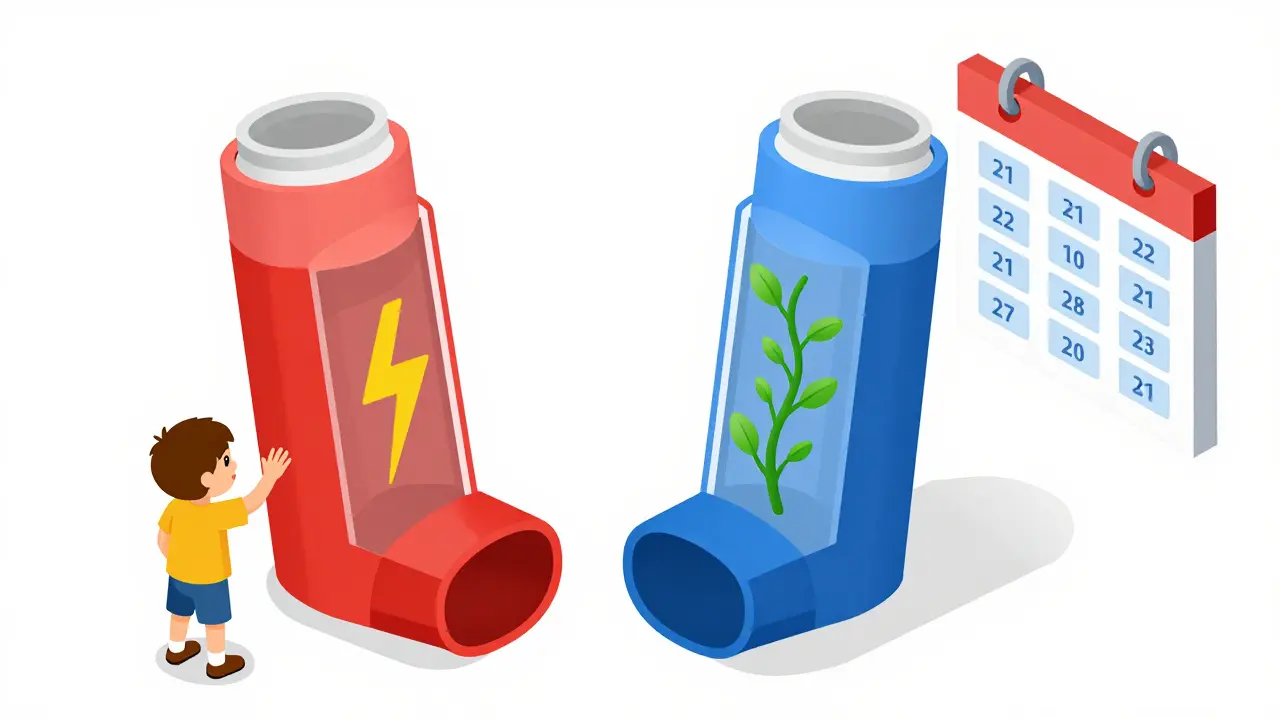
The biggest problem isn’t that people don’t know these inhalers exist. It’s that they look alike. Both are small, plastic, handheld devices. Many are colored red. Some even have the same shape and size. In 2022, the Institute for Safe Medication Practices reported 1,247 cases of patients grabbing the wrong inhaler. That’s why the FDA now requires new inhalers to use distinct colors: red for rescue, blue for maintenance. But older devices are still out there.And the consequences are real. Dr. Emily Mendez, Chief Medical Officer at Allergy & Asthma Centers of Texas, says confusing these inhalers is one of the top five preventable causes of asthma-related hospitalizations in children. A Reddit post from September 2024 by a user named WheezingWalter described using his Symbicort (a maintenance inhaler) like a rescue inhaler for three months. He didn’t realize he was masking symptoms instead of treating them. He ended up in the ER with uncontrolled asthma.
On the flip side, overusing rescue inhalers without maintenance therapy is just as risky. The American College of Allergy, Asthma & Immunology found that 38% of near-fatal asthma cases involved patients who relied only on rescue inhalers. They thought they were managing their condition-until they couldn’t breathe at all.
Modern Guidelines Are Changing
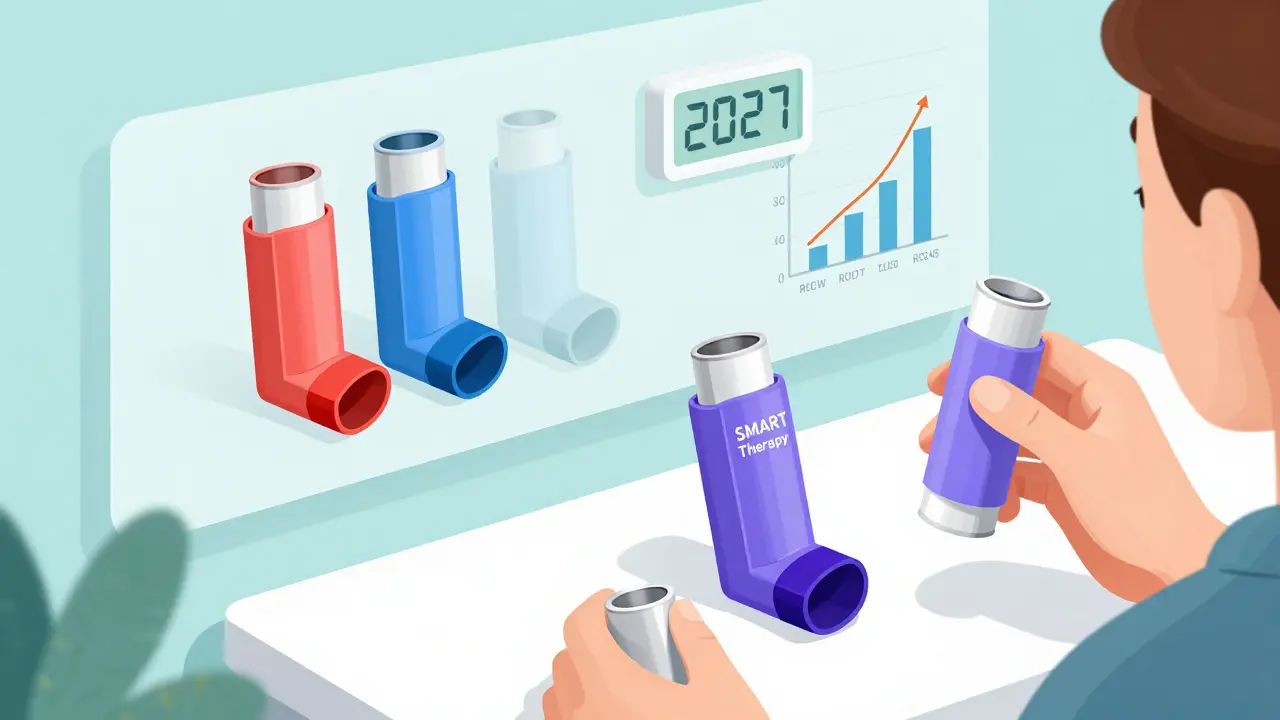
For years, the standard was two inhalers: one for daily control, one for emergencies. But guidelines are evolving. The Global Initiative for Asthma (GINA) updated its recommendations in 2023. For mild asthma, they now recommend using a single inhaler that contains both a corticosteroid and a fast-acting bronchodilator-like Symbicort-for both daily use and as-needed relief. This is called SMART therapy (Single Inhaler Maintenance and Reliever Therapy).Why? Because it simplifies things. One device. One routine. Less chance of confusion. Clinical trials show it works just as well, if not better, than the old two-inhaler system. The American Thoracic Society now supports this approach for many patients. By 2027, experts predict 60% of new asthma patients will start with a single-inhaler regimen.
But this doesn’t mean rescue inhalers are obsolete. They’re still essential for severe attacks. And for people with moderate to severe asthma, the traditional dual-inhaler system remains the gold standard. The key is matching the treatment to the person-not the other way around.
How to Use Them Right
Using these devices properly matters more than you think. If you don’t inhale correctly, you might get only 10% of the medicine. With proper technique, you can deliver 30-40% straight into your lungs.For rescue inhalers:
- Shake well.
- Breathe out fully.
- Place the mouthpiece in your mouth, seal your lips.
- Breathe in slowly and deeply for 5 to 7 seconds.
- Hold your breath for 10 seconds.
- Wait 30 seconds before taking a second puff if needed.
For maintenance inhalers, especially those with steroids:
- Rinse your mouth with water after each use. This prevents thrush, a fungal infection that can develop from leftover steroid residue.
- Take them at the same time every day. Set a phone alarm. Stick to it.
- Don’t stop because you feel fine. You’re not curing asthma-you’re preventing it.
Keep your inhalers stored below 30°C (86°F). Heat ruins the propellant. Check expiration dates. Rescue inhalers typically last 12 months after opening. Maintenance inhalers vary-some last 3 months, others up to 6. Always read the label.
What Your Usage Says About Your Asthma
Your rescue inhaler usage is a direct window into how well your asthma is controlled. The American Lung Association’s Asthma Action Plan says this: if you use your rescue inhaler more than twice a week, your asthma is not under control. That’s not a suggestion. That’s a signal to call your doctor.Here’s what real-world data shows:
- Patients who overused rescue inhalers (more than 12 uses per month) cut their usage from 18.7 to 4.3 uses per month after starting a daily maintenance routine.
- 92% of patients in one clinic saw symptom reduction when they stuck to their maintenance inhaler and limited rescue use.
And the cost? It’s not just medical. In the U.S., 42% of asthma patients skip maintenance doses because their copay is over $50 a month. That’s a huge barrier. Generic albuterol rescue inhalers cost $35-$50 without insurance. But Symbicort or Advair? They run $300-$350 monthly. That’s why many people choose the cheaper option-until they end up in the ER, where a single visit costs thousands.
What’s Next?
Researchers are working on faster-acting treatments. The NIH-funded PREPARE study is testing a new ultra-rapid corticosteroid inhaler that works in under 90 seconds. Results are expected in late 2025. If it works, it could blur the line between rescue and maintenance even further.But for now, the message is clear: if you have asthma, you need both tools. One for emergencies. One for prevention. And you need to know which is which. Color-coding helps. Labeling helps. Setting reminders helps. But the most important thing? Understanding the difference-and never treating a rescue inhaler like a cure.
Can I use my maintenance inhaler during an asthma attack?
No. Maintenance inhalers, like those containing fluticasone or budesonide, take days to weeks to work. They don’t open your airways quickly. Using one during an attack delays real relief and can make things worse. Always use your rescue inhaler (albuterol) for sudden symptoms.
Why do I need a maintenance inhaler if I only have symptoms once in a while?
Even infrequent symptoms mean your airways are inflamed. Rescue inhalers treat the symptom, not the cause. Without daily anti-inflammatory medication, your airways stay sensitive. Over time, attacks may become more frequent and severe. Maintenance inhalers prevent that progression.
Are combination inhalers like Symbicort better than using two separate inhalers?
For many people, yes. Symbicort and similar inhalers combine a corticosteroid and a fast-acting bronchodilator. They can be used daily for control and as needed for relief. This reduces confusion and improves adherence. GINA 2023 guidelines recommend them as first-line for mild to moderate asthma. But they’re not for everyone-your doctor will decide based on your severity and history.
How do I tell my rescue and maintenance inhalers apart?
Look at the color: red usually means rescue (albuterol). Blue usually means maintenance (steroid). But don’t rely on color alone. Check the label: "SABA" or "short-acting" means rescue. "ICS" or "controller" means maintenance. If you’re unsure, ask your pharmacist. Write it on the inhaler with a marker.
What if I can’t afford my maintenance inhaler?
Talk to your doctor. Generic options exist. Some manufacturers offer patient assistance programs. In the U.S., Teva’s generic albuterol costs under $50. For maintenance, ask about mail-order pharmacies or 90-day supplies, which often lower costs. Skipping doses because of price increases your risk of ER visits-those cost far more.
Can children use the same inhalers as adults?
Yes, but dosing and devices differ. Children often need spacers with inhalers to ensure proper delivery. Rescue inhalers like albuterol are safe for kids. Maintenance inhalers are prescribed based on severity, not age. Always use child-appropriate devices and follow your pediatrician’s instructions.


