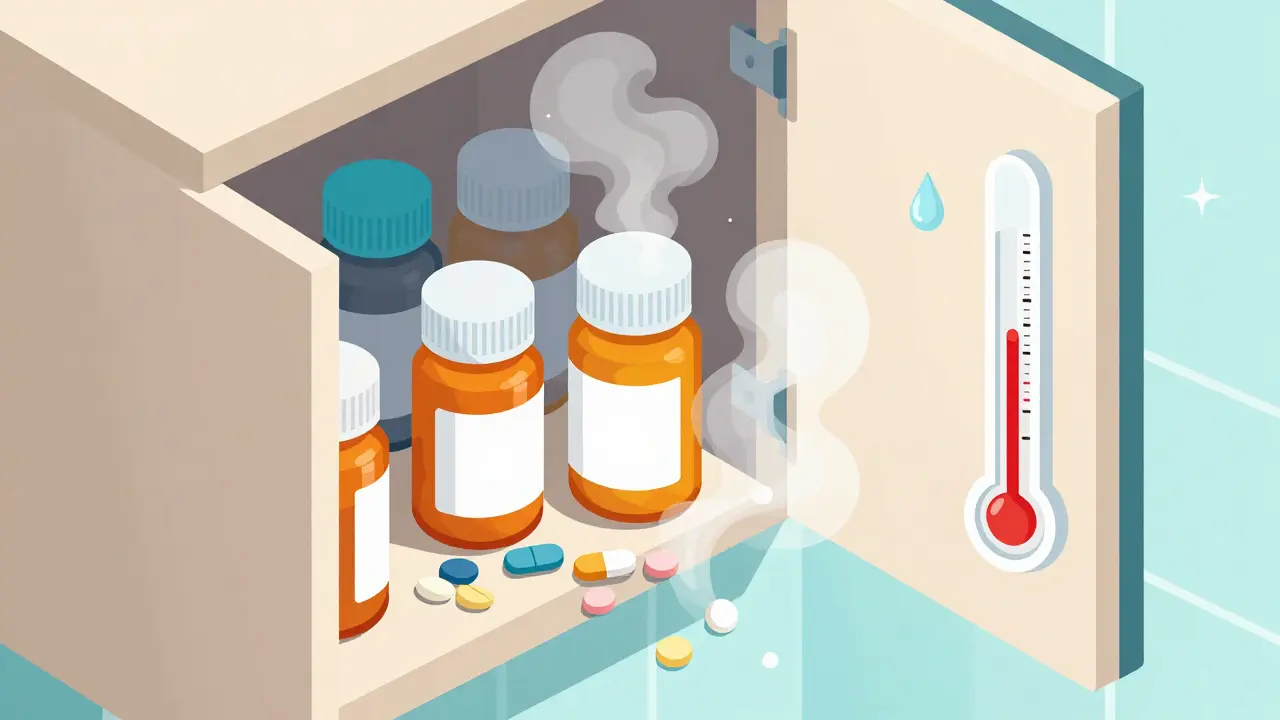
Have you ever opened a bottle of pills only to find they’ve turned into chalky dust or smell like vinegar? It’s frustrating, wasteful, and potentially dangerous. You might assume the expiration date printed on the box is an immutable law of nature, but in many cases, it’s not the calendar that ruins your medicine-it’s where you keep it. Improper storage conditions can degrade drugs long before their official expiry, rendering them ineffective or even harmful.
The stakes are high. In the United States alone, roughly $20 billion worth of medication is wasted annually due to premature expiration (American Pharmacists Association, 2023). Much of this waste stems from simple environmental errors: humidity in the bathroom, heat near the stove, or light exposure on a windowsill. Understanding how to store medications correctly isn’t just about saving money; it’s about ensuring that when you need that dose of antibiotics or heart medication, it actually works.
The Science Behind Expiration Dates
To understand why storage matters, we first need to look at what an expiration date actually means. Established by the U.S. Food and Drug Administration (FDA) in 1979, these dates represent the final day a manufacturer guarantees the drug retains 90-110% of its labeled potency, provided it has been stored under specific, controlled conditions. These conditions are defined through rigorous stability testing required by the Federal Food, Drug, and Cosmetic Act.
Think of the expiration date as a promise, not a cliff edge. If you store a medication perfectly according to the label instructions, it will remain effective until that date. However, if you expose it to heat, moisture, or light, the chemical bonds holding the drug together break down faster. This process, known as hydrolysis or oxidation, accelerates degradation. For example, aspirin breaks down into acetic acid (vinegar) and salicylic acid when exposed to humidity. That sharp vinegar smell in an old aspirin bottle is a clear sign the drug has chemically changed and lost its efficacy.
While some studies, such as the FDA’s Shelf Life Extension Program for military stockpiles, have shown that many drugs remain potent years past their expiration date, experts caution against relying on this for household use. Dr. Richard Klasco of Yale School of Medicine notes that those results apply to drugs stored in perfect, climate-controlled environments-not typical home settings. In a regular house, temperature and humidity fluctuate wildly, making proper storage the single most important factor in preserving drug stability.
Where Not to Store Your Medicines
Most people instinctively reach for the bathroom cabinet or the kitchen counter when organizing their medicines. Unfortunately, these are often the worst places to keep them. The Centers for Disease Control and Prevention (CDC) reports that improper storage accounts for 37% of premature medication expiration cases in households, with humidity being the primary culprit in 68% of those incidents.
- The Bathroom: Showers create steam spikes that can push relative humidity up to 85-95%. This moisture penetrates pill bottles and blister packs, accelerating the breakdown of tablets and capsules. A 2023 study by UCHealth found that bathroom storage increases aspirin’s hydrolysis rate by 300%.
- The Kitchen Counter or Near the Stove: Cooking generates significant heat. Temperatures near stoves can fluctuate by more than 15°C within 30 minutes. Research from Swedish Medical Center indicates that such fluctuations can degrade 42% of common antibiotics within just 90 days.
- The Car: Vehicles act like greenhouses. On a sunny July day in Bristol or anywhere else, the interior temperature of a parked car can soar well above 40°C (104°F), melting chocolates and destroying the molecular structure of many pharmaceuticals, especially insulin and liquid suspensions.
- Windowsills: Direct sunlight contains UV rays that break down active ingredients. Even through glass, enough UV light penetrates to cause photodegradation in sensitive medications.
Optimal Storage Conditions for Different Forms
Not all medications are created equal. The physical form of the drug dictates its sensitivity to environmental factors. Following the guidelines set by the United States Pharmacopeia General Chapter <1151>, here is how to handle different types of medications.
| Medication Form | Temperature Range | Humidity Limit | Key Protection Needs |
|---|---|---|---|
| Solid Dosage (Tablets/Capsules) | 20-25°C (68-77°F) | Below 60% | Keep in original container; protect from light |
| Liquid Medications (Refrigerated) | 2-8°C (36-46°F) | N/A (Sealed) | Center of fridge; avoid door shelves |
| Insulin (Unopened) | 2-8°C (36-46°F) | N/A | Continuous refrigeration until first use |
| Insulin (In Use) | Room Temp (<30°C) | N/A | Use within 28 days; no freezing |
| Nitroglycerin Tablets | Room Temp | Low Humidity | Original dark glass bottle; never plastic |
For solid dosage forms like tablets and capsules, a cool, dry place is ideal. The goal is to maintain a stable temperature between 20-25°C and keep relative humidity below 60%. Liquid medications require more precision. If a label says "refrigerate," it means keeping the drug between 2-8°C. Crucially, you should store these in the center of the refrigerator, not in the door. The door experiences the most temperature fluctuation every time you open it, which can compromise the drug’s stability.
Special attention is needed for biologics and sensitive compounds. Insulin, for instance, must be refrigerated until you start using it. Once opened, it can stay at room temperature for up to 28 days, but it must never be frozen. Nitroglycerin sublingual tablets are notoriously unstable. They must remain in their original amber-colored glass container, which blocks 97% of UV light. Transferring them to a plastic pillbox exposes them to air and light, causing them to lose potency rapidly.
Practical Tips for Home Organization
Knowing the science is one thing; implementing it in a busy household is another. Here are practical strategies to ensure your medications last as long as intended.
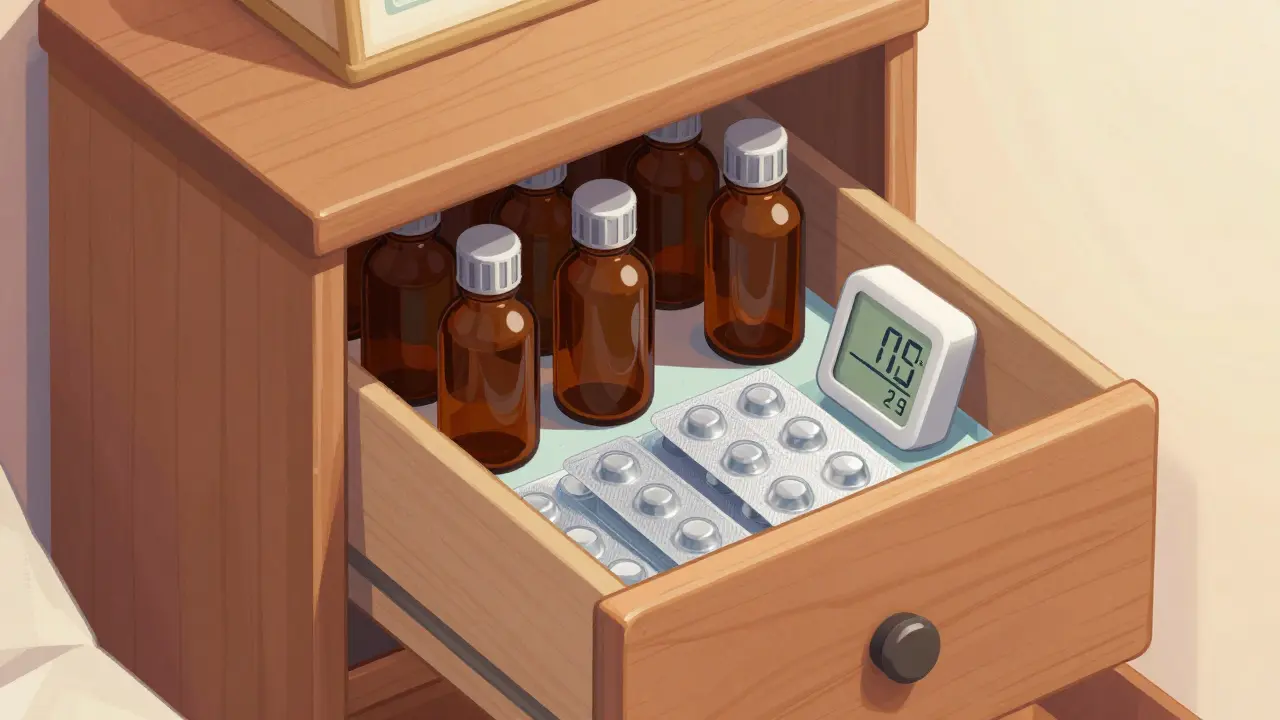
- Centralize Your Storage: Choose one location in your home that is consistently cool and dry. A locked cabinet in a bedroom or hallway, away from exterior walls and plumbing pipes, is often better than a bathroom cabinet. Studies show that storing meds in dresser drawers reduces humidity exposure by 45% compared to bathroom vanities.
- Keep Original Packaging: Never transfer pills to generic containers unless necessary for portability. The original prescription bottle provides critical protection. Amber bottles block UV light, and child-resistant caps seal out moisture. The label also contains vital storage instructions specific to that formulation.
- Monitor the Environment: Consider placing a small hygrometer (humidity gauge) in your medicine cabinet. If humidity regularly exceeds 60%, add silica gel packets (the little bags found in shoe boxes) to absorb excess moisture. Just ensure pets and children cannot access them.
- Implement a Color-Coding System: The Research Animal Resources Center at the University of Wisconsin-Madison developed a system using colored dot stickers to track expiration. Red dots for the current year, blue for next year, and green for two years out. This visual cue helps prioritize usage and prevents older stock from getting buried and forgotten.
- Assign a Monthly Check: Designate one person in the household to review all medications once a month. Look for changes in color, texture, or odor. Aspirin should not smell like vinegar. Tablets should not be cracked or discolored. Liquids should be clear, without particles or cloudiness.
Recognizing Degradation and Safe Disposal
Even with perfect storage, medications eventually expire. Recognizing signs of degradation is crucial for safety. Beyond the expiration date, look for physical changes. Tablet discoloration exceeding 15% from the original hue, crumbling textures, or separation in liquid suspensions that doesn’t mix back together are red flags. For eye drops and other liquids, contamination is a major risk. The American Society of Health-System Pharmacists warns that expired eye drops can harbor bacteria like Pseudomonas aeruginosa, leading to serious infections.
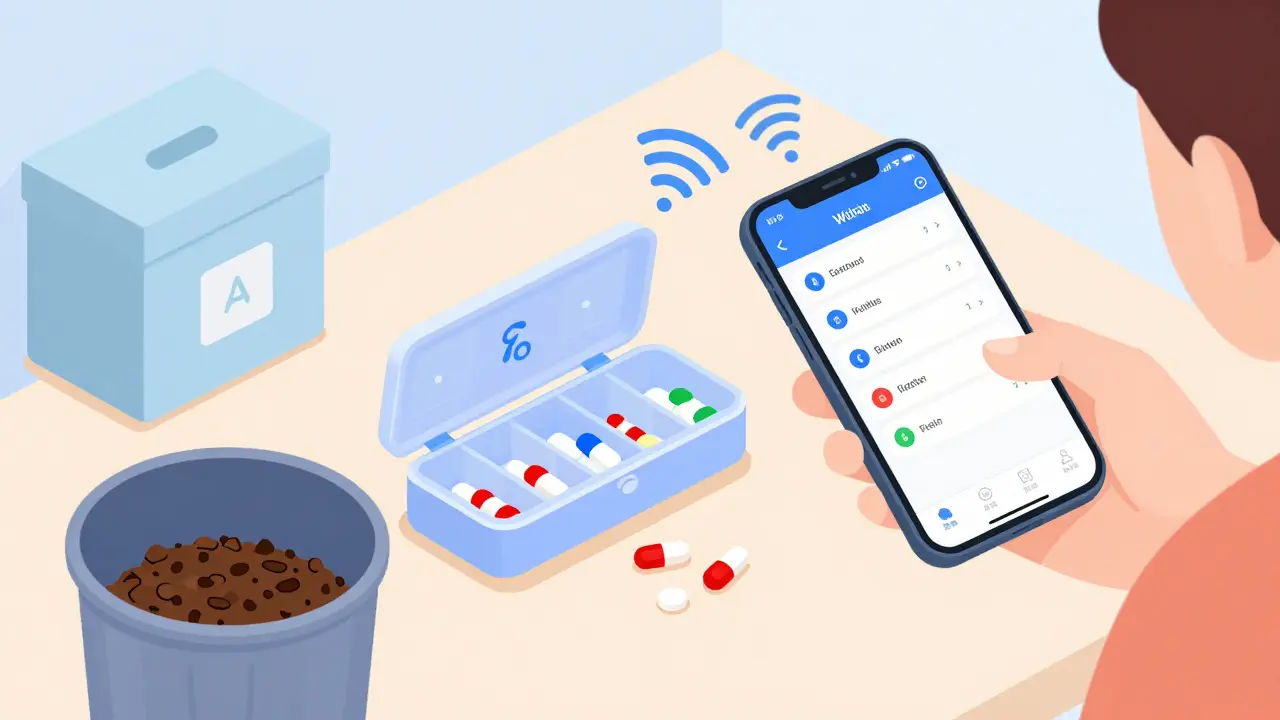
When it’s time to toss old meds, do not flush them unless the label explicitly instructs you to do so (usually for highly addictive opioids to prevent misuse). Flushing contaminates water supplies. Instead, utilize take-back programs. The DEA’s National Prescription Drug Take Back Day events provide secure collection sites. In the UK, pharmacies often offer disposal services. If neither is available, mix the medications with an unappealing substance like used coffee grounds or cat litter, seal them in a plastic bag, and throw them in the trash. Remove or scratch out personal information from the labels before disposing of the containers.
The Future of Medication Stability
The pharmaceutical industry is aware of these challenges. New technologies are emerging to help patients. Smart pillboxes with built-in sensors now monitor temperature and humidity, alerting users via apps if conditions become unsafe. Pharmaceutical companies are also developing more stable formulations. For example, Merck recently approved a heat-stable insulin variant that maintains potency at 30°C for over 50 days, reducing the burden of strict refrigeration for travelers.
Regulatory bodies are also evolving. The FDA has proposed rules requiring real-time stability indicators on high-risk medications, similar to the time-temperature indicators used in food shipping. While widespread adoption may take time, understanding current best practices empowers you to protect your health and your wallet right now.
Can I store my medication in the freezer?
Generally, no. Freezing can damage the chemical structure of many medications, particularly liquids and biologics like insulin. Unless the label specifically says "freeze," keep medications in the refrigerator or at room temperature. Freezing causes ice crystals to form, which can break down proteins and emulsions.
Is it safe to take medication slightly past its expiration date?
It depends on the drug and storage conditions. For non-critical medications stored properly, potency may decline gradually. However, for life-saving drugs like nitroglycerin, epinephrine auto-injectors, or antibiotics, efficacy is critical. Using degraded versions can lead to treatment failure. When in doubt, replace it.
Why shouldn't I put pills in weekly pill organizers?
Pill organizers expose medications to air, light, and humidity every time you open them. They lack the protective seal of the original bottle. Use them only for short-term daily doses. For long-term storage, keep bulk supplies in their original packaging.
How does humidity affect tablet medications?
Humidity causes hydrolysis, a chemical reaction where water molecules break down the active ingredient. This can turn tablets soft, crumbly, or discolored. It significantly reduces potency and can create harmful byproducts. Keeping humidity below 60% is essential for solid dosage forms.
What is the best way to dispose of unused prescription drugs?
The safest method is using a designated take-back program or drop-off site at a pharmacy or police station. If unavailable, mix the drugs with dirt, cat litter, or used coffee grounds, place the mixture in a sealed plastic bag, and discard it in your household trash. Remove personal info from labels first.