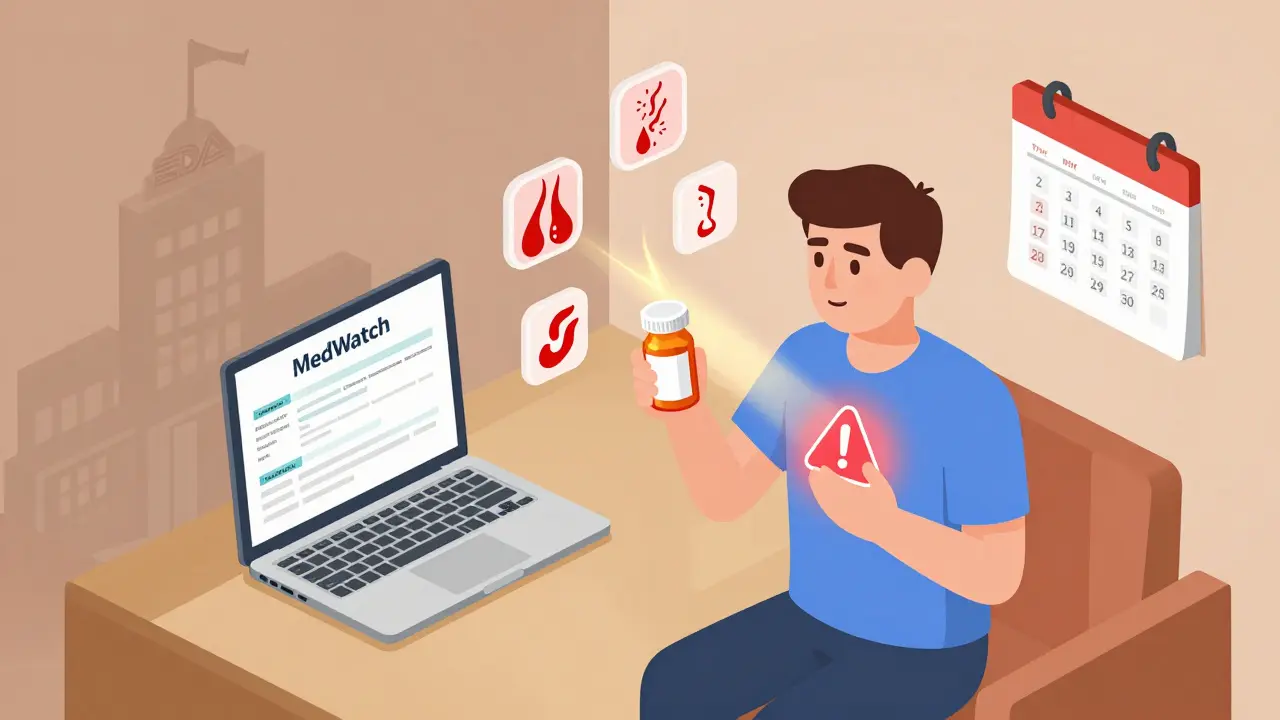
Every year, millions of people take prescription drugs safely. But for some, a medication causes an unexpected and sometimes serious reaction. When that happens, reporting it to the FDA isn’t just a good idea-it’s a critical part of keeping everyone safer. The adverse event reporting system doesn’t just collect complaints. It’s the early warning system that helps the FDA spot dangerous patterns, update warning labels, or even pull dangerous drugs off the market. If you’ve had a bad reaction to a medication, you’re not just speaking up for yourself-you’re helping protect others.
What Counts as an Adverse Event?
An adverse event is any harmful or unwanted experience that happens after taking a medication. It doesn’t have to be proven to be caused by the drug. If you took a pill and then got a rash, had trouble breathing, felt dizzy, or noticed something unusual like sudden memory loss or unexplained bruising, that’s worth reporting-even if your doctor says it’s "probably not related." The FDA defines it broadly: side effects, overdoses (accidental or intentional), drug interactions, lack of effectiveness, and even withdrawal symptoms after stopping a drug. The key is that it’s unexpected. If your medication’s label says "headache is a possible side effect," and you get one, that’s not usually reportable unless it’s severe. But if you get a rare reaction like liver failure or a life-threatening skin condition like Stevens-Johnson syndrome-that’s definitely reportable.Who Can Report?
Anyone can report an adverse event to the FDA. You don’t need to be a doctor, pharmacist, or even a U.S. citizen. Patients, family members, caregivers, nurses, pharmacists, and even foreign users can submit reports. But there are two main groups with different rules:- Healthcare professionals: Doctors, nurses, pharmacists, and other licensed providers are encouraged to report, and in some cases required by law-especially for vaccines under the National Childhood Vaccine Injury Act.
- Pharmaceutical companies: Manufacturers are legally required to report serious and unexpected adverse events within 15 days. They use specialized systems, not the public form.
- Consumers: You don’t need permission to report. Your report matters just as much as a doctor’s.
Even if you’re unsure whether the drug caused the problem, report it anyway. The FDA doesn’t assume causation-they look for patterns. One report might seem small. But if 50 other people report the same reaction within a few months? That’s a signal.
How to Report as a Patient or Family Member
Reporting as a consumer is simple, but doing it right makes your report far more useful. Here’s how:- Collect the facts. Gather the following before you start:
- The exact name of the medication (brand and generic, if known)
- The dosage and how long you took it
- When you started and stopped taking it
- When the reaction started and how long it lasted
- A clear description of what happened (e.g., "swelling of face and throat, difficulty breathing within 20 minutes of taking pill")
- Your age and gender
- Any relevant medical history (e.g., "I have asthma and kidney disease")
- Any lab results, hospital records, or photos of the reaction (like a rash)
- Go to the MedWatch website. Visit www.fda.gov/medwatch and click "Report a Problem." You’ll see Form 3500.
- Fill out the form. The online form lets you save your progress for up to three days if you need to step away. Use the "Detailed Description" box to explain what happened in your own words. Don’t hold back-include timing, severity, and how it affected your daily life.
- Upload supporting documents. You can attach photos of your prescription label, the pill bottle, or even pictures of a rash. This helps reviewers understand exactly what you were taking and what you experienced.
- Submit. You’ll get a confirmation email with a Report ID. Keep it. If the FDA needs more info, they’ll contact you using that number.
Pro tip: If you’re unsure about what to write, talk to your doctor first. They can help you describe the event accurately and may even submit the report for you using their professional account. Reports from healthcare providers include clinical context that makes them 73% more likely to trigger a safety review, according to FDA internal data.

What Happens After You Submit?
Your report goes into the FDA Adverse Event Reporting System (FAERS), a database with over 30 million entries dating back to 1968. It’s not a hotline-it’s a data mine. Every report is anonymized and added to the pool. Trained reviewers and automated systems scan for patterns. If a certain drug suddenly shows up with dozens of reports about liver damage, the FDA may launch a deeper investigation.You won’t get a personal response every time. But if your report is part of a larger trend-or if it’s especially detailed-the FDA may contact you for more information. One consumer in 2022 reported anaphylaxis after penicillin. The FDA reached out within 10 business days asking for lab results. That extra data helped confirm a rare but dangerous pattern.
Keep in mind: the system doesn’t prove cause. It finds signals. That’s why it’s so powerful. In 2018, FAERS flagged a link between fluoroquinolone antibiotics and aortic aneurysms. That led to new "Black Box" warnings-the strongest warning the FDA can issue.
What Not to Do
Many people make mistakes that reduce the value of their report:- Don’t wait. The sooner you report, the better. If you wait months, you might forget key details.
- Don’t assume it’s "not serious enough". Even if you recovered, others might not. A reaction that was mild for you could be deadly for someone else.
- Don’t skip the timeline. Saying "I took the drug and got sick" isn’t enough. Saying "I took 500mg of drug X on Jan 3 at 8 AM. Within 45 minutes, I broke out in hives and my throat swelled" is gold.
- Don’t use vague terms. Avoid "felt weird" or "not right." Use medical terms if you can: "dizziness," "tachycardia," "hypotension." If you don’t know the words, describe what happened physically.
The system has a 3,000-character limit for descriptions. That’s about 500 words. Use every bit of space. Be specific. Include symptoms, duration, treatment received, and outcome.
Why Reporting Matters-Even If You Think It’s Minor
The FDA estimates that only 1% to 10% of adverse events are ever reported. That means for every serious reaction you hear about, hundreds may have gone unreported. That gap hides real risks.Consider this: in 2022, over 2 million reports came into FAERS. Of those, about 400,000 came from consumers like you. That’s not a drop in the bucket-it’s the foundation of drug safety. A single report from a patient in rural Iowa helped uncover a contamination issue in a popular blood pressure medication. That led to a nationwide recall.
And it’s not just about drugs. The same system tracks vaccines, dietary supplements, and even medical devices. If you had a bad reaction to a supplement labeled "natural" or a device like a glucose monitor, report it. The FDA doesn’t assume safety just because something is sold over the counter.
Challenges and Real-World Hurdles
The system isn’t perfect. Many people report technical problems:- The MedWatch website times out during submission. Save your work often.
- Some users say the form is confusing or doesn’t let them describe complex reactions fully.
- There’s no real-time confirmation-just an email after submission.
- It can take months for the FDA to review a report and act on it.
And here’s the hard truth: the FDA is understaffed. As of 2023, each safety reviewer handles about 18,000 reports. That means your report might sit for over seven months before anyone looks at it closely.
That’s why your detail matters. Reports with lab results, exact timing, and clear descriptions are 68-82% more likely to be flagged for investigation. Be thorough. Be precise. Your effort directly increases the chance your report makes a difference.
What’s Changing in 2025?
The FDA is upgrading its systems. In 2024, they started using AI to scan reports for patterns-training algorithms on 10 million past reports to spot red flags faster. They’re also working to connect FAERS with electronic health records. If your doctor’s system automatically sends a report when you’re hospitalized for a suspected drug reaction, that could increase reporting rates by 300%.There’s also a push to make reporting easier on mobile phones. The FDA’s 2022 Patient-Focused Drug Development initiative already led to a 22% rise in consumer submissions after they redesigned the form for smartphones.
But the biggest change? More people are speaking up. And that’s what keeps the system alive.
Final Thoughts: Your Voice Saves Lives
You don’t need to be a scientist or a doctor to help protect public health. You just need to notice something wrong-and speak up. Reporting an adverse event takes 15 minutes. But it can lead to warnings, recalls, or even new safety guidelines that prevent someone else from ending up in the hospital.Don’t wait for someone else to report it. Don’t assume it’s "not a big deal." If you had a bad reaction, you’re not alone-and your report matters more than you know.
Visit www.fda.gov/medwatch today. Your next report could be the one that saves a life.


