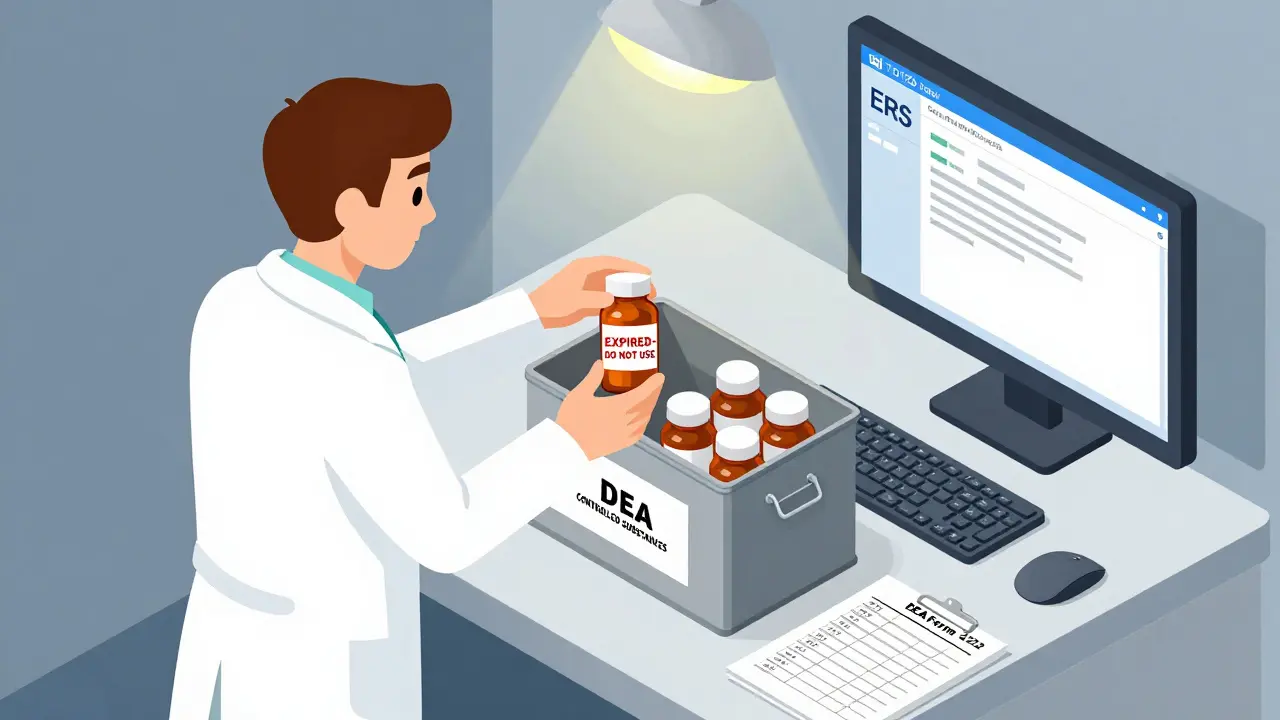
Handling expired controlled substances isn’t just about cleaning out a cabinet-it’s a legal, safety-critical process. If you’re a pharmacist, doctor, vet, or even a research lab manager, getting this wrong can lead to fines, legal trouble, or worse: drugs ending up in the wrong hands. The DEA doesn’t take this lightly. In 2022 alone, they issued over 300 warning letters and collected $2.47 million in fines for improper disposal. This isn’t theoretical. People have died from accidental overdoses using pills pulled from home trash bins or flushed down toilets. So if you’ve got expired oxycodone, fentanyl patches, or even leftover hydrocodone, here’s exactly how to handle them-no guesswork, no shortcuts.
Understand the DEA’s Rules-There’s No Room for Error
The Controlled Substances Act (CSA) of 1970 created the framework, but the real rules you need to follow come from 21 CFR Part 1317, updated in 2014 after the Secure and Responsible Drug Disposal Act. This law made it clear: expired or unwanted controlled substances can’t be thrown in the trash, flushed, or dumped down the sink. The DEA classifies these drugs into five schedules based on abuse potential. Schedule II drugs-like oxycodone, fentanyl, and methadone-are the most tightly controlled. Schedule III to V include things like codeine cough syrup or low-dose benzodiazepines. Each has different disposal rules.Here’s the hard truth: incineration is the only method the DEA officially approves to make controlled substances non-retrievable. That means crushing them into powder, mixing with coffee grounds, or using blue disposal pads? Not allowed. Even if you see those methods recommended for regular painkillers like ibuprofen, they’re illegal for narcotics. The DEA says it plainly: if there’s a recoverable amount, it must be destroyed by heat. No exceptions.
Know the Difference: Inventory vs. Wastage
Not all expired drugs are treated the same. The DEA distinguishes between two types of disposal: inventory disposal and wastage.Inventory disposal applies when you’re getting rid of entire bottles, vials, or stock you no longer need-like a box of expired morphine tablets sitting in your pharmacy’s back room. This requires a reverse distributor. These are licensed companies that pick up your drugs, document everything, and incinerate them under DEA supervision. You’ll need to complete DEA Form 222 for Schedule II substances (now electronic through the ERS system since January 2023), and you’ll pay anywhere from $250 to $500 per pickup, depending on volume and location.
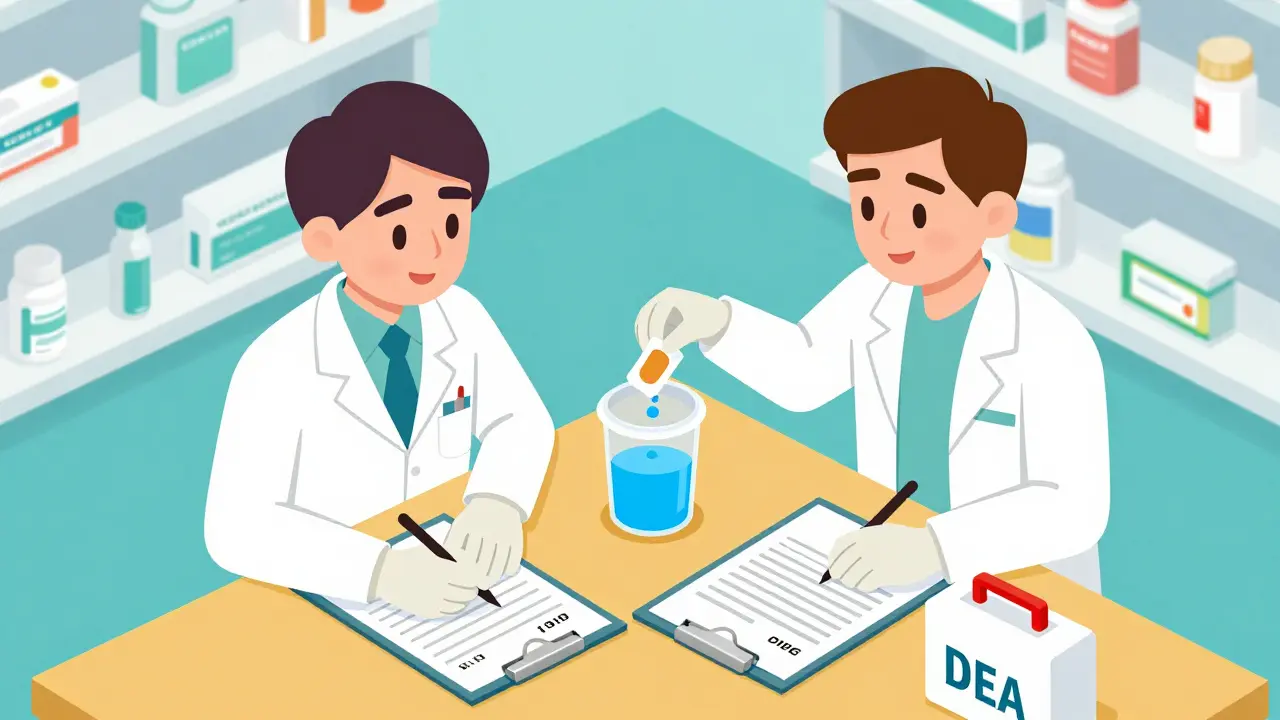
Wastage is the small amount left in a syringe after giving a dose, or a single tablet you accidentally dropped. For these, you don’t need a reverse distributor. But you do need two authorized people present. One must be the person who ordered the drug (or their designated agent). Both witness the disposal, sign a log, and record the date, drug name, quantity, and method. This log must be kept for at least two years. No witnesses? That’s a violation-even if you only got rid of one pill.
Step-by-Step: What to Do When You Find Expired Controlled Substances
If you’re holding expired controlled substances, follow this exact process:
- Label everything. Use clear, bold labels: “EXPIRED - DO NOT USE” or “TO BE DISPOSED.” Don’t rely on memory. Put these in a locked, separate container away from active inventory.
- Identify the schedule. Check the DEA schedule for each drug. Schedule II? You’re going to a reverse distributor. Schedule III-V? You might qualify for in-house wastage if it’s small amounts.
- For inventory: Contact a reverse distributor. Use the DEA’s online locator tool (updated November 2022) to find a licensed provider near you. Major companies include Stericycle, Daniels Health, and Drug and Laboratory Disposal, Inc. (DLD). Schedule the pickup. Don’t wait-average wait times are 14.7 business days, according to University of Michigan’s 2023 survey.
- For wastage: Get two witnesses. Both must be DEA-registered individuals. One of them must be the person responsible for the drug’s order. Watch as the substance is destroyed (usually by pouring into a sharps container with a DEA-approved neutralizing agent). Sign and date the disposal log immediately.
- Document everything. Record the drug name, DEA schedule, quantity, date, method, and names of witnesses. Store this log securely for two years. Many institutions use digital systems like UCSF’s RIO platform to avoid paper errors-paper logs have an 18.7% error rate, per a 2022 DEA audit.
What Happens If You Don’t Follow the Rules?
Ignoring these steps isn’t just sloppy-it’s dangerous and illegal. The DEA conducted 1,847 disposal inspections in 2022. Over 300 facilities got warning letters. Some lost their DEA registration. Others paid fines up to $50,000 per violation. But the real cost isn’t just financial.
Improper disposal contributes to drug diversion. In 2022, 14.3% of veterinary drug diversion cases traced back to improper disposal, according to the American Veterinary Medical Association. That means a dog’s leftover painkiller ended up in a teenager’s medicine cabinet. That’s not a hypothetical. It’s happened. And it’s preventable.
Smaller practices-especially vet clinics with fewer than five staff-are the most at risk. Only 41.7% of them comply with proper disposal, per the American Animal Hospital Association’s 2022 survey. Many think, “It’s just one pill,” or “We’ll throw it in the trash.” They’re wrong. The DEA doesn’t care how small the amount is. If it’s a controlled substance, the rules apply.
Training and Accountability Are Non-Negotiable
Every person who handles controlled substances must be trained. The DEA requires a 2-hour initial training and a 1-hour refresher every year. But here’s the problem: only 67.3% of facilities met this requirement in a 2022 audit. That’s not just negligence-it’s a liability. If someone gets hurt because an expired opioid was improperly disposed of, you can be held responsible.
At institutions like UCSF, the EHS director makes it clear: “It is the responsibility of each person that orders and receives Controlled Substances to notify EH&S about waste.” That means no one can say, “I didn’t know.” Training isn’t a box to check. It’s your shield.
What’s Changing Soon? Prepare for 2025
The rules are tightening. By 2025, the DEA will roll out the Electronic Inventory Management System (EIMS). This will require real-time reporting of every disposal-no more waiting weeks to submit paperwork. You’ll need to log each waste event within 24 hours. If you’re still using paper logs, you’re already behind.
Meanwhile, reverse distributor fees are rising 6.8% per year. The global market for pharmaceutical waste management is now worth $14.7 billion, with controlled substance disposal making up nearly $1.8 billion of that. That’s because regulators are cracking down harder. The DEA’s 2023 Strategic Plan makes it clear: compliance isn’t optional. It’s the new baseline.
Common Mistakes (And How to Avoid Them)
- Mistake: Mixing expired narcotics with kitty litter or coffee grounds. Fix: Only use this for non-controlled medications. Controlled substances must be incinerated.
- Mistake: Waiting until you have a full box before disposing. Fix: Dispose immediately after expiration. Don’t let expired drugs sit in your storage.
- Mistake: One person disposing alone. Fix: Always have two authorized personnel present for wastage. No exceptions.
- Mistake: Assuming a pharmacy will take your expired drugs. Fix: Most pharmacies only accept non-controlled medications. For narcotics, you need a reverse distributor.
- Mistake: Not keeping records. Fix: Two years is the minimum. If you’re audited and can’t produce logs, you’re in trouble.
What About Home Disposal?
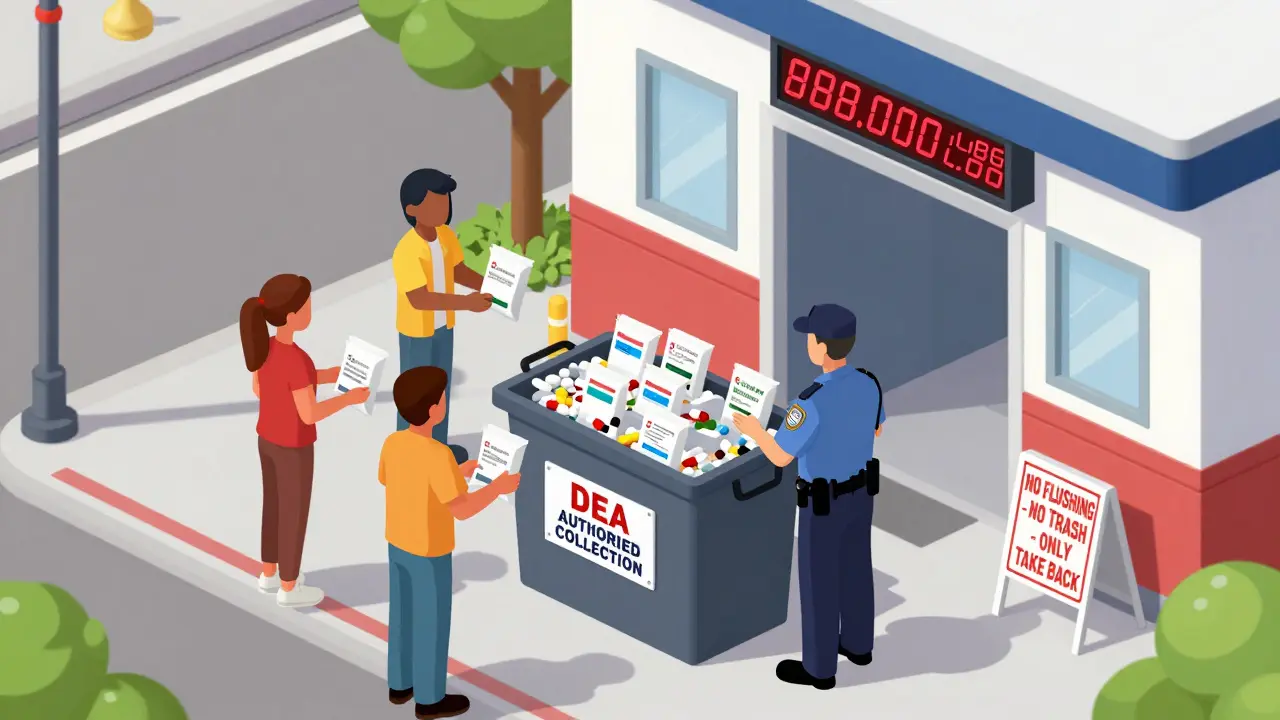
If you’re a patient with expired narcotics at home, the safest option is a DEA-authorized collection site. These are often located at pharmacies, hospitals, or police stations. The DEA’s National Take Back Day collects hundreds of thousands of pounds of unused drugs each year. In October 2023 alone, over 888,000 pounds were collected. Check the DEA website for a drop-off location near you.
Never flush, burn, or throw narcotics in the trash-even if you think they’re expired. If you can’t get to a collection site, call your pharmacy or local health department. They’ll tell you how to safely store them until you can drop them off.
Can I flush expired opioids down the toilet?
No. Flushing is strictly prohibited for all controlled substances, including opioids like oxycodone or fentanyl. The FDA’s 2023 guidelines explicitly state that flushing is never recommended for these drugs. Even if you’ve heard otherwise, it’s illegal and environmentally harmful. Always use a reverse distributor or take-back program.
What if I’m a small veterinary clinic with only a few expired pills?
Even small amounts require proper disposal. For Schedule II substances, you still need a reverse distributor. For Schedule III-V, you can dispose of small wastage in-house with two authorized staff members present. Document every instance, no matter how small. Many vets use the DEA’s online locator tool to find nearby reverse distributors. Don’t assume “it’s just one pill”-diversion risks are real.
Do I need to keep disposal records if I use a reverse distributor?
Yes. Even if a reverse distributor handles the destruction, you must maintain your own records for at least two years. This includes the date of transfer, the quantity disposed, the name of the distributor, and your signed documentation. The DEA can audit you at any time. Your records prove you followed the law.
Can I just throw expired controlled substances in the regular trash?
No. Throwing controlled substances in the trash is a violation of DEA regulations. These drugs can be retrieved from landfills and pose serious public safety risks. The DEA requires all such substances to be rendered non-retrievable-typically through incineration. Only reverse distributors or approved in-house wastage procedures meet this standard.
How often do I need to train staff on controlled substance disposal?
Initial training must be two hours, and you must provide a one-hour refresher every year. Failure to do so is a compliance violation. Many facilities miss this requirement-DEA audits in 2022 showed only 67.3% of clinics were up to date. Don’t be one of them. Training protects your license, your team, and your patients.
Final Takeaway: Compliance Is Protection
Disposing of expired controlled substances isn’t about bureaucracy-it’s about preventing harm. Every pill you handle correctly is one less chance someone overdoses. Every log you keep is one less reason you’ll face a DEA audit. Every trained employee is one more layer of safety.
Don’t wait for an inspection to force your hand. Start today. Label your expired drugs. Train your team. Find your reverse distributor. Keep your records. The system is strict, but it’s there to protect you-and everyone else.


