To understand how we get cheap, reliable generics today, we have to look at how this law evolved from a basic safety shield into a sophisticated engine for market competition. It wasn't just about paperwork; it was about preventing tragedies and eventually breaking the monopoly of brand-name drugs.
The Tragic Roots of the FD&C Act
The FD&C Act didn't appear out of thin air. It was born from a disaster. In 1937, a company released an elixir sulfanilamide that used diethylene glycol-essentially antifreeze-as a solvent. Over 100 people died. Back then, companies didn't have to prove a drug was safe before selling it. The Federal Food, Drug, and Cosmetic Act was signed into law on June 25, 1938, by President Franklin D. Roosevelt to ensure that such a tragedy never happened again. It gave the Food and Drug Administration (FDA) the power to oversee the safety of food, drugs, and cosmetics.
While the 1938 law focused on safety, it didn't actually require drugs to be effective. That didn't change until the 1962 Kefauver-Harris Amendments. This added a second layer of protection: drugs now had to be both safe and effective. This created a gold standard for a New Drug Application (NDA), but it also created a massive wall for generic manufacturers. Because they had to submit a full NDA with all the clinical data, the cost was simply too high. Generic drugs were a tiny fraction of the market because no one could afford the entry fee.
The Game Changer: Hatch-Waxman Amendments
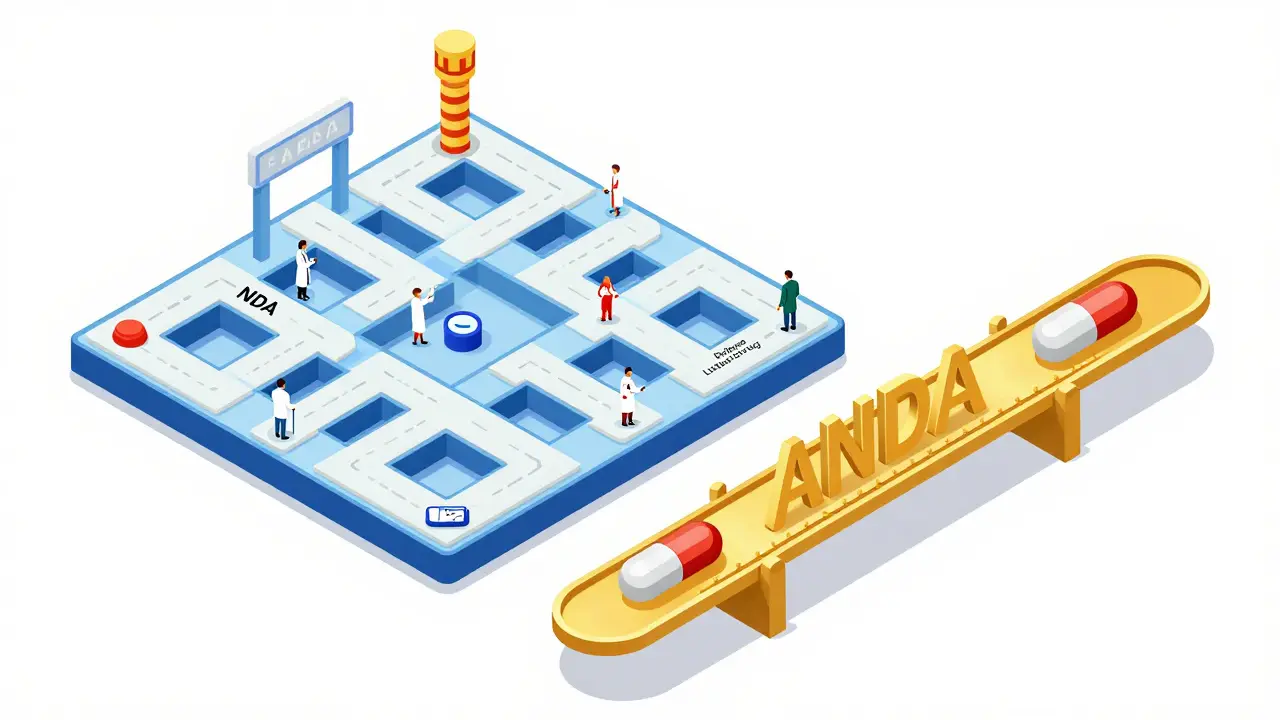
Everything changed in 1984 with the Drug Price Competition and Patent Term Restoration Act, which most people know as the Hatch-Waxman Amendments. This legislation was a masterclass in compromise. On one side, brand-name companies wanted to protect their investments; on the other, the public needed cheaper meds. The solution was the creation of the Abbreviated New Drug Application (ANDA) pathway under section 505(j) of the FD&C Act.
The ANDA is essentially a "shortcut" for generics. Instead of repeating clinical trials, a generic manufacturer only has to prove that their product is the same as the Reference Listed Drug (RLD). They don't need to re-prove the drug works; they just need to prove their version is a chemical and biological match. This shifted the goalposts from "does this molecule work?" to "is this version identical to the one that already works?"
| Requirement | Full NDA (Brand) | ANDA (Generic) |
|---|---|---|
| Clinical Trials | Required (Phase I, II, III) | Not Required |
| Safety & Efficacy Data | Must be independently proven | References the RLD |
| Bioequivalence Study | Standard part of trials | Mandatory (The core requirement) |
| Cost of Entry | Extremely High | Relatively Low |
Proving the Match: Bioequivalence and the Orange Book
How does the FDA know a generic is actually the same? They use a strict set of rules called Bioequivalence. For a generic to be approved, it must have the same active ingredient, strength, dosage form, and route of administration as the brand. The FDA checks the pharmacokinetics-basically, how fast the drug enters the bloodstream and how much of it gets there. Specifically, they look for a 90% confidence interval where the Cmax (peak concentration) and AUC (total exposure) are within 80-125% of the brand-name product.
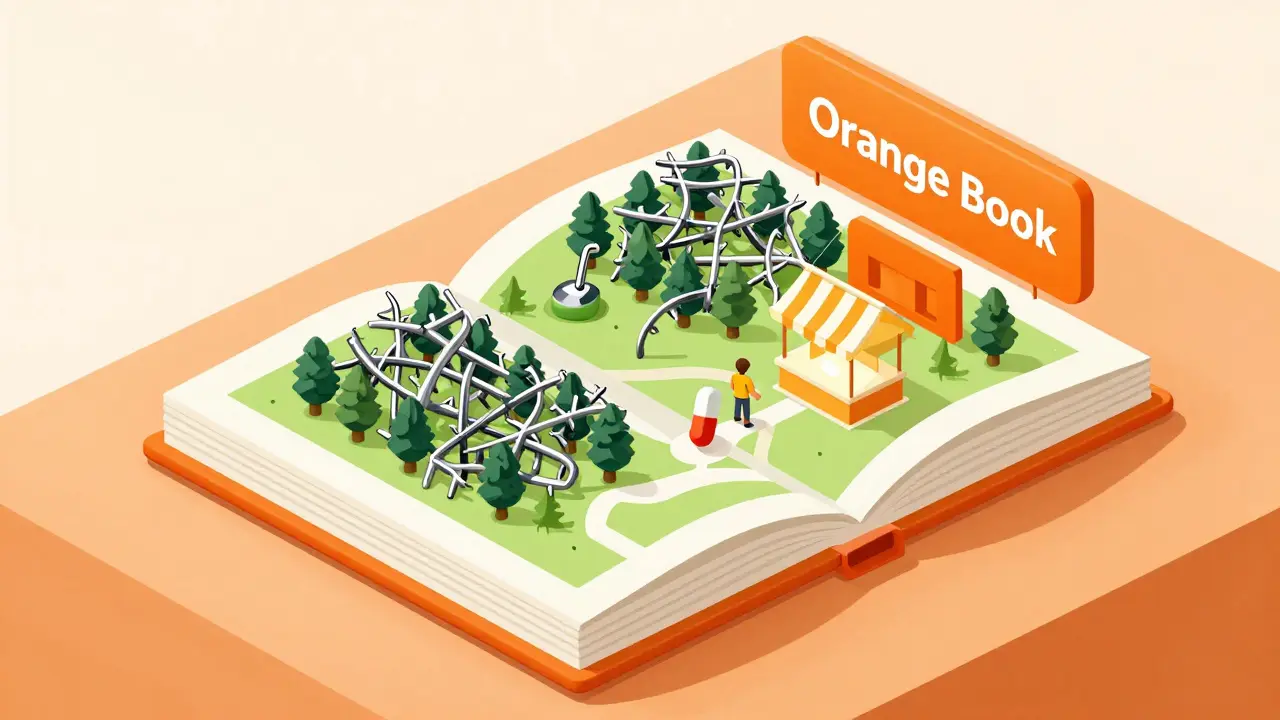
To make this process transparent, the FDA maintains the Orange Book. This is the official directory of approved drug products. If you're a generic company, the Orange Book is your map. It lists the patents the brand company holds, and the generic company must either prove those patents are invalid or wait until they expire. This prevents "wild west" copying while ensuring a clear path to competition once the patent clock runs out.
The Carrot and the Stick: Incentives for Competition
The Hatch-Waxman framework doesn't just make generics possible; it makes them profitable to pursue. One of the most clever parts of the law is the 180-day exclusivity period. The first generic company to successfully challenge a brand's patent gets 180 days of market exclusivity. This means they are the only generic on the shelf for six months, allowing them to capture a huge amount of profit before other generics flood the market. It's a massive incentive for companies to take the legal risk of suing a brand-name giant.
However, the system isn't perfect. Brand-name companies often use a tactic called "evergreening." This is where they file a secondary patent for a tiny change-like a slow-release version of the same drug-to extend their monopoly. This creates a "patent thicket" that can block generics for years. For example, the Generic Pharmaceutical Association has noted that complex drugs like inhalers have seen generic entry drop by 42% because these legal hurdles are so high.
Modern Updates and Future Directions
The law hasn't stayed static. To speed up approvals, the Generic Drug User Fee Amendments (GDUFA) were introduced in 2012. Essentially, generic companies pay a fee to the FDA, and in exchange, the FDA commits to meeting specific review deadlines. It's a "pay-for-performance" model that has worked. In the 90s, it could take 30 months to get an ANDA approved; now, 95% are approved within 10 months.
More recently, the CREATES Act of 2019 was passed to stop "product hopping." This happens when a brand company pulls an old version of a drug off the market just as a generic is about to launch, forcing patients onto a new, patented version. By giving generic developers a legal way to get the samples they need for bioequivalence testing, the CREATES Act closes one of the biggest loopholes used to stall competition.
What is the main difference between an NDA and an ANDA?
A New Drug Application (NDA) is for brand-name drugs and requires full clinical trial data to prove the drug is safe and effective. An Abbreviated New Drug Application (ANDA) is for generics; it doesn't require new clinical trials but requires the manufacturer to prove the generic is bioequivalent to the original brand-name drug.
How does the Orange Book help generic drug manufacturers?
The Orange Book lists all approved drug products and their associated patents. Generic companies use it to identify which patents they need to challenge or wait for before they can legally launch their version of the drug.
What is "bioequivalence" in simple terms?
Bioequivalence means that the generic drug delivers the same amount of active ingredient into the patient's bloodstream at the same rate as the brand-name drug. If the drug's behavior in the body is virtually identical, it is considered bioequivalent.
Why do some generics take so much longer to reach the market than others?
Complex generics, such as inhalers or injectables, are harder to copy and often face "patent thickets"-multiple overlapping patents that the brand company uses to delay competition. These take more time and legal effort to navigate than simple pill-form medications.
What happens if a generic company violates the FD&C Act?
Violations, such as selling "adulterated" or "misbranded" drugs or failing to follow current Good Manufacturing Practices (cGMP), can lead to severe civil penalties, sometimes exceeding $1 million per violation, or even criminal prosecution.
Next Steps for Compliance and Development
If you're navigating the generic drug space, the first step is always the Orange Book. You need a clear patent strategy-decide whether to wait for expiration or pursue a "Paragraph IV certification" to challenge a patent and aim for that 180-day exclusivity.
For those in manufacturing, focus heavily on cGMP (current Good Manufacturing Practice). The FDA is increasingly cracking down on data integrity and quality control. A single warning letter regarding your facility's cleanliness or record-keeping can halt your ANDA approval for months or years.


