
Imagine you are at the pharmacy counter. You hand over a prescription for a brand-name medication, and the pharmacist hands you back a generic version in a different colored box. It looks different, but it costs significantly less. Have you ever wondered how they know it is safe to swap one for the other? The answer lies in a complex system of letters and numbers known as therapeutic equivalency codes. These codes are not just administrative labels; they are the legal backbone of pharmaceutical substitution in the United States.
The process isn't random. It is governed by strict federal laws and scientific evaluations that determine whether a generic drug can produce the exact same clinical effect as its brand-name counterpart. Understanding these codes helps patients, pharmacists, and healthcare providers navigate the balance between cost savings and medical safety. Let's break down how this system works, where the rules come from, and what those confusing 'A' and 'B' ratings actually mean for your health.
The Legal Foundation: Hatch-Waxman and the FD&C Act
To understand why we have therapeutic equivalency codes, we need to look back at 1984. Before this year, bringing a new drug to market was incredibly expensive and slow, which kept prices high. Congress passed the Drug Price Competition and Patent Term Restoration Act, commonly known as the Hatch-Waxman Amendments, to change this landscape. This legislation created a pathway for generic manufacturers to prove their products were equivalent to existing brand-name drugs without repeating costly clinical trials from scratch.
This law operates under the broader umbrella of the Federal Food, Drug, and Cosmetic Act (FD&C Act), specifically Section 505. Under this framework, generic companies submit an Abbreviated New Drug Application (ANDA). Instead of proving safety and efficacy through human trials again, they must demonstrate two key things: pharmaceutical equivalence and bioequivalence. Pharmaceutical equivalence means the generic has the same active ingredient, strength, dosage form, and route of administration as the brand-name Reference Listed Drug (RLD). Bioequivalence ensures that the drug behaves the same way in the body-absorbing at the same rate and reaching similar concentrations in the blood.
The FDA evaluates these applications and assigns a therapeutic equivalency code based on this evidence. This system allows generics to enter the market faster and cheaper, leading to massive healthcare savings. According to industry data, generic drugs with approved equivalence ratings have generated hundreds of billions in savings annually since the mid-1990s, making essential medicines accessible to millions who otherwise couldn't afford them.
The Orange Book: The Definitive Reference
If you want to see these codes in action, you need to look at the Orange Book. Officially titled "Approved Drug Products with Therapeutic Equailability Evaluations," this publication is the primary resource used by pharmacists and state boards across the country. First published in 1980, it was significantly expanded after the Hatch-Waxman Act and is now updated monthly. As of late 2023, it contains evaluations for over 14,000 approved drug products.
The Orange Book serves as the bridge between federal science and state-level practice. While the FDA determines if a drug is therapeutically equivalent, individual states decide the actual rules for substitution. However, all 50 states reference the Orange Book's ratings when creating their laws. For example, California’s Business and Professions Code explicitly permits pharmacists to substitute only those products designated with an 'A' rating. Without the Orange Book, there would be no standardized way to verify if a generic is truly interchangeable with a brand-name drug.
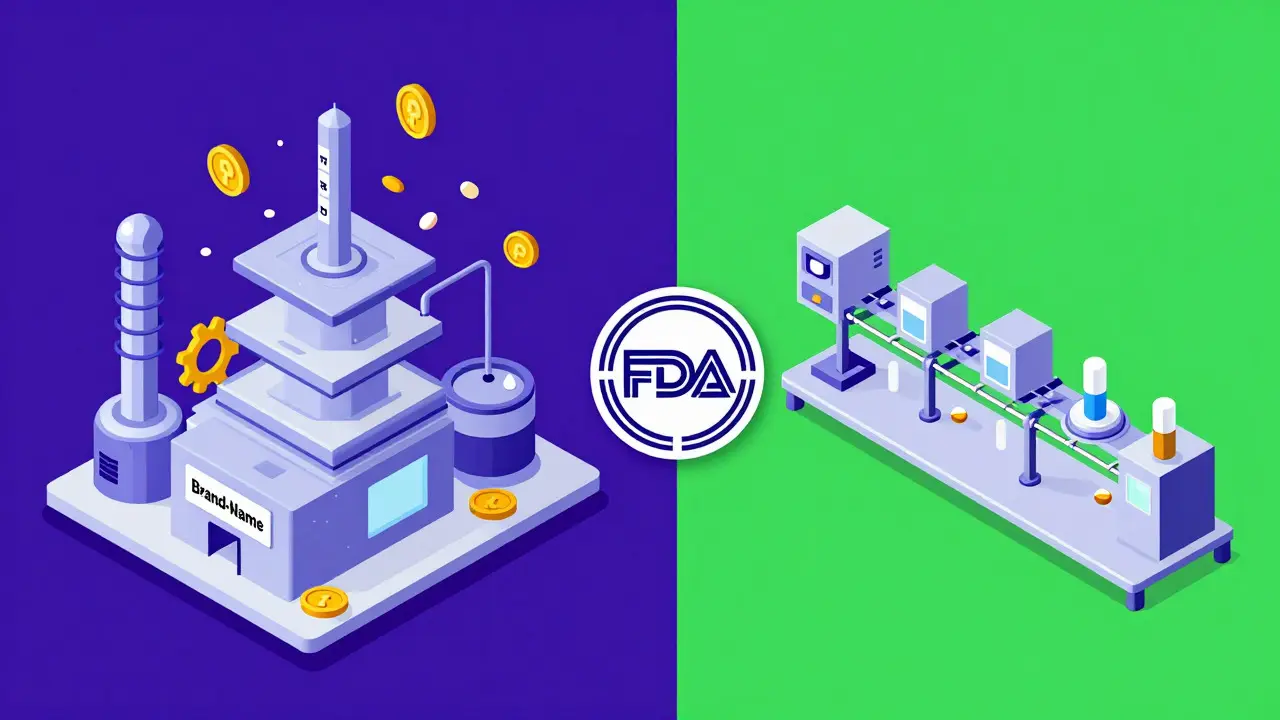
| Feature | Brand-Name Drug (NDA) | Generic Drug (ANDA) |
|---|---|---|
| Approval Basis | New chemical entity requiring full safety/efficacy data | Bioequivalence to an existing Reference Listed Drug |
| Clinical Trials | Extensive Phase I-III human trials required | In vivo/in vitro bioequivalence studies only |
| Cost | Billions of dollars in R&D | Fraction of brand-name development costs |
| TE Code Assignment | Serves as the Reference Listed Drug (RLD) | Assigned 'A' or 'B' code based on equivalence |

Decoding the Letters: What Do A and B Mean?
The core of the therapeutic equivalency system is a simple alphanumeric code. The first letter tells you the most important information: is the drug considered therapeutically equivalent? An 'A' rating means yes. A 'B' rating means no, or that there are unresolved issues.
Products with an 'A' code are deemed substitutable with the full expectation that they will produce the same clinical effect and safety profile as the prescribed product. To earn an 'A', a generic must meet stringent criteria. It must be a pharmaceutical equivalent to the Reference Listed Drug and demonstrate bioequivalence through rigorous scientific testing. The second character in the code provides more detail. For instance, 'AA' designates immediate-release oral dosage forms with no bioequivalence issues. 'AB' indicates products that initially had concerns but were later proven equivalent through additional evidence. These 'A' rated products make up the vast majority of generic prescriptions dispensed in the U.S., accounting for nearly 95% of generic usage according to recent studies.
On the other hand, 'B' codes indicate products where therapeutic equivalence is not established or is questionable. These might include drugs with documented bioequivalence problems ('BD'), insufficient data ('BX'), or specific delivery challenges like topical creams ('BT') or nebulizers ('BN'). If a drug has a 'B' code, pharmacists generally cannot automatically substitute it for the brand-name version unless a doctor specifically approves it. This distinction is crucial because it protects patients from receiving medications that might behave differently in their bodies due to formulation differences.
State Laws vs. Federal Guidelines
Here is where it gets tricky. The FDA sets the scientific standard, but states control the practice of pharmacy. This means that while the Orange Book is the national reference, the actual ability to swap a drug depends on where you live. Every state has its own pharmacy board and statutes governing substitution.
Most states have "automatic substitution" laws that allow pharmacists to dispense a generic with an 'A' rating without calling the prescriber. However, some doctors can write "Dispense as Written" (DAW) on the prescription to block this. In states like New York, pharmacists are mandated to check the current edition of the Orange Book before making any substitution. If a generic has a 'B' code, the pharmacist must typically contact the prescriber to get permission to switch. This dual-layer system ensures that while cost-saving measures are encouraged, patient safety remains the top priority, with local regulations adapting to specific regional needs.
Complex Generics and Future Challenges
Not all drugs are simple pills. Complex generics, such as extended-release capsules, inhalers, and injectables, pose unique challenges for bioequivalence testing. Traditional methods sometimes struggle to prove that these complex delivery systems work identically to the brand-name version. Consequently, many complex generics receive 'B' codes, limiting their market access despite being FDA-approved.
The FDA recognizes this bottleneck. Through initiatives like the Complex Generic Drug Initiative, the agency aims to reduce the percentage of 'B' code products. By developing new scientific methodologies and expanding the definition of bioequivalence for complex formulations, the FDA hopes to convert more 'B' codes to 'A' codes. This effort is driven by both public health goals and economic incentives, as expanding the pool of substitutable generics increases competition and lowers prices further. Recent guidance documents published in 2023 outline clearer pathways for demonstrating equivalence for these difficult-to-test products, signaling a shift toward greater accessibility for complex therapies.
Practical Implications for Patients and Providers
For patients, understanding these codes empowers you to ask better questions. If you are concerned about switching from a brand-name drug to a generic, ask your pharmacist about the TE code. If it is an 'A' rated product, you can be confident it meets the highest standards of equivalence. If it is a 'B' rated product, discuss the reasons with your doctor. There may be valid clinical reasons to stick with the brand, especially for narrow therapeutic index drugs where small changes in blood concentration can matter.
For healthcare providers, staying informed about the Orange Book updates is part of responsible prescribing. Knowing which generics have strong equivalence data helps in writing prescriptions that are both effective and affordable. It also aids in managing patient expectations regarding medication appearance and minor inactive ingredients, which do not affect therapeutic outcome but often cause unnecessary anxiety among patients.
What does an 'A' therapeutic equivalency code mean?
An 'A' code means the FDA considers the generic drug therapeutically equivalent to the brand-name Reference Listed Drug. It has identical active ingredients and demonstrated bioequivalence, ensuring the same clinical effect and safety profile. Pharmacists can usually substitute these drugs automatically under state laws.
Can a pharmacist substitute a drug with a 'B' code?
Generally, no. A 'B' code indicates unresolved bioequivalence issues or insufficient data. Most state laws require pharmacists to obtain prior authorization from the prescriber before dispensing a 'B' rated generic instead of the brand-name product.
Why are there different TE codes for the same drug?
Different manufacturers may use different formulations or delivery systems. One generic might easily prove bioequivalence (earning an 'A' code), while another might face scientific hurdles due to its specific inactive ingredients or release mechanism (resulting in a 'B' code).
How often is the Orange Book updated?
The FDA updates the Orange Book monthly. These updates reflect new drug approvals, changes in patent status, and revisions to therapeutic equivalence ratings based on new scientific evidence.
Do OTC drugs have therapeutic equivalency codes?
No. The FDA's therapeutic equivalency coding system applies only to multisource prescription drug products approved under Section 505 of the FD&C Act. Over-the-counter drugs are evaluated differently and do not receive TE codes.