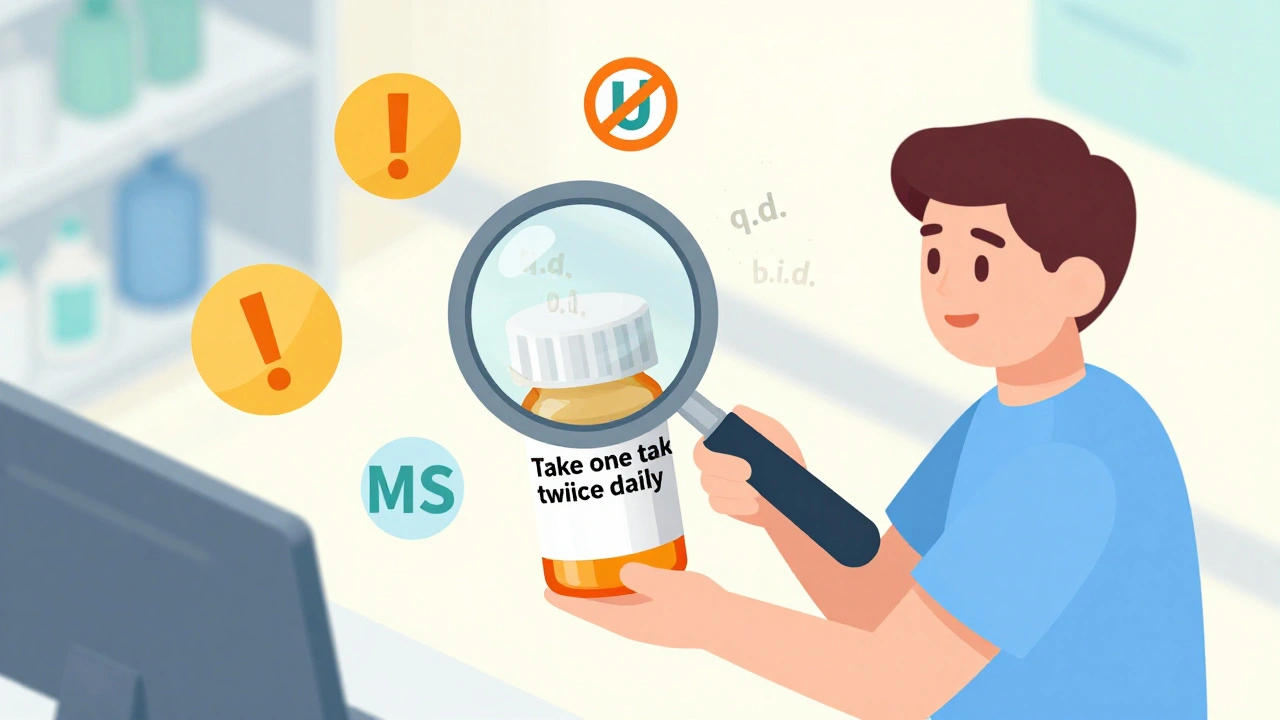
Have you ever looked at your prescription label and felt like you were reading a secret code? Prescription abbreviations are everywhere - on the bottle, in the instructions, even in the fine print. But these tiny letters aren’t just shorthand for pharmacists. They’re safety tools. And when they’re misunderstood, people get hurt.
Take Rx. You see it at the top of every prescription. It doesn’t mean "recipe" like you might think. It comes from the Latin word recipe, which means "take." Doctors have used it since the 1500s. But today, it’s just a symbol - a marker that says, "This is a medication order." You don’t need to know Latin to understand it. You just need to know what comes after it.
What Do Common Abbreviations Like q.d. and b.i.d. Really Mean?
One of the most confusing parts of a prescription is the dosing schedule. You might see q.d., b.i.d., or t.i.d. on the label. These are Latin abbreviations that tell you how often to take the medicine.
- q.d. = quaque die = once daily
- b.i.d. = bis in die = twice daily
- t.i.d. = ter in die = three times daily
- q.i.d. = quater in die = four times daily
But here’s the problem: q.d. looks a lot like q.i.d.. In 2021, the Institute for Safe Medication Practices found that nearly 22% of dosing errors involving abbreviations happened because someone read q.d. as q.i.d. - meaning a patient got four doses instead of one. That’s dangerous. That’s why most hospitals and pharmacies now write "daily," "twice daily," or "three times daily" on patient labels. No guessing. No confusion.
Eye and Ear Abbreviations: A Silent Risk
Some of the most dangerous abbreviations aren’t about how often you take a pill - they’re about where you put it.
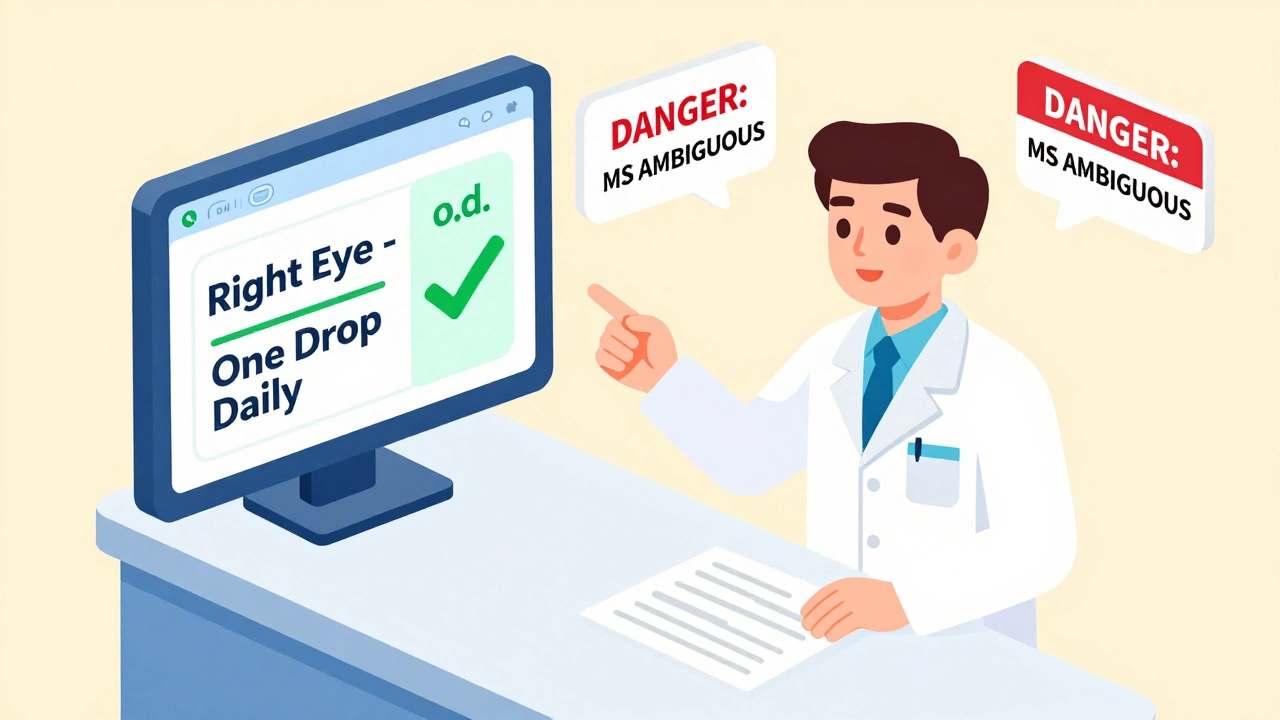
For eye drops, you might see o.d. and o.s.. Those stand for oculus dexter (right eye) and oculus sinister (left eye). But if a pharmacist misreads o.d. as "overdose," or if a patient applies the wrong drop to the wrong eye, it can cause serious harm - especially with glaucoma or steroid eye drops.
Same thing with ears: a.d. and a.s. mean right and left ear. In 2022, the American Academy of Ophthalmology reported that 12.3% of eye medication errors were linked to these abbreviations. Ear drops meant for the right ear accidentally put in the left - and vice versa. That’s why Walmart, CVS, and Walgreens now print "right eye" or "left ear" directly on the label. No Latin. No ambiguity.
The Dangerous Ones: U, MS, and 1.0
Some abbreviations aren’t just confusing - they’ve caused deaths.
U for "units" was banned by the Joint Commission in 2004 because it looks like a "4" or a "0." In Pennsylvania alone, from 2018 to 2022, 12 people died from insulin overdoses because someone misread "5U" as "50 units." Now, every prescription must say "units."
MS is another killer. It could mean morphine sulfate - or magnesium sulfate. One is a powerful painkiller. The other treats seizures. Mix them up, and you could kill someone. The American Society of Health-System Pharmacists now requires all prescribers to write out "morphine sulfate" in full. No shortcuts.
And what about 1.0 mg? That trailing zero? It looks like 10 mg. That’s a tenfold overdose. Since 2004, the Joint Commission has required 0.5 mg, not 1.0 mg. Leading zeros are mandatory. Trailing zeros are forbidden.
Why Do These Abbreviations Still Exist?
If they’re so dangerous, why haven’t they disappeared?
Because change is slow. Many doctors still use old habits. Some electronic systems still auto-fill "q.d." because that’s what’s been used for decades. Even though 92% of U.S. hospitals now use computerized prescribing systems, 68% of community pharmacies still get handwritten prescriptions with risky abbreviations - especially from older physicians or clinics using paper charts.
And then there’s resistance. In the UK, they banned all Latin abbreviations in 2019. Dispensing errors dropped by nearly 30%. But some doctors complained it took longer to write prescriptions. One doctor said adding "twice daily" instead of "b.i.d." added 3 minutes to his day. That’s 2 hours a week. For busy practices, that’s a real burden.
But here’s the trade-off: 14,287 medication incidents in U.S. hospitals in 2023 were linked to abbreviations. The cost? $2.17 billion. That’s not just money. It’s hospital stays. Emergency visits. Lives lost.
What’s Changing - and What You Should Expect
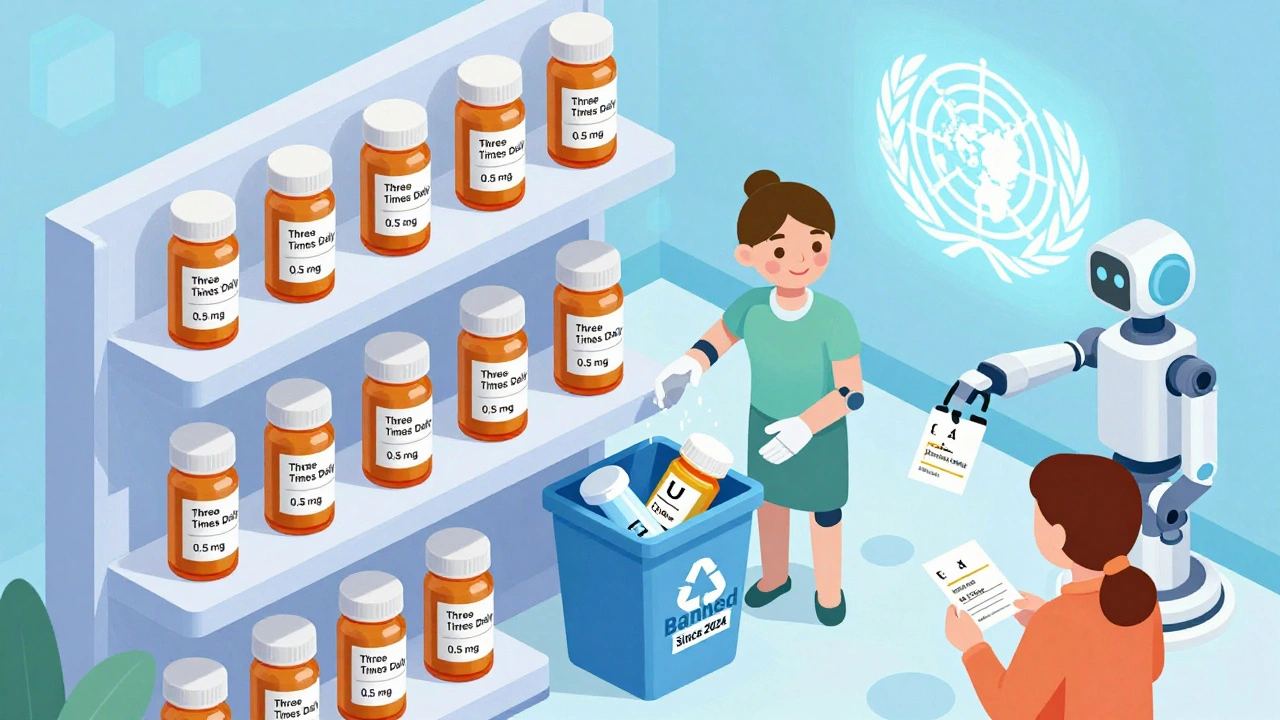
Things are shifting fast. The World Health Organization now recommends using only English terms. The U.S. Pharmacopeia’s new rules, effective May 2024, require all prescriptions to use plain language. By 2030, WHO wants all countries to eliminate non-English abbreviations.
Pharmacies are already adapting. At CVS and Walgreens, every prescription goes through a three-step check:
- Automated system flags banned abbreviations like "U," "MS," or "q.d."
- Pharmacist reviews the prescription and calls the doctor if something’s unclear
- The patient label prints everything in plain English: "Take one tablet by mouth twice daily."
AI tools like IBM Watson Health’s MedSafety AI now automatically convert "t.i.d." to "three times daily" with 99.2% accuracy. These systems are becoming standard in hospitals - and soon, they’ll be in every pharmacy.
What You Can Do to Stay Safe
You don’t need to memorize Latin. But you do need to be an active participant in your care.
- Always read your label. If you see "q.d.", ask: "Does this mean once a day?"
- If you see "o.d." or "a.d.", confirm: "Is this for my right eye or right ear?"
- If the label says "MS," ask: "Is this morphine sulfate or magnesium sulfate?"
- Never assume. Even if you’ve taken the medicine before, double-check the instructions.
- Ask your pharmacist to explain the label in plain language. They’re trained to do this - and they want you to understand.
Pharmacists aren’t just filling bottles. They’re your last line of defense. A 2023 survey found that 83.6% of pharmacy technicians see a dangerous abbreviation at least once a week. Most of those errors are caught before they reach you - but only if the pharmacist takes the time to check.
The Future of Prescription Labels
Within five years, you’ll rarely see Latin abbreviations on a prescription label. They’re being replaced by clear, simple English. That’s not because tradition is being erased - it’s because safety is finally winning.
Imagine a world where every prescription says exactly what it means. No guessing. No misreading. No deaths from a misplaced dot or a confusing letter.
That world is coming. And you’re already part of it. By asking questions, reading labels, and speaking up - you’re helping make medicine safer for everyone.


