
Imagine waking up with a pain in your eye that feels like a piece of grit you just can't blink away, only to find your vision is becoming hazy and your eye is lobster-red. For many, this is the start of a corneal ulcers nightmare. It isn't just a simple irritation; it is an open sore on the clear front surface of your eye that can lead to permanent blindness if you don't act fast. While these infections can happen to anyone, there is a massive, often overlooked link between how we handle our contact lenses and the risk of losing our sight.
| Feature | Corneal Abrasion | Corneal Ulcer |
|---|---|---|
| What is it? | A superficial scratch on the surface | An open sore with tissue loss |
| Cause | Dirt, fingernails, or debris | Infection (bacteria, fungi, viruses) |
| Healing | Usually heals quickly on its own | Requires urgent medical treatment |
| Risk Level | Mild to Moderate | Severe / Vision-Threatening |
Why Your Contact Lenses Might Be the Culprit
If you wear contacts, you are already at a higher baseline risk. But it is not the lenses themselves that are the enemy-it is how we use them. When you leave a lens in for too long, you essentially create a plastic barrier that blocks oxygen from reaching your eye. This weakens the corneal surface, making it an open invitation for bacteria to set up shop.
The numbers here are honestly frightening. A person who wears contacts is about 10 times more likely to develop an ulcer than a non-wearer. However, if you are someone who "just naps" in your lenses or wears extended-wear soft contacts overnight, that risk jumps to 100 times higher. You are creating a warm, moist, anaerobic environment-basically a luxury hotel for pathogens.
It is also about what you bring to the party. Bacteria from your fingertips or non-sterile cleaning solutions get trapped underneath the lens, pressing the germs directly against your eye for hours on end. This is why the FDA the federal agency responsible for protecting public health by ensuring the safety and efficacy of medicines and medical devices issues such stern warnings about strict adherence to replacement schedules.
Spotting the Red Flags Before It's Too Late
Time is everything when dealing with an ulcer. Because the cornea is packed with nerves, the pain is usually intense. But you shouldn't wait for the pain to become unbearable before calling a doctor. Look for these specific signals:
- Vision Changes: Your sight feels blurry, hazy, or like you are looking through a fog.
- Photophobia: A sudden, sharp sensitivity to light that makes you want to squint or close your eyes in a bright room.
- Physical Appearance: The eye looks bloodshot or red, and you might notice a distinct white or greyish patch on the clear part of the eye.
- Discharge: Unusual itching accompanied by watery eyes or thicker discharge.
If any of these hit you, the first move is simple: take your contacts out immediately. Do not "test" it by putting them back in to see if the redness goes away. That is a gamble with your vision.

What Happens at the Urgent Care Clinic?
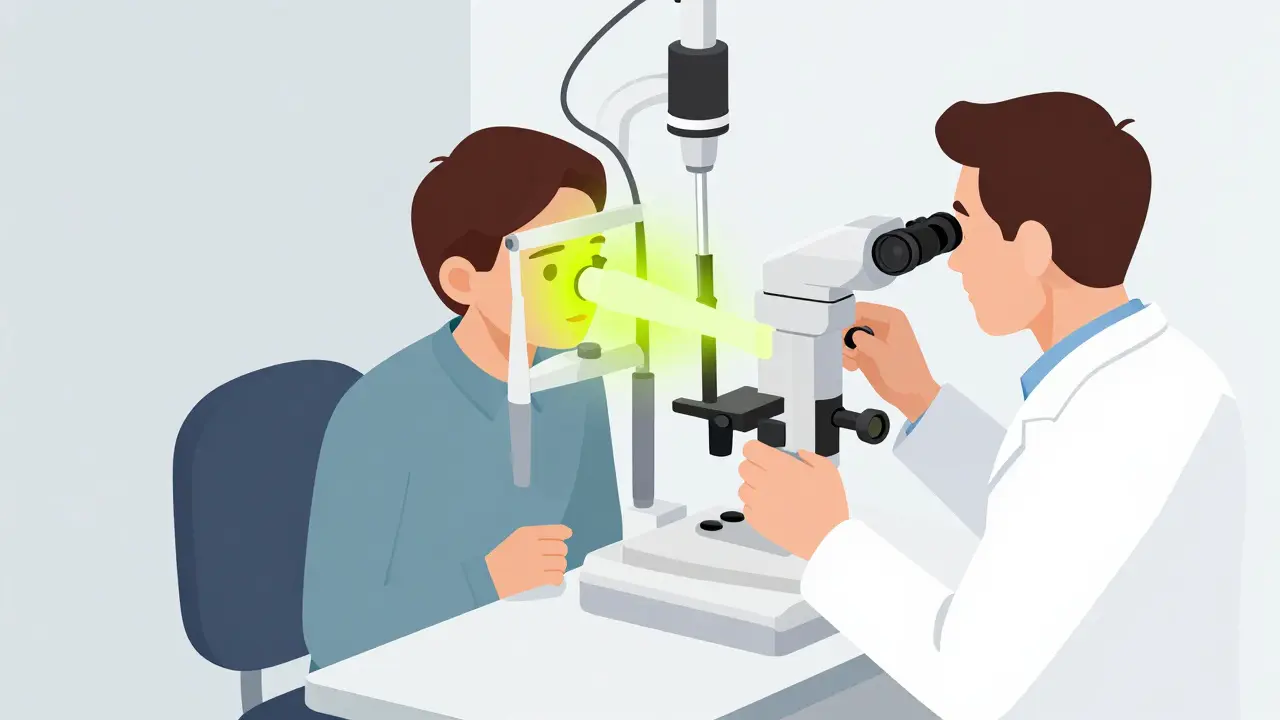
When you arrive at the eye specialist, they won't just glance at your eye. They need to see the depth and cause of the damage. You will likely undergo a slit-lamp examination a diagnostic tool that uses a high-intensity light source to provide a magnified, cross-sectional view of the cornea. This allows the doctor to see the ulcer in 3D.
To make the damage visible, they use fluorescein staining. They put a yellow-green dye in your eye; the dye sticks to the damaged areas where the corneal epithelium is missing, highlighting the ulcer like a neon sign. In more serious cases, they will perform corneal scraping. This sounds scary, but it's just taking a tiny sample of the ulcer to send to a lab. This is the only way to know if you are fighting a bacteria, a fungus, or a virus, which is crucial because the wrong medication can actually make some ulcers worse.
The Road to Recovery: Treatment Options
Treatment depends entirely on what is causing the hole in your cornea. For standard bacterial ulcers, doctors usually start with fluoroquinolones a potent class of broad-spectrum antibiotic eye drops used to treat severe bacterial corneal infections. These are heavy-duty antibiotics designed to penetrate the corneal tissue quickly.
If the infection is viral, you'll likely need antivirals like acyclovir. Fungal ulcers are the toughest to treat and require specialized antifungal meds that can take much longer to work. In some cases, a doctor might use corticosteroids to bring down swelling, but this is a dangerous balancing act-if used too early or without antibiotics, steroids can actually help the infection spread.
If the ulcer is "sight-threatening"-meaning it is larger than 2mm or too close to the center of your vision-the treatment becomes much more aggressive. If the infection causes a permanent scar that blocks your vision, the final resort is a corneal transplant, where the damaged dome is replaced with donor tissue.
How to Keep Your Eyes Safe (The Non-Negotiables)
Preventing a corneal ulcer is far easier than treating one. It comes down to a few rigid habits that most of us tend to slack on. First, treat your contact lens case like a piece of medical equipment. If you are topping off old solution instead of replacing it, you are just breeding bacteria.
Next, follow the "no water" rule. This is a big one: Acanthamoeba a free-living amoeba found in water and soil that can cause severe keratitis and corneal ulcers is a parasite that loves tap water and swimming pools. It can get trapped under your lens and eat away at your cornea. Never shower or swim in your soft lenses.
- Wash your hands with soap and water every single time before touching your eyes.
- Respect the clock: If your lenses are two-week lenses, throw them away at day 14, even if they feel "fine."
- Give your eyes a break: Switch to glasses for a few hours a day or a full day a week to let your corneas breathe.
- Never sleep in lenses unless they are specifically FDA-approved for overnight wear, and even then, proceed with extreme caution.
Can a corneal ulcer go away on its own?
No. Unlike a superficial scratch (abrasion), a corneal ulcer involves the loss of actual corneal tissue and is usually caused by an infection. Without medical intervention and the correct antibiotics or antifungals, the infection will likely spread, cause permanent scarring, or lead to perforation of the eye.
Is there a difference between keratitis and a corneal ulcer?
Yes, though they are related. Keratitis inflammation of the cornea is a general term for any inflammation of the cornea. A corneal ulcer is a more advanced stage of keratitis where the inflammation has progressed to an actual open sore or lesion on the eye.
How long does it take for a corneal ulcer to heal?
Healing time varies based on the cause. Bacterial ulcers often respond quickly to fluoroquinolone drops and may show improvement within a few days. Fungal ulcers are much slower and can take weeks or months of intensive treatment. The goal is to stop the infection before a permanent scar forms.
Can I use redness-relief drops if I suspect an ulcer?
Absolutely not. Redness-relief drops only mask the symptoms by constricting blood vessels; they do nothing to treat the infection. Masking the redness can lead you to believe the condition is improving while the ulcer continues to eat away at your corneal tissue.
Are daily disposable lenses safer than monthly ones?
Generally, yes. Because you discard them every day, there is a much lower chance of bacteria building up on the lens surface over time. However, risk still exists if you handle them with dirty hands or if you attempt to wear a "daily" lens for more than 24 hours.


