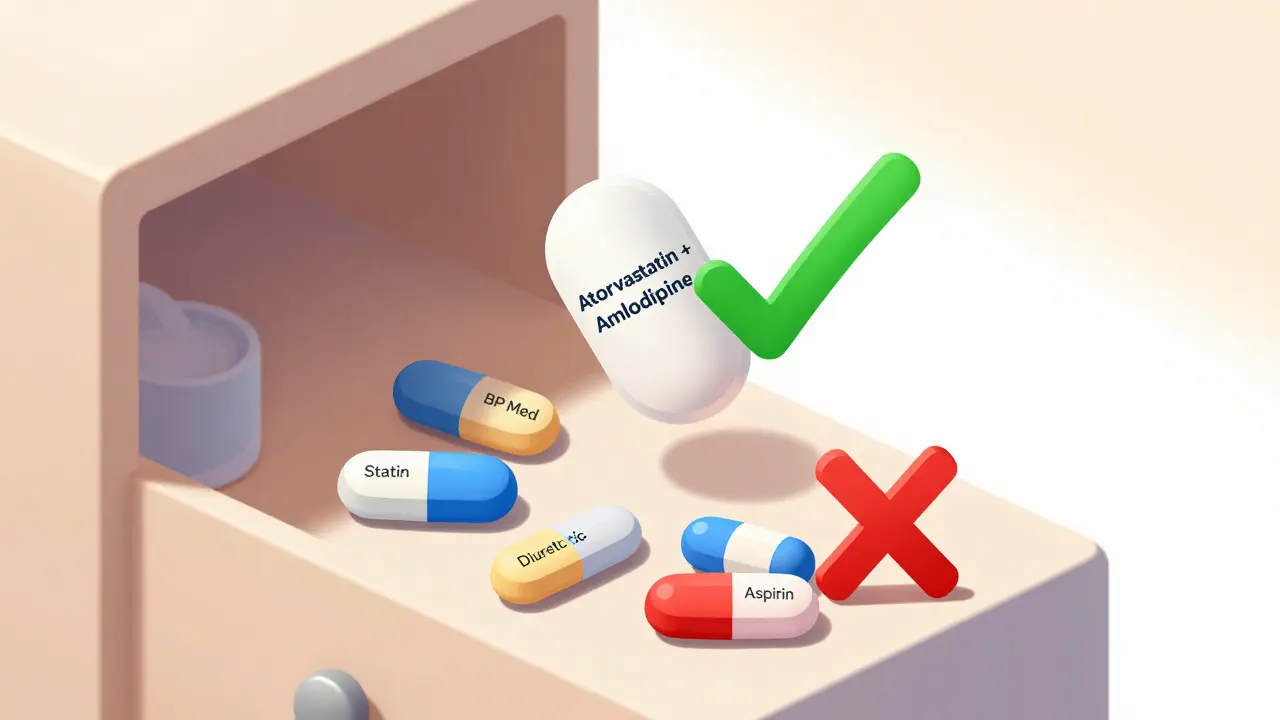
When you’re managing high blood pressure, cholesterol, or heart disease, taking multiple pills every day can feel overwhelming. One pill for blood pressure, another for cholesterol, maybe a third for blood thinning. It’s not just inconvenient-it’s a major reason why so many people stop taking their meds. That’s where cardiovascular combination generics come in. These are single pills that combine two or more heart medications into one, making it easier to stick to your treatment plan and saving you money at the pharmacy.
Why Combination Pills Matter for Heart Health
Studies show that when people have to take four or more separate pills a day, adherence drops to just 25-30%. But when those same medications are combined into one pill, adherence jumps to 75-85%. That’s not a small difference-it’s life-changing. For someone recovering from a heart attack or living with heart failure, skipping a dose can mean a trip to the ER or worse.
The idea of a "polypill"-a single tablet with aspirin, a statin, a blood pressure med, and a beta-blocker-was first proposed over 20 years ago. Back then, researchers like Dr. Salim Yusuf estimated it could cut cardiovascular events by 75% in high-risk patients. Today, we don’t have a single polypill with all four components in the U.S., but we do have plenty of two- and three-drug combos that work just as well for most people.
Common Cardiovascular Combination Generics
Not all combinations are created equal. Some are FDA-approved as fixed-dose generics, while others are just two separate generics packaged together. Here are the most common ones you’ll actually see prescribed today:
- Atorvastatin + amlodipine: Combines a statin (for cholesterol) with a calcium channel blocker (for blood pressure). Used for patients with both high LDL and hypertension.
- Simvastatin + amlodipine: Similar to above, but with simvastatin instead of atorvastatin. Often cheaper, especially in generic form.
- Lisinopril + hydrochlorothiazide: An ACE inhibitor plus a diuretic. A classic combo for high blood pressure that’s been generic for over a decade.
- Losartan + hydrochlorothiazide: An ARB instead of an ACE inhibitor, with the same diuretic. Good alternative if you get a dry cough from ACE drugs.
- Carvedilol + hydrochlorothiazide: A beta-blocker with a diuretic. Often used in heart failure patients.
- Ezetimibe + simvastatin: This combo lowers cholesterol more than a statin alone. The brand version (Vytorin) was expensive-now the generic costs under $15 a month.
- Isosorbide dinitrate + hydralazine: Used specifically for heart failure in Black patients. Generic versions have been available since 2012.
- Sacubitril + valsartan: The first generic version of Entresto (used for heart failure) was approved in 2022. This combo is a game-changer for reducing hospitalizations.
These aren’t theoretical-they’re in use every day. Medicare Part D data from 2017 showed that generic cardiovascular combinations cost about $15.67 per fill, compared to $85.43 for brand-name versions. That’s an 82% savings.
How Do Generic Combos Compare to Brand Names?
You might have heard rumors that generics aren’t as good. That’s not true. The FDA requires generic drugs to deliver 80-125% of the active ingredient compared to the brand name-within a very tight range. In over 60 clinical trials reviewed by the European Heart Journal, generic cardiovascular drugs showed identical effectiveness and safety profiles.
But here’s the catch: sometimes, the inactive ingredients differ. These are the fillers, dyes, or coatings-not the medicine itself. For most people, this doesn’t matter. But if you’re sensitive to certain dyes or have a rare reaction to a specific filler, you might notice a change in side effects. This is most relevant with drugs that have a narrow therapeutic index, like warfarin. But for statins, blood pressure meds, and most heart failure drugs, the risk is extremely low.
Real-world data backs this up. On Drugs.com, 78% of 1,245 patients rated generic heart meds as "equally effective" as brand names. Only 12% reported minor side effect changes-mostly mild dizziness or fatigue that faded after a few weeks.
What’s Missing? The Polypill Gap
Despite the clear benefits, we’re still missing one big piece: a true four-drug polypill with aspirin, a statin, an ACE inhibitor, and a beta-blocker in one tablet. It’s available in some countries like the UK and India, but not yet in the U.S. Why? Because each drug has different dosing needs. A 65-year-old with diabetes might need 80 mg of atorvastatin, while a 72-year-old with kidney issues needs only 20 mg. Combining them into one pill makes it harder to fine-tune doses.
So, while a single-pill polypill sounds ideal, doctors often prefer to start with two-drug combos and adjust doses separately. That gives more control-and better outcomes.

Cost Savings You Can’t Ignore
Let’s say you’re taking four separate generics: atorvastatin ($5), lisinopril ($4), metoprolol ($3), and aspirin ($1). That’s $13 a month. Now imagine a combo of atorvastatin + lisinopril ($12) and metoprolol + aspirin ($5). You’re still at $17-but now you’re taking two pills instead of four. That’s a 50% reduction in pill burden.
But here’s the real win: if your insurance doesn’t cover the combo, you might pay more for the branded version. A 2020 study in Circulation: Cardiovascular Quality and Outcomes estimated that if all eligible patients switched from brand-name combinations to generics, U.S. healthcare could save $1.3 billion a year. That’s money that could go to screenings, rehab, or even lower premiums.
When You Should Be Careful
Most people can switch safely. But there are exceptions:
- If you’ve had a bad reaction to a generic version before, stick with the brand-or ask your doctor to try a different generic manufacturer.
- If you’re on warfarin, avoid switching unless under close supervision. Even tiny changes in blood levels can be dangerous.
- If you’re elderly or have kidney or liver disease, your body processes meds differently. Your doctor may need to adjust doses more carefully.
- If you’re switching from a brand-name combo to two separate generics, make sure your pharmacy doesn’t accidentally give you the wrong doses.
Dr. Aaron Kesselheim from Brigham and Women’s Hospital warns that "certain high-risk cardiovascular medications may require more careful monitoring during transitions." That doesn’t mean avoid generics-it means talk to your doctor before switching.
What Pharmacists Want You to Know
A 2019 survey by the American Pharmacists Association found that 65% of patients expressed concerns about generics. The top two fears? "Will this work as well?" and "Will I have side effects?"
But here’s the good news: 89% of pharmacists routinely explain bioequivalence to patients. They know the data. They’ve seen the outcomes. And they’ll tell you this: if your doctor says it’s safe, the generic is just as good.
Also, pharmacists can help you find the cheapest option. Sometimes, buying two separate generics is cheaper than the combo pill. Always ask them to compare prices before you leave the counter.

How to Talk to Your Doctor About Switching
You don’t need to wait for a crisis to ask about combination generics. Here’s how to bring it up:
- "I’m having trouble keeping up with all my pills. Are there any combination generics I could take instead?"
- "I’ve heard these can save money-can we check if there’s a cheaper option?"
- "I’m worried about forgetting doses. Would a combo pill help me stay on track?"
Doctors are more likely to suggest combos if you ask. A 2018 study found only 45% of primary care physicians knew all the available generic combinations. So you might be the one to remind them.
State Laws and What They Mean for You
Forty-two states have laws that allow pharmacists to substitute generics automatically. But 18 states require your consent before switching. That means if your prescription says "brand necessary," your pharmacist can’t change it without your OK.
Check your prescription label. If it says "dispense as written" or "DAW 1," that means no substitution. If it’s blank or says "DAW 2," your pharmacist can swap it out. Ask if you’re unsure.
What’s Next for Combination Generics?
The future is bright. The FDA released new guidance in 2021 to speed up approval of fixed-dose combinations. The World Heart Federation is pushing for polypills in low-income countries, where heart disease kills more people than anywhere else. And with the first generic Entresto hitting the market in 2022, we’re seeing more innovation than ever.
For now, the best strategy is simple: ask your doctor if any of your meds can be combined. Look at your pill bottle. Count how many you take each day. Then ask: "Can this be simpler?"
It’s not just about saving money. It’s about staying alive.
Are cardiovascular combination generics as effective as brand-name drugs?
Yes. The FDA requires generic combination drugs to deliver the same amount of active ingredient as the brand name, within a strict 80-125% range. Over 60 clinical trials have confirmed that generics for blood pressure, cholesterol, and heart failure drugs work just as well. Most patients report no difference in effectiveness or side effects.
Can I switch from brand-name heart meds to generics on my own?
No. Always talk to your doctor first. While most switches are safe, some medications-like warfarin or certain heart failure drugs-require close monitoring. Your doctor can check your health status, review your current doses, and make sure the generic version is appropriate for you.
Why don’t I see a "polypill" with aspirin, statin, beta-blocker, and ACE inhibitor all in one?
Because dosing needs vary too much between patients. A 60-year-old with diabetes might need 80 mg of atorvastatin, while a 75-year-old with kidney disease needs only 20 mg. A fixed-dose polypill can’t adjust for that. For now, doctors prefer two-drug combos that allow more flexibility in dosing.
How much money can I save with combination generics?
On average, generic cardiovascular combinations cost 80-85% less than brand-name versions. For example, a brand-name combo might cost $85 per month, while the generic version costs under $15. If you’re taking four separate pills, switching to two combo pills could cut your monthly cost by half and reduce your pill burden by 50%.
Do I need to worry about side effects with generic heart meds?
For most people, no. Minor differences in inactive ingredients (like dyes or fillers) can cause rare reactions, especially in sensitive individuals. But serious side effects are extremely uncommon. If you notice new symptoms after switching-like unusual fatigue, dizziness, or swelling-tell your doctor. Otherwise, 78% of patients report no difference in how they feel.
Can my pharmacist switch my meds without asking me?
It depends on your state. Forty-two states allow pharmacists to substitute generics automatically. But 18 states require your consent. Check your prescription label: if it says "DAW 1" or "dispense as written," the pharmacist can’t switch it. If it’s blank or says "DAW 2," they can. Always ask if you’re unsure.
Are there any combination generics for heart failure?
Yes. Sacubitril/valsartan (brand name Entresto) became available as a generic in 2022. This combo is used for heart failure with reduced ejection fraction and has been shown to reduce hospitalizations and improve survival. It’s one of the most important advances in heart failure treatment in the last decade.
Why do some doctors still prescribe brand-name combos?
Some doctors aren’t aware of all the available generics. A 2018 study found only 45% of primary care physicians knew all the options. Others may prescribe brands out of habit, or because they think the patient needs a specific formulation. Always ask if a generic version exists-it’s worth the conversation.


