Ever wondered why your blood sugar spikes after a simple slice of bread but stays stable after a salad? The answer lies in carbohydrate counting, a precise method that turns food into numbers you can actually manage. It is not about starving yourself or banning your favorite snacks; it is about understanding exactly how much fuel your body is getting and matching it with the right amount of insulin or medication. If you have Type 1 diabetes or use insulin for Type 2, this skill is arguably the most powerful tool in your kit. It gives you freedom to eat almost anything, provided you know what is inside.
Many people think carb counting means reading every label until their eyes cross. In reality, it is a structured approach endorsed by major health bodies like the American Diabetes Association (ADA) and the Centers for Disease Control and Prevention (CDC). By tracking grams of carbs instead of just "servings," you gain direct control over your glucose levels. This guide breaks down how it works, what tools you need, and how to start without feeling overwhelmed.
What Is Carbohydrate Counting?
Carbohydrate counting is a meal planning technique where individuals track the total grams of carbohydrates they consume to manage blood glucose levels. Unlike older dietary advice that focused on vague portion sizes, this method uses specific gram measurements. For most adults with Type 1 diabetes, daily intake typically ranges between 150 and 250 grams of carbohydrates. This usually makes up 45% to 65% of total daily calories. The goal is simple: match the carbs you eat with the insulin you take so your blood sugar stays within a target range.
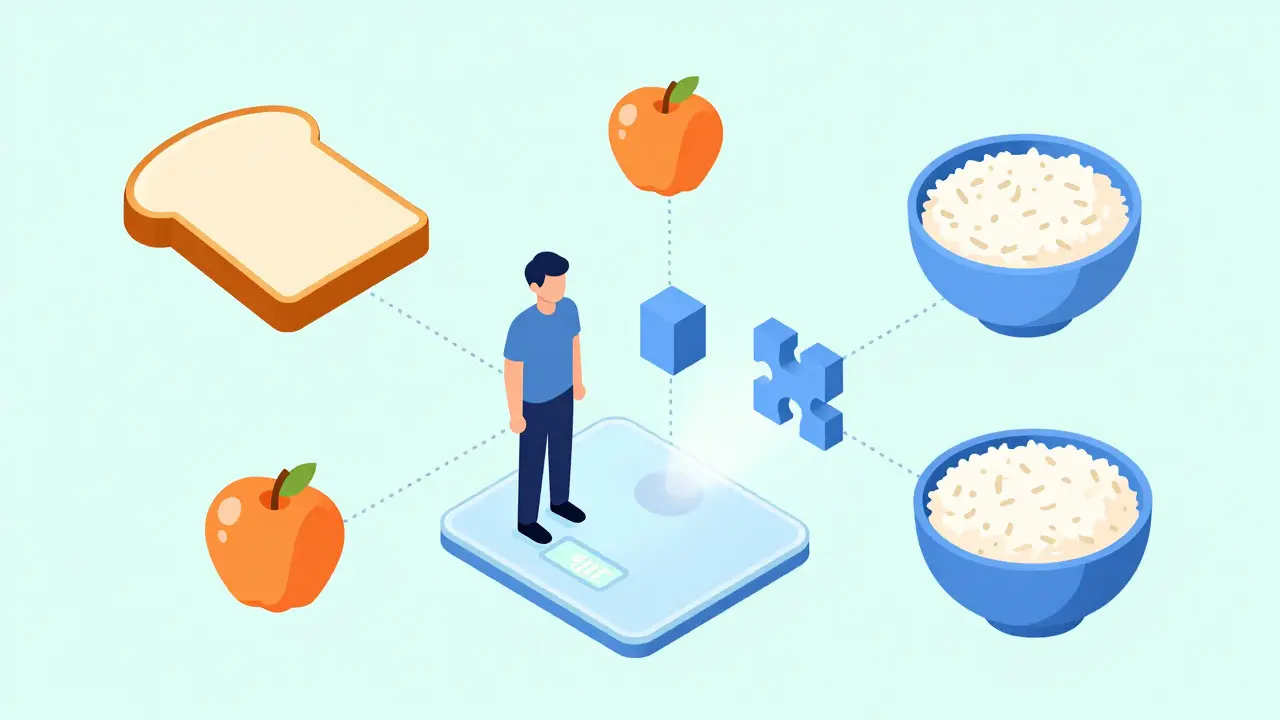
The core principle is straightforward. When you eat carbs, your body breaks them down into glucose, which enters your bloodstream. Insulin helps your cells absorb that glucose. If you eat more carbs than your insulin covers, your blood sugar rises. If you eat less, it might drop too low. By counting grams, you create a predictable equation. One standard serving of carbs is defined as approximately 15 grams. This unit serves as your building block for meals. For example, one slice of white bread, one small apple, or half a cup of cooked rice all equal roughly 15 grams of carbs. Once you understand this baseline, complex meals become manageable puzzles rather than scary unknowns.
Why Precision Matters More Than Guessing
You might ask why we count grams instead of just using the "plate method" or looking at the glycemic index. While those methods have their place, carb counting offers precision that is critical for insulin users. The plate method relies on visual estimation, which can be inaccurate if you are hungry or distracted. Glycemic index focuses on the speed of digestion, but it doesn't tell you exactly how much insulin to inject. Carb counting provides the exact number needed for dosing calculations.
This precision is particularly valuable for those using intensive insulin therapy, such as multiple daily injections or an insulin pump. According to data from the UCSF Diabetes Teaching Center, carb counting is recommended as the most effective method for people who need to adjust their mealtime insulin. It allows for flexibility. You can swap foods as long as the total carb count remains similar. Want pizza instead of pasta? No problem, as long as you account for the crust and toppings. This adaptability is a huge win for social eating and travel, reducing the stress often associated with managing diabetes.
How to Read Nutrition Labels Like a Pro
Reading a nutrition label is the first practical step. You don't need to memorize everything on the back of the package. Focus on the line that says "Total Carbohydrates." This number includes sugars, starches, and fiber. However, there are two adjustments you need to make for accuracy.
- Fiber: Dietary fiber does not raise blood sugar because it isn't digested into glucose. If the label lists fiber, you can subtract the full amount from the total carbohydrate count. For instance, if a snack has 20g total carbs and 5g fiber, you only count 15g.
- Sugar Alcohols: These are common in "sugar-free" products. They provide fewer calories than regular sugar and have a smaller impact on blood glucose. To calculate, divide the grams of sugar alcohols by 2 and subtract that result from the total carbs. If a product has 10g total carbs and 4g sugar alcohols, you subtract 2g (half of 4), leaving you with 8g countable carbs.
Remember, the FDA updated labeling requirements in 2020 to make these values clearer. Always check the serving size first. Many packages contain multiple servings, and it's easy to accidentally double-count. A quick habit to form is to always look at the serving size before checking the carb count. This small step prevents a common error that leads to unexpected blood sugar swings.
Setting Your Personal Carb Targets
There is no universal number for everyone. Your healthcare provider will help you determine your personal carb targets based on your age, activity level, medications, and current blood sugar patterns. However, general guidelines suggest that most adults aim for 150-250 grams per day. Within that total, you'll distribute carbs across three main meals and potentially snacks.
A typical distribution might look like this:
- Breakfast: 30-45 grams
- Lunch: 45-60 grams
- Dinner: 45-60 grams
- Snacks: 15-30 grams each
Tools and Apps That Make It Easier
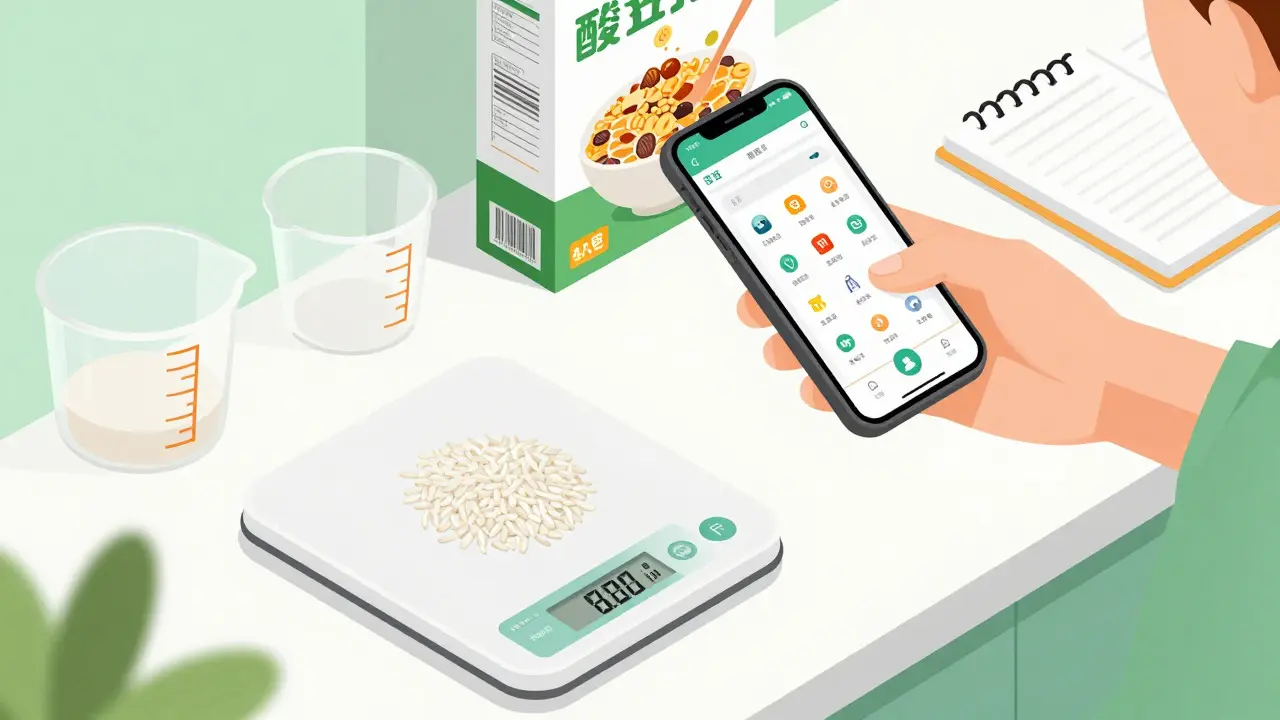
Doing the math in your head is possible but exhausting. Digital tools take the burden off. Smartphone apps like MyFitnessPal or Carb Manager are popular choices. They allow you to scan barcodes, search for foods, and automatically calculate totals. Carb Manager, for example, has a feature called SmartScan that uses image recognition to estimate carb content, achieving around 85% accuracy in independent tests. This is incredibly useful when you are out and don't have a label handy.
Beyond apps, physical tools still matter. A digital kitchen scale is invaluable for measuring raw ingredients like rice, beans, or nuts. Measuring cups help with liquids and dry goods. Start by weighing everything for the first few weeks. Over time, your eye will get better at estimating portions, but accuracy is crucial in the beginning. A study published in the Journal of Diabetes Science and Technology found that most people reach 85% accuracy in estimation after just 30 days of consistent practice. So, give yourself a month of careful measurement before trusting your gut.

Common Mistakes and How to Avoid Them
Even experienced counters make mistakes. Here are the top pitfalls to watch out for:
- Forgetting Hidden Carbs: Milk, yogurt, sauces, and starchy vegetables like potatoes and corn contain significant carbs. These sources account for about 25% of daily intake for many people. Don't forget to count them.
- Restaurant Estimates: Restaurant portions are often larger than home-cooked meals. Research suggests restaurant carb counts can be 20-30% higher than labeled amounts. When dining out, call ahead to ask for nutrition info or ask for half portions to stay safe.
- Ignoring Fiber Adjustments: As mentioned earlier, subtracting fiber improves accuracy. Skipping this step can lead to over-dosing insulin slightly.
- Inconsistent Tracking: Missing one meal here and there is okay, but skipping logging entirely throws off your pattern recognition. Consistency builds confidence and accuracy.
If you hit a wall, remember that the learning curve typically spans 4 to 8 weeks. It is normal to feel frustrated at first. Keep a food diary to share with your doctor. This record helps identify patterns and adjust your insulin-to-carb ratio if needed.
Integrating Carb Counting with Modern Technology
Carb counting fits seamlessly into modern diabetes care. Continuous Glucose Monitors (CGMs) provide real-time feedback on how well your counting matches your actual blood sugar response. If you count 45g of carbs but your CGM shows a spike higher than expected, you know your estimate was off or your insulin sensitivity changed that day. This feedback loop accelerates learning significantly.
Furthermore, emerging technologies like artificial pancreas systems are beginning to integrate carb input directly into automated dosing algorithms. Research from Harvard's Joslin Diabetes Center shows promising results in automating insulin delivery based on real-time carb data. While fully automated systems are still developing, the foundation is built on accurate carb counting. Mastering this skill now prepares you for future advancements in diabetes technology.
| Food Item | Portion Size | Total Carbs (grams) | Fiber (grams) | Countable Carbs (grams) |
|---|---|---|---|---|
| White Bread | 1 slice | 15 | 1 | 14 |
| Apple | 1 small (4 oz) | 19 | 4 | 15 |
| Cooked White Rice | 1/2 cup | 25 | 0.5 | 24.5 |
| Pizza (Cheese) | 1 slice | 30 | 2 | 28 |
| Milk (2%) | 1 cup | 12 | 0 | 12 |
Getting Started: Your First Week Plan
Ready to begin? Start with a three-day baseline. Record everything you eat and drink, including portion sizes. Do not change your diet yet; just observe. This helps you see your current habits. After three days, calculate your average daily carb intake. Use this number to discuss targets with your healthcare provider.
In week one, focus on breakfast and lunch. Dinner can be estimated initially. Buy a kitchen scale and start weighing your main carb sources. Use an app to log your meals. Don't worry about perfection. Aim for consistency. By the end of the first month, you should feel more confident in your estimates. Celebrate small wins, like keeping your post-meal blood sugar within range. This positive reinforcement keeps you motivated.
Carb counting is a skill, not a punishment. It empowers you to take control of your health. With practice, it becomes second nature, allowing you to enjoy life with less anxiety about blood sugar spikes. Start today, keep it simple, and let the data guide you.
Do I need to count fiber in my carbs?
No, you should subtract dietary fiber from the total carbohydrate count. Fiber is not digested into glucose, so it does not raise blood sugar levels. If a food has 20g total carbs and 5g fiber, you only count 15g.
Is carb counting only for Type 1 diabetes?
While it is essential for Type 1 diabetics and those using insulin for Type 2, it can benefit anyone managing blood glucose through diet. However, those managing Type 2 with oral medications alone may find simpler methods sufficient unless advised otherwise by their doctor.
How accurate do I need to be?
Aim for within 10-15 grams of your actual intake. Small errors are normal and can be corrected with correction doses. Perfect accuracy is impossible, but consistent estimation leads to better overall control.
Can I eat fruit if I am counting carbs?
Yes, absolutely. Fruit contains natural sugars and fiber. Just count the net carbs (total carbs minus fiber). A small apple is about 15g of countable carbs, making it a convenient snack option.
What if I forget to count a meal?
Check your blood sugar later to see the effect. If it is high, you may need a correction dose. Log the meal retrospectively in your app to maintain your records. Consistency matters more than perfect recall for every single bite.