Bipolar Antidepressant Risk Calculator
This calculator estimates the risk of mood destabilization when using antidepressants for bipolar disorder based on clinical evidence. High risk means antidepressants should be avoided or used with extreme caution.
Antidepressant Selection
Patient Factors
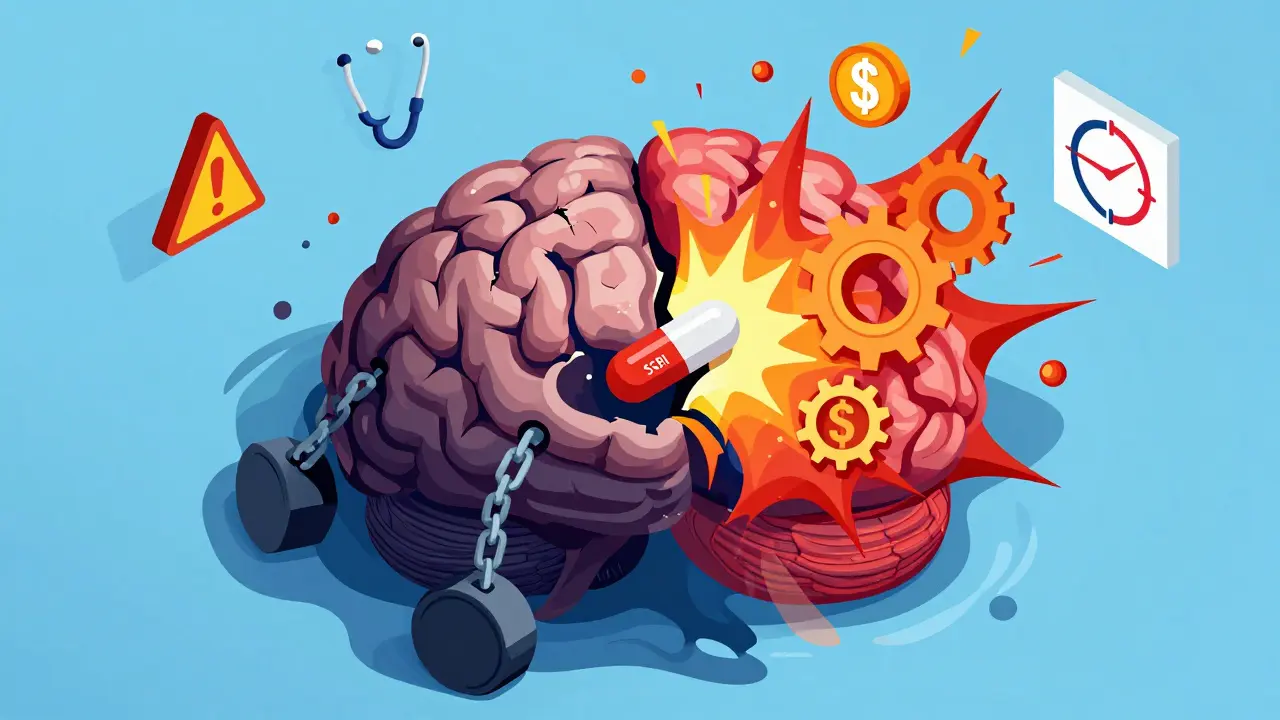
When someone with bipolar disorder feels deep depression, it’s tempting to reach for an antidepressant. After all, they work well for unipolar depression. But in bipolar illness, these medications don’t just treat sadness-they can flip the entire mood system. What looks like relief might be the start of a manic episode, rapid cycling, or a dangerous mixed state where despair and agitation crash together. This isn’t speculation. It’s backed by decades of data, clinical trials, and real patient outcomes.
Antidepressants Can Trigger Mania in Bipolar Disorder
The biggest danger isn’t that antidepressants don’t work-they sometimes do. It’s that they can trigger mania or hypomania in people with bipolar disorder. This isn’t rare. In randomized trials involving over 10,000 patients, about 12% experienced a switch from depression into mania or hypomania after starting an antidepressant. In retrospective studies-where doctors look back at patient records-the number jumps to 31%. That’s not a side effect. It’s a fundamental risk built into how these drugs interact with a bipolar brain.
Why does this happen? Bipolar disorder isn’t just “depression plus mania.” It’s a cycling illness where the brain’s mood regulation system is unstable. Antidepressants, especially those that boost serotonin, can overstimulate this system. Instead of lifting mood gently, they can push it into overdrive. The result? Sleepless nights, reckless spending, impulsive decisions, or even psychosis. One patient in a UK support group described it this way: “One pill of sertraline sent me into a 3-week mania. I didn’t sleep, spent $8,000 on online gambling, and ended up in the ER.”
Not All Antidepressants Are Created Equal
Some antidepressants carry higher risks than others. Tricyclics (like amitriptyline) and SNRIs (like venlafaxine) are the worst offenders, with switch rates between 15% and 25%. SSRIs (like fluoxetine or sertraline) are somewhat safer, with rates around 8% to 10%. Bupropion (Wellbutrin) has the lowest risk among common antidepressants, possibly because it doesn’t strongly affect serotonin. But even bupropion isn’t risk-free.
Here’s what the numbers show:
| Class | Average Switch Risk | Notes |
|---|---|---|
| Tricyclics (TCAs) | 15-25% | Highest risk; avoid in bipolar |
| SNRIs (e.g., venlafaxine) | 12-20% | Strong serotonin/norepinephrine boost |
| SSRIs (e.g., sertraline, fluoxetine) | 8-10% | Lower risk, but still dangerous |
| Bupropion | 5-8% | Lowest risk; preferred if used |
Even with the “safer” options, the risk isn’t zero. And for some people-those with a history of prior switches-it can be over 30%.
Who’s at Highest Risk?
Not everyone with bipolar disorder is equally likely to switch. Certain factors make mood destabilization far more probable:
- Bipolar I diagnosis (vs. Bipolar II) - higher risk due to more severe manic episodes
- History of antidepressant-induced mania - if it happened once, it’s 3.2 times more likely to happen again
- Rapid cycling - having four or more mood episodes in a year increases risk dramatically
- Mixed features - when depression includes agitation, irritability, or racing thoughts (present in 20% of cases)
- Stopping mood stabilizers - using antidepressants alone removes the protective layer
One study found that patients with mixed features had a switch rate of over 40% when given antidepressants. That’s not a gamble worth taking.
The Efficacy Problem: Do They Even Work?
If antidepressants are so risky, do they even help? The answer is: barely.
In unipolar depression, antidepressants have a Number Needed to Treat (NNT) of 6 to 8-meaning for every 6 to 8 people treated, one will respond. In bipolar depression, the NNT is 29.4. That means you’d need to treat nearly 30 people to get one person to respond. Meanwhile, the Number Needed to Harm (NNH) for a mood switch is about 200. So, you’re risking harm to 1 in 200 people to help 1 in 30.
Compare that to FDA-approved treatments for bipolar depression:
- Quetiapine (Seroquel): 50-60% response rate, <5% switch risk
- Lurasidone (Latuda): 50% response rate, 2.5% switch risk
- Cariprazine (Vraylar): 48% response rate, 4.5% switch risk
These drugs don’t just work better-they’re safer. And they’re designed for bipolar disorder, not borrowed from unipolar depression protocols.
Why Do Doctors Still Prescribe Them?
Despite clear guidelines, antidepressants are still widely used. In community clinics, 80% of bipolar patients get them. In academic centers, it’s closer to 50%. Why the gap?
First, misdiagnosis. About 40% of people with bipolar disorder are initially misdiagnosed as having unipolar depression. They’re put on antidepressants for years before anyone notices the mania.
Second, patient demand. Many people feel better quickly on antidepressants and don’t want to stop-even if their doctor warns them.
Third, inertia. Switching to a mood stabilizer or atypical antipsychotic requires education, monitoring, and time. Antidepressants are easy. They’re familiar. They’re in every pharmacy.
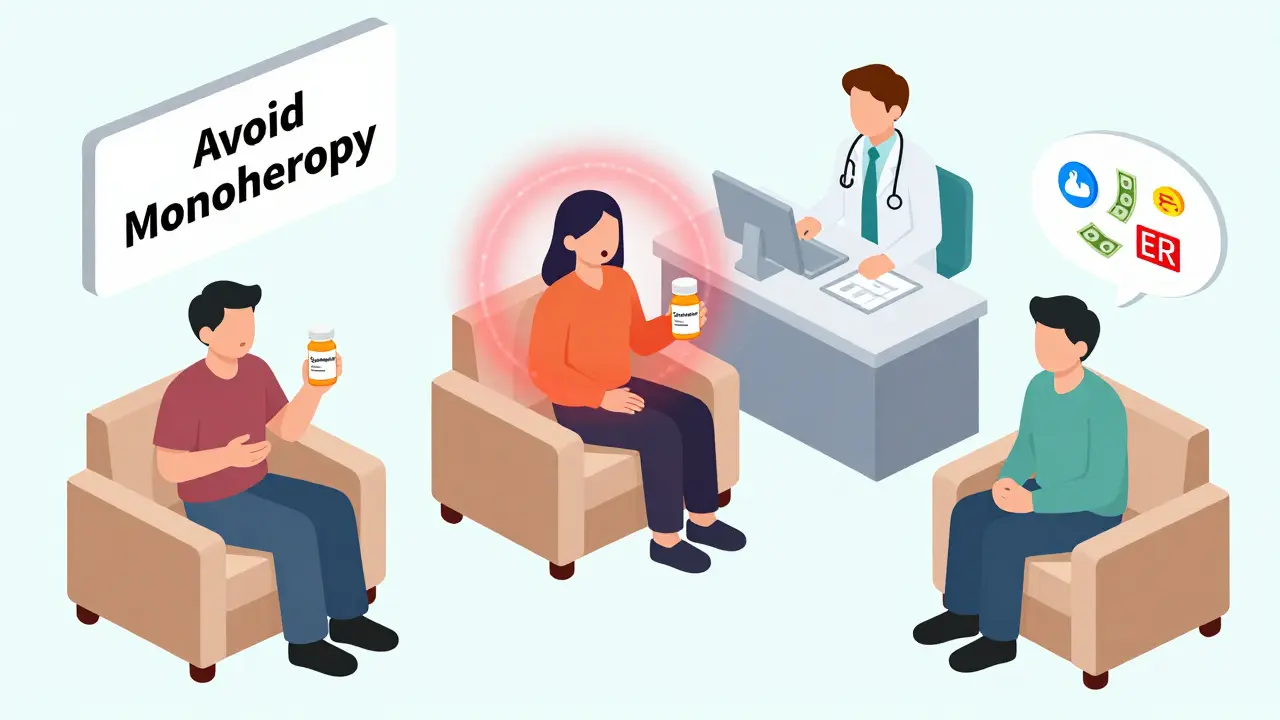
But this isn’t sustainable. The European Medicines Agency and the FDA have both issued warnings. The International Society for Bipolar Disorders (ISBD) says antidepressants should be avoided as monotherapy and used only as short-term adjuncts in severe, treatment-resistant cases.
When Might They Be Used-And How?
There are rare situations where antidepressants might be considered:
- Severe, treatment-resistant depression after trying at least two FDA-approved bipolar treatments
- No history of mania, mixed episodes, or rapid cycling
- Used only as a short-term add-on to a mood stabilizer or antipsychotic
- Only SSRIs or bupropion are chosen-never TCAs or SNRIs
Even then, strict rules apply:
- Weekly mood checks for the first 4 weeks
- Immediate discontinuation at the first sign of increased energy, reduced sleep, or irritability
- Never used longer than 8 to 12 weeks
- Documented informed consent about switch risks
Most experts agree: if you’re using an antidepressant for bipolar depression, you’re not treating the illness-you’re managing a symptom while risking the whole system.
The Bigger Picture: What’s Replacing Them?
The future of bipolar depression treatment is moving away from antidepressants entirely. New drugs are being developed that don’t just lift mood-they stabilize it.
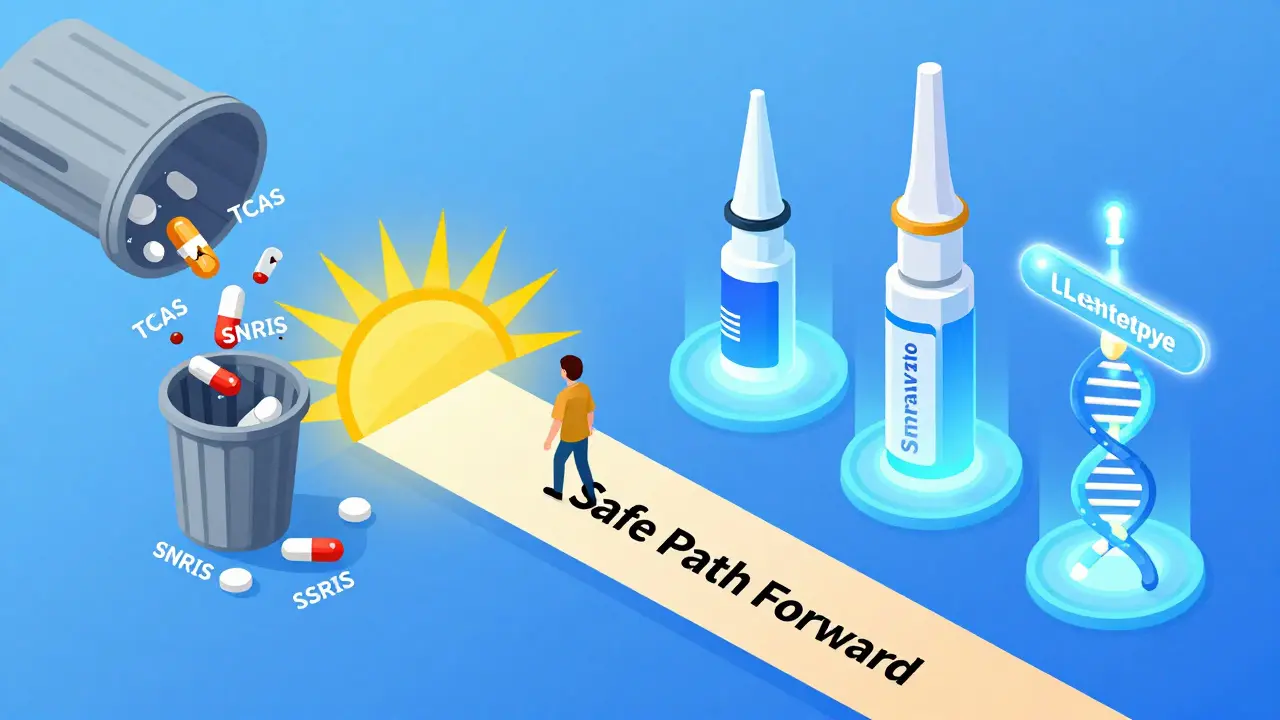
Eskeketamine nasal spray (Spravato), approved for treatment-resistant depression, showed a 52% response rate in bipolar depression with only a 3.1% switch risk in a 2023 trial. Other dual-acting agents are in development that combine antidepressant effects with mood-stabilizing properties. These aren’t experimental anymore-they’re the new standard.
Even genetic testing is starting to help. A 2022 study found that people with a specific gene variant (LL genotype of 5-HTTLPR) had a 3.2 times higher risk of switching on antidepressants. In the next few years, this kind of testing may become part of routine care.
What Patients Need to Know
If you have bipolar disorder and are on an antidepressant:
- Ask your doctor: “Have you ruled out bipolar I or mixed features?”
- Ask: “Is this drug being used as monotherapy?” (It shouldn’t be.)
- Ask: “What’s the plan if I start feeling unusually energetic or irritable?”
- Track your mood daily. Even small changes in sleep, energy, or spending habits matter.
- Don’t stop abruptly-work with your doctor to taper safely.
If you’re being prescribed an antidepressant for depression and have a family history of bipolar disorder, ask for a full mood disorder evaluation. Misdiagnosis is the biggest driver of harm.
Final Takeaway
Antidepressants aren’t a cure for bipolar depression. They’re a temporary tool with dangerous side effects. For most people, they do more harm than good. The real solution isn’t adding more drugs-it’s using the right ones from the start. Mood stabilizers, atypical antipsychotics, and emerging therapies like ketamine derivatives offer better outcomes with far less risk.
The question isn’t whether antidepressants work. It’s whether the price-manic episodes, hospitalizations, lost relationships-is worth it. For most with bipolar disorder, the answer is no.


