Kidney/Liver Anticoagulant Dosing Calculator
Select Patient Condition
Recommended Anticoagulant Therapy
Why Anticoagulation Gets So Complicated in Kidney and Liver Disease
When your kidneys or liver aren’t working right, taking a blood thinner becomes a high-wire act. You’re trying to prevent clots-like strokes or pulmonary embolisms-but every pill you swallow carries a real risk of internal bleeding. This isn’t theoretical. In the U.S., over 37 million people have chronic kidney disease, and nearly 6 million have chronic liver disease. Many of them also have atrial fibrillation, which means they need anticoagulation. But most of the big clinical trials that proved DOACs like apixaban or rivaroxaban were safe didn’t include patients with severe kidney or liver failure. So doctors are left guessing.
How Kidney Function Changes Everything
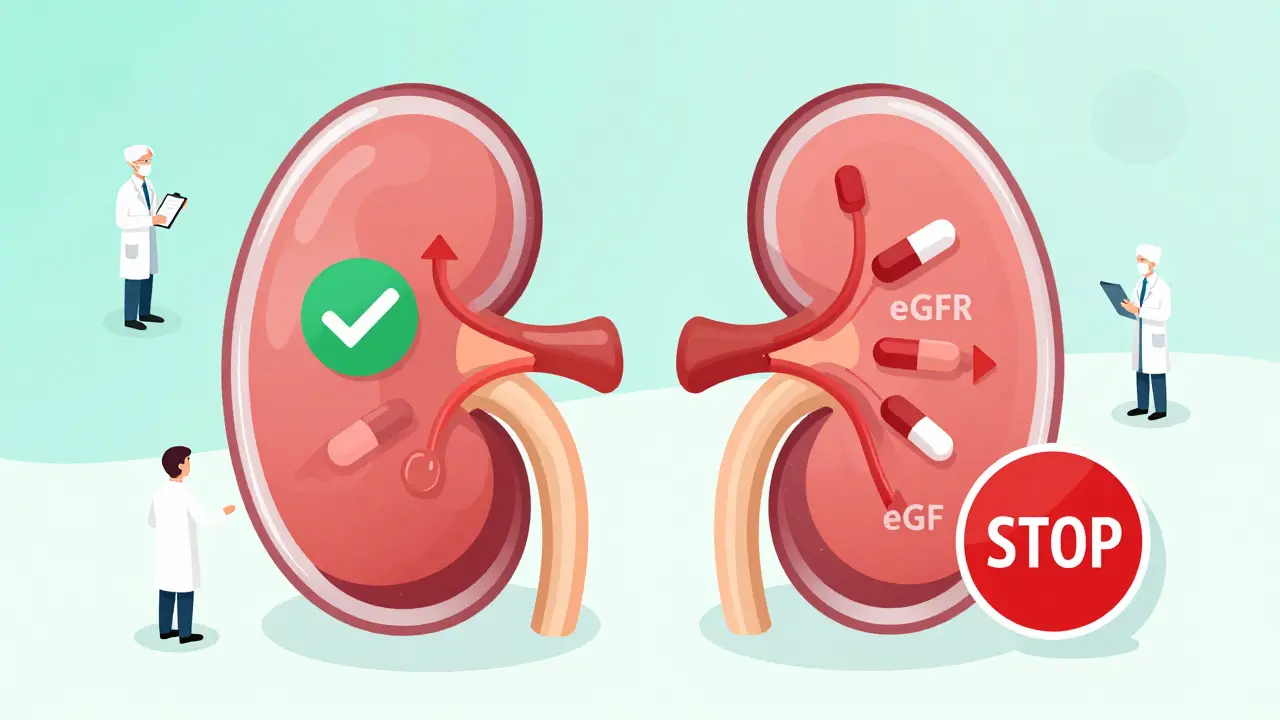
Renal function isn’t just a number on a lab report-it directly affects how long anticoagulants stay in your body. Drugs like dabigatran are cleared 80% by the kidneys. If your eGFR drops below 30 mL/min, that drug builds up fast. That’s why dabigatran is off-limits in advanced kidney disease. Apixaban, on the other hand, is only 27% kidney-dependent. That small difference makes it the only DOAC with any real data in patients on dialysis.
Here’s what works in practice:
- eGFR 45+ (Stages 1-3a): All DOACs are fine at standard doses.
- eGFR 30-44 (Stage 3b): Reduce apixaban to 2.5 mg twice daily, rivaroxaban to 15 mg daily, edoxaban to 30 mg daily.
- eGFR <30 (Stages 4-5): Apixaban 2.5 mg twice daily is the only DOAC with FDA approval here, based on post-hoc data from ARISTOTLE showing a 70% lower bleeding risk than warfarin. Rivaroxaban and edoxaban are contraindicated by the EMA. Dabigatran? Absolutely not.
- On hemodialysis: Apixaban 2.5 mg twice daily is the most studied option. Trough levels are about half of normal, but clinical outcomes suggest it’s still effective. Warfarin is still used in over 60% of dialysis patients, but it’s harder to control. INR targets often drop to 1.8-2.5 because these patients bleed more easily.
Liver Disease: It’s Not Just About INR
When the liver is damaged, everything goes sideways. It doesn’t just make fewer clotting factors-it also makes fewer natural anticoagulants. Platelets drop because of an enlarged spleen. And the liver can’t clear drugs properly. That’s why the Child-Pugh score matters more than any single lab value.
Here’s how doctors think about it:
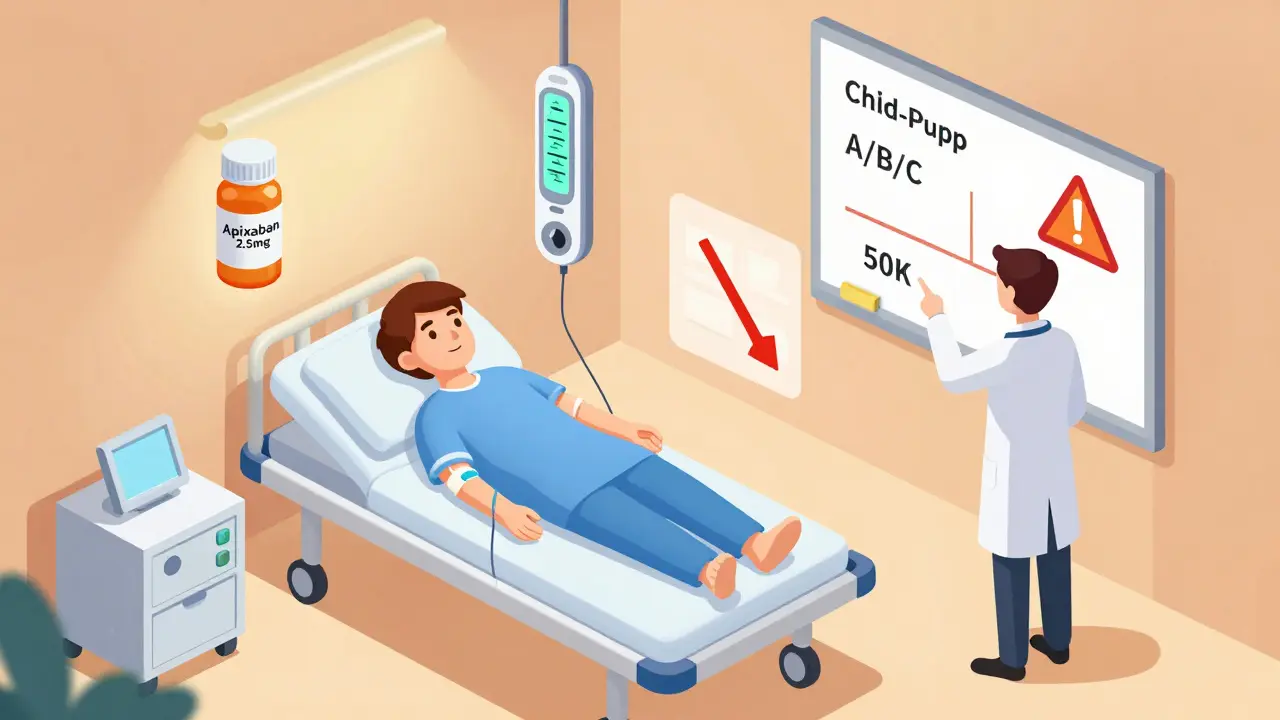
- Child-Pugh A (score 5-6): DOACs are generally safe at full dose. Many hepatologists start with apixaban or rivaroxaban.
- Child-Pugh B (score 7-9): Proceed with caution. Dose reduction is common. Platelet count becomes a key factor-if it’s under 50,000/μL, many will hold off.
- Child-Pugh C (score ≥10): DOACs are not recommended. Bleeding risk jumps 5.2 times compared to people with healthy livers. Warfarin is often used here, but it’s unreliable. INR can be normal even when someone is at high risk of bleeding because INR only measures vitamin K-dependent factors. It ignores low fibrinogen, low platelets, and poor clot stability.
That’s why some centers use thromboelastography (TEG or ROTEM) to get a full picture of clotting. But only 38% of U.S. hospitals have access to these tests. So most doctors still rely on platelet counts, albumin, bilirubin, and INR-even though INR is misleading.
DOACs vs. Warfarin: The Real Trade-Offs
DOACs are easier to use. No weekly INR checks. Fewer food interactions. But in advanced organ disease, the data gets messy.
For kidney disease:
- Apixaban reduces major bleeding by 31% compared to warfarin in eGFR 25-30 mL/min patients.
- DOACs cut intracranial hemorrhage risk by 62% in CKD patients.
- But in end-stage renal disease, warfarin may still be preferred for mechanical heart valves. DOACs aren’t approved here, and there’s no solid evidence they work.
For liver disease:
- Warfarin has reversal agents (vitamin K, fresh frozen plasma), but it’s hard to keep INR stable. Only 45% of cirrhotic patients stay in the therapeutic range more than 60% of the time.
- DOACs have specific reversal agents-idarucizumab for dabigatran, andexanet alfa for factor Xa inhibitors-but they’re expensive ($3,500-$19,000 per dose) and not widely available.
- One study found rivaroxaban doubled gastrointestinal bleeding risk in dialysis patients compared to warfarin.
What Happens in Real Hospitals?
Studies show a shocking gap between need and treatment. In one registry of 12,850 dialysis patients with atrial fibrillation, only 28% got anticoagulation-even though 76% had a CHA₂DS₂-VASc score of 3 or higher, meaning they were at high stroke risk. Of those treated, 63% got warfarin, 37% got a DOAC.
Bleeding rates were lower with DOACs (14.2 vs. 18.7 events per 100 patient-years), but stroke rates were nearly identical. That’s the trade-off: you can reduce bleeding without increasing stroke risk.
In liver disease, 68% of hepatologists reported at least one major bleeding event in the past year linked to anticoagulation. Many adjust therapy based on platelet function, not just counts. One nephrologist on Reddit shared success with apixaban 2.5 mg daily in 15 dialysis patients over two years-no bleeds. Another described a patient who had a fatal retroperitoneal hemorrhage on the same dose. There’s no perfect answer.
How Doctors Decide: Protocols, Teams, and Uncertainty
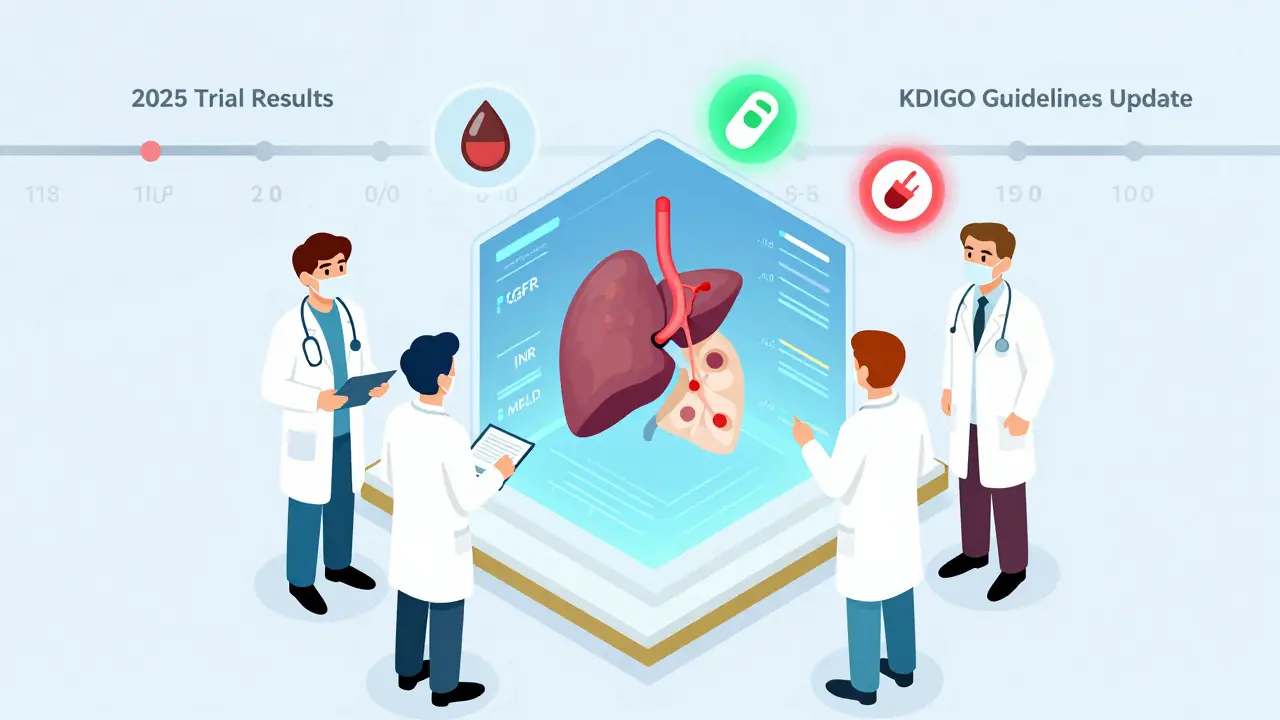
There’s no single guideline that covers all cases. That’s why multidisciplinary teams are becoming essential.
- Mayo Clinic: Requires nephrology-cardiology consult for eGFR under 30. eGFR must be checked every 3 months-or monthly if it’s dropping fast.
- UCSF: Monitors platelets and MELD score monthly. Stops anticoagulation if platelets fall below 50,000/μL or MELD exceeds 20.
- Reversal readiness: Only 45% of U.S. hospitals have andexanet alfa on hand. Many don’t have formal protocols for dual organ failure. That’s why medication errors are 3.2 times more common in these patients.
Experts disagree. Some say, “Don’t let the absence of data stop you.” Others warn: “We’re guessing based on pharmacokinetics, not outcomes.” The truth? We’re in the middle of a transition.
What’s Coming Next?
Two major trials are underway:
- MYD88 Trial (NCT04713709): Randomizing 500 dialysis patients to apixaban vs. warfarin. Results expected in 2025.
- LIVER-DOAC Registry (NCT05128933): Tracking 1,200 cirrhotic patients on DOACs worldwide.
The FDA is considering new labeling for apixaban in end-stage kidney disease based on modeling data. KDIGO plans to update its guidelines in late 2024, incorporating 17 new observational studies.
By 2026, an estimated 1.2 million patients in the U.S. with advanced kidney or liver disease are still untreated for atrial fibrillation-not because they don’t need it, but because doctors fear bleeding. The next few years will determine whether we can safely expand anticoagulation to these high-risk groups.
Bottom Line: No One-Size-Fits-All
If you or someone you know has kidney or liver disease and needs a blood thinner, don’t assume the rules are the same as for healthy people. Apixaban is the most studied DOAC in these populations. Warfarin is still used, but it’s harder to manage. The goal isn’t to hit a perfect INR-it’s to prevent stroke without causing a bleed. That means frequent monitoring, team-based decisions, and accepting that sometimes, the best choice is the one with the least known risk.


